

Commentary
Uri Dadush
{
  "authors": [
    "Uri Dadush"
  ],
  "type": "other",
  "centerAffiliationAll": "",
  "centers": [
    "Carnegie Endowment for International Peace"
  ],
  "collections": [],
  "englishNewsletterAll": "",
  "nonEnglishNewsletterAll": "",
  "primaryCenter": "Carnegie Endowment for International Peace",
  "programAffiliation": "",
  "programs": [],
  "projects": [],
  "regions": [
    "North America"
  ],
  "topics": [
    "Economy",
    "Trade",
    "Global Governance",
    "Foreign Policy"
  ]
}
Source: Getty
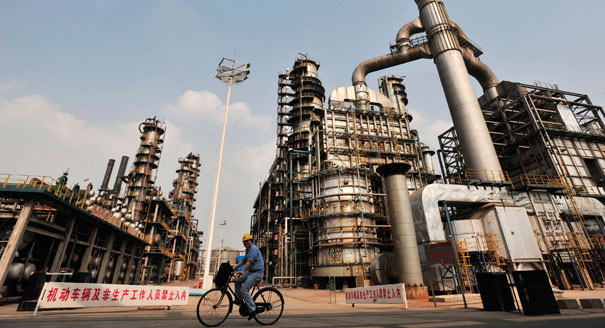
Industrial policy is a controversial, even taboo, subject in policy circles. Yet it is widely practiced by advanced and developing countries alike.
Source: OCP Policy Center
For the purpose of this short note, industrial policy is defined as government intervention in a specific sector which is designed to boost the growth prospects of that sector and to promote development of the wider economy. I exclude from this definition horizontal policies, such as investment in education, reinforcement of the rule of law and property rights, and so on, even though these horizontal policies can affect different sectors differently and so can be part of an industrial policy. I do so for the sake of brevity and because the importance of horizontal policies is widely understood, and there is much less controversy surrounding them than around sectoral interventions. To sharpen the focus further, I also exclude interventions at the sectoral level which aim to achieve other objectives than growth and employment, such as improving environmental and safety standards, as these interventions aim to correct well-recognized market failures and are also relatively uncontroversial.
Industrial policy so defined takes many shapes, including regulatory reform, subsidies, protection, and direct government ownership of enterprises, and it has a checkered past. Its heyday was in the 1950s and 1960s, a period characterized by post-war recovery, rapid growth, decolonization, and import substituting industrialization (ISI). Following the ideas of Hirschman (1958) dynamic industrial sectors paying high wages and exhibiting strong backward linkages received special attention. While many developing countries did well during this phase, their inability to sustain growth following the oil shocks and inflation of the 1970s, the international interest rate hikes and Latin American debt crisis that followed, severely discredited ISI. Drawing on the example of a small number of successful “Asian tigers”, a new “outward-oriented” model of industrial policy became increasingly accepted. This entailed systematic promotion of key manufacturing export sectors which could exploit large world markets, but which also required imports of state-of-the-art machinery, the know-how of foreign investors, and maintenance of a competitive exchange rate (Dani Rodrik, Middle East Development Journal, 2008). Encouraged by some international organizations such as UNIDO and UNCTAD, many developing countries, for example, Brazil and India, continue to practice this model today, or at least, attempt to do so....This article was originally published by the OCP Policy Center.

Former Senior Associate, International Economics Program
Dadush was a senior associate at the Carnegie Endowment for International Peace. He focuses on trends in the global economy and is currently tracking developments in the eurozone crisis.
Recent Work
Uri Dadush
Uri Dadush
Carnegie does not take institutional positions on public policy issues; the views represented herein are those of the author(s) and do not necessarily reflect the views of Carnegie, its staff, or its trustees.

The Bureau of Industry and Security needs to adjust its focus and practices to maintain its position as the U.S. government’s primary champion of international technological competition.

Geoffrey Irving

European Commission President Ursula von der Leyen is about to give her annual address on the state of the EU. Here’s what she won’t—but should—say.

Rym Momtaz

Depleted financial reserves and a shrinking tax base mean it is no longer possible to simultaneously deliver high defense spending, price stability, and economic growth.

Alexandra Prokopenko

The books, podcasts, and films that explain the world it made.

Andrew Leber
U.S. trading partners in Asia are closely watching the dispute for signs of how it may affect their own interests.

Barbara Weisel