

Article
C. Raja Mohan, Darshana M. Baruah
{
  "authors": [
    "C. Raja Mohan"
  ],
  "type": "legacyinthemedia",
  "centerAffiliationAll": "dc",
  "centers": [
    "Carnegie Endowment for International Peace",
    "Carnegie Europe",
    "Carnegie India"
  ],
  "collections": [
    "EU Integration and Enlargement",
    "Brexit and UK Politics"
  ],
  "englishNewsletterAll": "ctw",
  "nonEnglishNewsletterAll": "",
  "primaryCenter": "Carnegie India",
  "programAffiliation": "SAP",
  "programs": [
    "South Asia",
    "Europe"
  ],
  "projects": [],
  "regions": [
    "South Asia",
    "India",
    "Western Europe",
    "United Kingdom",
    "Europe",
    "Iran"
  ],
  "topics": [
    "Foreign Policy",
    "EU"
  ]
}
Source: Getty
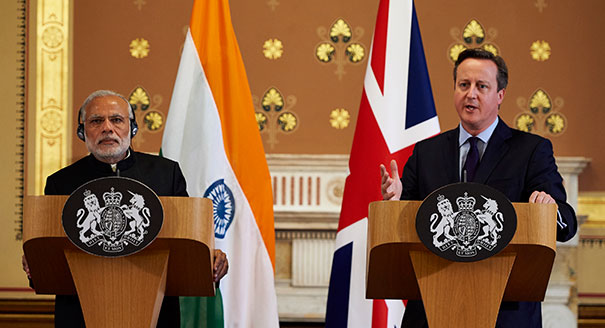
India must immediately signal strong solidarity with Britain and Europe, both of whom are likely to be weakened in the near term.
Source: Indian Express
As India figures out the long-term implications of the British vote to leave the European Union for economic globalisation and international security, New Delhi must immediately signal strong solidarity with Britain and Europe, both of whom are likely to be weakened in the near term.
The idea of an ‘ever closer union’ between the European states has been an unchanging element of the Eurasian landscape for long. If the fracturing of Europe makes India’s security environment a lot more uncertain than it was before the Brexit vote, strengthening strategic partnerships with Britain and Europe must be central to any new Indian effort to shape the Eurasian balance of power.The impending economic divorce between London and Brussels will be long, painful and involve much recrimination. For India, though, Britain and Europe are among its most important partners. Finding ways to rejuvenate the economic and political ties to both should now be at the top of India’s diplomatic agenda.
While nationalism, backlash against economic integration and resentment against large scale immigration have been among the factors that made Brexit possible, the idea of reconnecting to its old economic partners in the British Commonwealth has been among the few positive ideas that animated the movement.
Many British leaders demanding separation from Europe had argued that the loss from the severance of the European market can be easily made up by Britain’s independent economic engagement with the rest of the world, including the United States, China and India.
Although President Barack Obama had publicly cautioned Britain against leaving the European Union, there is considerable support across the aisle in America. The presumptive presidential nominee of the Republican Party, Donald Trump, has hailed the vote as “fantastic”. Arriving in Scotland on Friday, Trump, whose focus is on mobilising anti-globalisation and anti-immigration sentiments in the United States, had every reason to cheer the vote.
Beijing, which has made major inroads into Britain over the last few years and was celebrating the prospect of a “golden decade” in the bilateral relationship, is well poised to become an even stronger partner to London in the coming years.
New Delhi, which has much goodwill among the Brexiteers, must make its move sooner than later. On the economic front, India must signal readiness to negotiate a quick free trade agreement with Britain. Although India can in no way substitute for Europe or match the size of American or Chinese resources, it can offer a measure of economic comfort at this difficult juncture.
India must match economic reassurance with a political exploration of the possibilities for strengthening the Commonwealth as a political institution. While independent India has sought membership of every global club since its independence, it has largely looked down on the Commonwealth that it inherited from the Raj.
As a club of globally dispersed states from the South Pacific to the Caribbean and the Southern Africa to the Middle East and South East Asia, the Commonwealth was for long ripe for Indian leadership.
Reviving the Commonwealth at this moment might be lot more demanding than it would have been a few years ago, but it is never too late. The first step is to initiate a high-level consultation among key members of the Commonwealth including Britain, Canada, Australia and India.
If nostalgia for the Commonwealth, hopes for restoring the special relationship with the US, and expanding the financial and commercial engagement with China give something to fall back upon, Europe after Brexit finds itself in a difficult corner.
The growing populist pressures, hostility towards the European bureaucracy in Brussels, anger against the power of international terrorist groups to target cites with impunity, and the growing resistance to movement of refugees from the South has put great strain on the European political leadership. Making matters worse is the European inability to either confront an increasingly assertive Russia or find much needed political accommodation.
Long the model for regionalism and the possibilities for transcending the traditional notions of territorial sovereignty, the European project has never looked as shaky as it does today.
To be sure, the North Atlantic Treaty Organisation, the military alliance between America and Europe, could endure even amidst the weakening of the EU. Despite much talk, the EU has never looked capable of replacing the NATO.
But now NATO itself looks vulnerable, amidst the growing American scepticism about its utility. Trump has been at the forefront of demanding a new framework for security burden-sharing between America and Europe.
As Germany and France struggle to deal with the political shock waves from the British vote and fend off potential copycats elsewhere in Europe, New Delhi must reach out to Berlin and Paris, who have been staunch supporters of India’s political aspirations in recent years. An early conclusion of a free trade agreement with Europe would be a strong vote of confidence from India.
This article was originally published in the Indian Express.
Former Nonresident Senior Fellow, Carnegie India
A leading analyst of India’s foreign policy, Mohan is also an expert on South Asian security, great-power relations in Asia, and arms control.
Recent Work

C. Raja Mohan, Darshana M. Baruah


Alexander Gabuev, Paul Haenle, C. Raja Mohan, …
Carnegie does not take institutional positions on public policy issues; the views represented herein are those of the author(s) and do not necessarily reflect the views of Carnegie, its staff, or its trustees.

Are Germany’s economic, industrial, and political struggles becoming a liability for the EU’s ability to rise to the geopolitical moment?

Rym Momtaz, ed.

China’s police training infrastructure construction projects provide benefits to recipient countries, promote China’s image as a major global security provider, and are likely to reinforce alignment between Beijing’s security priorities and those of countries in the Global South.


Cameron Waltz, Sheena Chestnut Greitens, Kim Nguyen, …

The Bureau of Industry and Security needs to adjust its focus and practices to maintain its position as the U.S. government’s primary champion of international technological competition.

Geoffrey Irving
Despite myriad challenges and occasional stumbles, the new Hungarian government is moving ahead with energy and conviction to uproot years of illiberalism and corruption and rebuild Hungarian democracy.

Thomas Carothers

European Commission President Ursula von der Leyen is about to give her annual address on the state of the EU. Here’s what she won’t—but should—say.
Rym Momtaz