

Commentary
Andrei Kolesnikov
{
  "authors": [
    "Andrei Kolesnikov"
  ],
  "type": "commentary",
  "centerAffiliationAll": "",
  "centers": [
    "Carnegie Endowment for International Peace",
    "Carnegie Russia Eurasia Center"
  ],
  "collections": [],
  "englishNewsletterAll": "",
  "nonEnglishNewsletterAll": "",
  "primaryCenter": "Carnegie Endowment for International Peace",
  "programAffiliation": "",
  "programs": [],
  "projects": [],
  "regions": [],
  "topics": []
}
Source: Getty
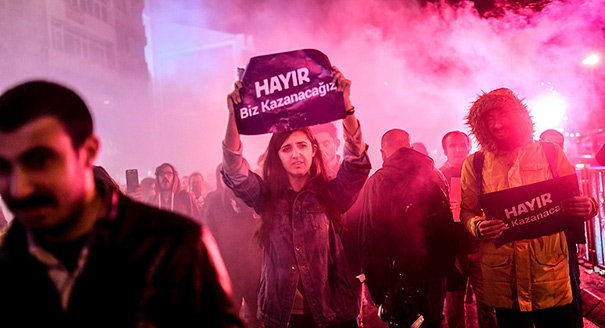
Although Russian officials were initially shocked and concerned about the military coup in Turkey, it has in fact given them a formula for strengthening their gradually declining regime: all they have to do to restore their vanishing legitimacy is declare themselves defenders of democracy.
In recent days, more than one Western analyst has come close to lamenting the failure of the military coup in Turkey, recalling the successes of the country’s coups in second half of the twentieth century. But we aren’t living in the 1960s or even the 1990s anymore: the social forces and institutional structures that gave rise to the Turkish coups of the last century are no longer influential. Nor are they in Russia, which is why Russian officials were shocked and concerned about the events in Turkey, and quickly expressed a kind of sympathy for Erdogan—their fellow authoritarian.
If the coup hadn’t happened, Erdogan would have had to stage it himself. Whereas before the coup he had been guiding the country toward authoritarianism, Erdogan now looks like a defender of constitutional democracy.
There is an important lesson here for Russian authoritarians: they now have a formula for buttressing their ostensibly strong but in fact gradually declining regime. All they have to do to restore their vanishing legitimacy is declare themselves defenders of democracy.
Russia’s ruling class won’t even have to stage a coup to do so. (Nobody would believe it was real anyway.) The regime, rotting from years of corruption and inefficiency, will find other ways to legitimate itself.
The 2016 parliamentary elections present an opportunity for the government to do just that. It won’t be hard to make the elections look “fair”; all they have to do is put a familiar “menu” of political parties on the ballot. No falsification will be necessary: the disoriented voter will simply prefer to order “the usual,” opting for the parties and candidates they recognize. The 2018 elections will be even “fairer,” featuring zero viable alternatives to the incumbent elite.
What next? Russian elites aren’t rushing to try out the time-tested scenario described by Tancredi Falconeri in Luchino Visconti’s classic, The Leopard: “If we want things to stay as they are, things will have to change.” To put this maxim into practice and ensure the survival of the aristocracy, Falconeri first fights alongside Garibaldi’s forces, then cynically joins the new Savoy regime while also marrying a daughter from a nascent bourgeois class.
Similarly, in Economic Origins of Dictatorship and Democracy, Daron Acemoglu and James Robinson conclude that democracy emerges to avoid revolutions. Or, in the words of Earl Grey, whom they quote, “The principle of my reform is to prevent the necessity of revolution…reforming to preserve and not to overthrow.”
The Russian autocracy is now searching for ways to survive after 2018. This is why Alexei Kudrin has been brought back into the regime’s political orbit. But the regime lacks Falconeri’s savvy; it may be unable to change things in order to keep them the same.
Former Senior Fellow, Carnegie Russia Eurasia Center
Kolesnikov was a senior fellow at the Carnegie Russia Eurasia Center.
Recent Work
Andrei Kolesnikov
Andrei Kolesnikov
Carnegie does not take institutional positions on public policy issues; the views represented herein are those of the author(s) and do not necessarily reflect the views of Carnegie, its staff, or its trustees.