

Commentary
Are Germany’s economic, industrial, and political struggles becoming a liability for the EU’s ability to rise to the geopolitical moment?
Rym Momtaz, ed.
{
  "authors": [
    "Arushi Kumar"
  ],
  "type": "legacyinthemedia",
  "centerAffiliationAll": "",
  "centers": [
    "Carnegie Endowment for International Peace",
    "Carnegie India"
  ],
  "collections": [],
  "englishNewsletterAll": "",
  "nonEnglishNewsletterAll": "",
  "primaryCenter": "Carnegie India",
  "programAffiliation": "",
  "programs": [],
  "projects": [],
  "regions": [
    "South Asia",
    "Pakistan",
    "Middle East",
    "Saudi Arabia"
  ],
  "topics": [
    "Foreign Policy"
  ]
}
Source: Getty
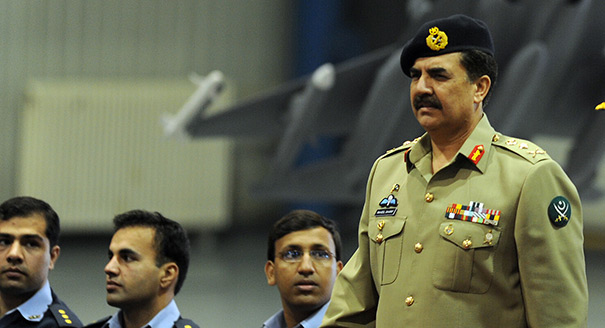
If General Raheel Sharif agrees to head the Islamic Military Alliance, it would have major domestic and foreign policy implications for Pakistan.
Source: Scroll.in
The former Pakistani chief of army staff, General Raheel Sharif, is reported to have been appointed to the helm of the Islamic Military Alliance to Fight Terrorism – a Saudi Arabia-led coalition of Muslim countries – though contradictory statements emanating out of the country made it unclear whether he had accepted the position. However, should he do so, it would have significant implications for Pakistan. The appointment is said to have been made at the behest of Saudi Defence Minister Prince Muhammad Bin Salman al-Saud. This Saudi invitation has not only highlighted the civil-military tension in Pakistan, it would also exacerbate Islamabad’s geo-strategic imbalance vis-a-vis Tehran and Riyadh.
Domestically, Sharif’s assent to lead the alliance would indicate that he circumvented due process and acted against the wishes of the Pakistani Parliament. On a Geo News programme on January 6, the Pakistani Defence Minister Khawaja Muhammad Asif confirmed the appointment had been made in agreement with the incumbent government and the Pakistan Army’s General Headquarters. He has since retracted his position in a statement to the senate.
Responding to Senate Chairman Mian Raza Rabbani’s queries on the fulfilment of the constitutional requirements preceding such an appointment, the minister confirmed that a retired officer seeking a position in a government department would require a no-objection certificate from the Ministry of Defence. Asif clarified that while the provisions of re-employment refer to civilian roles within the country, the same would apply to positions abroad, and that no such request had been received from Sharif.
Further, as per the federal government’s Rules of Business 1973, made under Articles 90 and 99 of the Pakistani Constitution, the Ministry of Defence has been assigned the precise responsibility of “defence matters pertaining to treaties and agreements with other governments except those relating to purchase stores; and matters regarding the military assistance to foreign countries.” Given that Sharif retired in November, it is uncertain in what capacity he would be able to accept or reject such an offer.
In terms of foreign policy, Sharif’s acquiescence to command the alliance would demonstrate a shift from Pakistan’s current strategy of balancing Riyadh and Tehran. The alliance is perceived to be sectarian due to the inclusion of predominantly Sunni states, and the conspicuous absence of Iran and the main victims of terrorism inflicted by Daesh or the Islamic State – Iraq and Syria.
In light of this, several Pakistani senators opposed Sharif’s appointment on the grounds that it would undermine Parliament’s unanimous decision, by way of a joint session in April 2015, to abstain from the Saudi-led air campaign against Shia rebels in Yemen. Pakistan’s refusal to aid its close ally, Saudi Arabia, was attributed to the fact that it has the second largest Shia population in the world. Its burgeoning security and energy trade ties with Iran were also factored in as possible reasons.
The absence of Iran – a distinguishing feature from the Organisation of Islamic Cooperation, a 57-nation group that call itself “the collective voice of the Muslim world” – has also made the raison d’être of the alliance questionable. The Pakistani Parliament was already divided over the issue in December 2015 when Rabbani, the senate chairman, admonished Foreign Affairs Advisor Sartaj Aziz for bypassing Parliament by agreeing to become part of an alliance about which it possessed incomplete information.
Questions regarding the very nature and objectives of the Islamic Military Alliance to Fight Terrorism endure: how will they define terrorism when many nations within the alliance are accused of abetting terrorist organisations and fomenting sectarianism within their territories? What will be the chain of command and who will control strategic decision-making? Will member states like Bahrain, Lebanon and Azerbaijan with significant Shia populations coordinate intelligence and maintain security? Is the alliance a union of states that engages with internal security matters along the lines of the European Union, or will it be a collective defence pact like the North Atlantic Treaty Organisation that aims to safeguard the security of its members from external forces? If the latter, who do they perceive as opponents?
Whatever Sharif’s decision, having a celebrated general of a nuclear-armed state move straight out of retirement to head a Saudi-led coalition would send a strong message with significant domestic and foreign policy reverberations.
Arushi Kumar
Carnegie does not take institutional positions on public policy issues; the views represented herein are those of the author(s) and do not necessarily reflect the views of Carnegie, its staff, or its trustees.

Are Germany’s economic, industrial, and political struggles becoming a liability for the EU’s ability to rise to the geopolitical moment?

Rym Momtaz, ed.

China’s police training infrastructure construction projects provide benefits to recipient countries, promote China’s image as a major global security provider, and are likely to reinforce alignment between Beijing’s security priorities and those of countries in the Global South.


Cameron Waltz, Sheena Chestnut Greitens, Kim Nguyen, …

The Bureau of Industry and Security needs to adjust its focus and practices to maintain its position as the U.S. government’s primary champion of international technological competition.

Geoffrey Irving

European Commission President Ursula von der Leyen is about to give her annual address on the state of the EU. Here’s what she won’t—but should—say.
Rym Momtaz

Understanding the climatic pain points is necessary for policymakers hoping to minimize the war’s negative environmental consequences.



Alejandro Martin Rodriguez, Joy Arkeh, Sarah Yerkes