

Commentary
Washington’s decision to support some UN functions while letting others wither is pulling the organization apart at the seams.
Stewart Patrick, Theodore Zaritsky
{
  "authors": [
    "Bruce Jones",
    "Tamara Cofman Wittes",
    "Sarah Yerkes"
  ],
  "type": "other",
  "centerAffiliationAll": "dc",
  "centers": [
    "Carnegie Endowment for International Peace"
  ],
  "collections": [],
  "englishNewsletterAll": "menaTransitions",
  "nonEnglishNewsletterAll": "",
  "primaryCenter": "Carnegie Endowment for International Peace",
  "programAffiliation": "MEP",
  "programs": [
    "Middle East"
  ],
  "projects": [],
  "regions": [
    "Middle East",
    "Syria"
  ],
  "topics": [
    "Security",
    "Foreign Policy"
  ]
}
Source: Getty
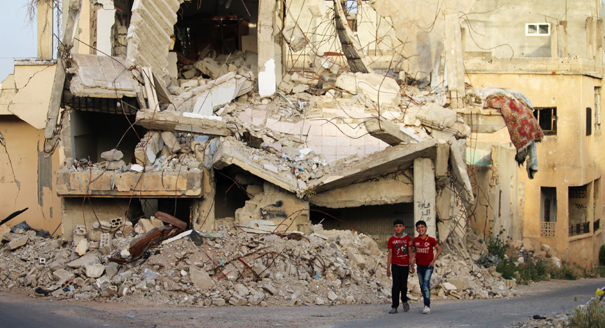
Policymakers examining the real options for bringing Syria’s civil war to an end, or mitigating its destructive violence, must start with a number of realities.
Source: Brookings Institution
Syria is entering its sixth year of debilitating violence at a moment of geopolitical flux. It has been and remains a crucible in the geopolitics of the Middle East; a flash point in great power politics; a source of extraregional instability; and a devastating human tragedy. Sadly, the international response to Syria has dealt with those aspects in that order, rather than prioritizing the human suffering.
Most analysts of civil wars believe that the approach to the Syrian civil war most likely to result in a sustained end to bloodshed would have the following elements: increased scale and coherence of Western engagement, in order to enhance Western leverage in negotiations with Russia and Iran; political negotiations that link international, regional, and local actors; the forging of an interim political deal—either a deal that sees President Bashar Assad leave power eventually, or at least one that limits Assad’s ability to execute violence against his opponents; and the installation of transitional institutions that can oversee interim security arrangements (including the disposition of Syria’s armed forces and intelligence agencies) and the beginnings of social reconciliation and economic reconstruction. These will be mammoth tasks, given the scale of devastation, destruction, and distrust.
The prospects for such an approach, however, remain dim. Indeed, given the current geopolitical dynamics, we do not believe an equitable negotiated settlement that removes Assad from power is possible. However, when Assad does eventually leave power, either through a pacted transition, an election, or eventual retirement or death, the international community may have an opportunity to guide Syria through a new negotiated political framework, allowing for a different set of stability measures and a robust reconciliation process.
In the shorter term, however, policymakers examining the real options for bringing Syria’s civil war to an end, or mitigating its destructive violence, must start with the following realities.
The net result of all of these factors is that what are often depicted as alternate scenarios for the eventual reconstruction of Syria, are in fact points along a spectrum. And whereas the common scenarios examined for Syria refer primarily to the disposition of military forces on the ground, we believe it is necessary to construct scenarios by tying geopolitical and ground realities together.
This piece was originally published by the Brookings Institution.
Bruce Jones
Senior Fellow, The Brookings Institution
Bruce Jones is a senior fellow with the Strobe Talbott Center for Security, Strategy, and Technology in the Foreign Policy program at the Brookings Institution; he also works with the Center for Asia Policy Studies. He is also a consulting professor at the Freeman Spogli Institute at Stanford University. From 2015 to 2020, Jones previously served as the vice president and director for the Foreign Policy program.

Tamara Cofman Wittes
Tamara Cofman Wittes is a senior fellow in the Center for Middle East Policy at Brookings, where she focuses on U.S. policy in the Middle East.

Acting Co-Director and Senior Fellow, Middle East Program
Sarah Yerkes is acting co-director and a senior fellow in Carnegie’s Middle East Program, where her research focuses on Tunisia’s political, economic, and security developments as well as state-society relations in the Middle East and North Africa.
Carnegie does not take institutional positions on public policy issues; the views represented herein are those of the author(s) and do not necessarily reflect the views of Carnegie, its staff, or its trustees.
Washington’s decision to support some UN functions while letting others wither is pulling the organization apart at the seams.

Stewart Patrick, Theodore Zaritsky

Are Germany’s economic, industrial, and political struggles becoming a liability for the EU’s ability to rise to the geopolitical moment?

Rym Momtaz, ed.

China’s police training infrastructure construction projects provide benefits to recipient countries, promote China’s image as a major global security provider, and are likely to reinforce alignment between Beijing’s security priorities and those of countries in the Global South.


Cameron Waltz, Sheena Chestnut Greitens, Kim Nguyen, …

The Bureau of Industry and Security needs to adjust its focus and practices to maintain its position as the U.S. government’s primary champion of international technological competition.

Geoffrey Irving
They face an uphill climb, but they could draw on a strategy that other diplomats have used in the past.


Shana Tabak, Alejandro Martin Rodriguez