• Research
  • Emissary
  • About
  • Experts
Carnegie Global logoCarnegie lettermark logo
DemocracyIran
  • Donate
{
  "authors": [
    "R. K. Misra",
    "Sarv Saravanan"
  ],
  "type": "legacyinthemedia",
  "centerAffiliationAll": "",
  "centers": [
    "Carnegie Endowment for International Peace",
    "Carnegie India"
  ],
  "collections": [],
  "englishNewsletterAll": "",
  "nonEnglishNewsletterAll": "",
  "primaryCenter": "Carnegie India",
  "programAffiliation": "",
  "programs": [],
  "projects": [
    "Technology and Society"
  ],
  "regions": [
    "South Asia",
    "India"
  ],
  "topics": [
    "Economy"
  ]
}

Source: Getty

In The Media
Carnegie India

Can India Innovate? Fact Is That Even Successful Indian Startups Are Often Modelled on Western Businesses

As nations impose restrictions on immigration and movement of people, New Delhi can attract top global talent and nurture Indian talent with the right policies and frameworks.

Link Copied
By R. K. Misra and Sarv Saravanan
Published on Apr 25, 2017
Project hero Image

Project

Technology and Society

This program focuses on five sets of imperatives: data, strategic technologies, emerging technologies, digital public infrastructure, and strategic partnerships.

Learn More

Source: Times of India

India is the top region for innovation in Asia, as per a recent report. This might seem like excellent news, till we ask how much of this innovation is truly Indian? According to the Patent Office, over 70% of the patents filed in the country are by MNCs. Indian companies and academia share the remaining 30%. Currently, we rank 66th on the Global Innovation Index list. That places us 41 places behind China.

According to the World Intellectual Property Organization (WIPO) India filed 1,423 international patents in 2015. US filed 57,385, Japan 44,235, China 29,846 and South Korea 14,626. On a list of the world’s most innovative companies, only one Indian organisation Asian Paints ranks in the top 20 at #18. Hindustan Unilever comes in at #31. The top 10 list is dominated by the US.

Even successful Indian startups have based their business model on proven Western businesses, for example Flipkart on Amazon, Ola on Uber. Where is the true Indian innovation that takes the world by storm? If we are to make India the innovation destination of the world, we need to change the conversation around IPR, innovation and patents.

The time is now; as nations impose restrictions on immigration and movement of people, we can attract top global talent and nurture Indian talent with the right policies and frameworks.

Fortunately, the current government is putting some serious thought into modernising our age old IPR and patent policies. Notable amongst these are the Intellectual Property Policy and the Ministry of Electronics and Information Technology’s Draft Software Policy 2016. Other steps include establishment of the Ministry for Skill Development and Entrepreneurship, and Intellectual Property Facilitation Centres, introducing financial schemes and incubation programmes and increasing expenditure on infrastructure. Initiatives like Make in India will go a long way in encouraging desi companies to focus on out of the box thinking.

Inclusivity and ease of filing patents are critical areas of focus. Israel has one of the most innovation friendly policy environments in the world with provisions for tax exemption from 0-25% for home grown companies recognised as ‘approved industrial enterprises’. Israel also invests in R&D through international cooperation between different countries and regions that helps in establishing links between local companies, multinationals and academic institutions. China reduces patent fees by 75-80% for people who can’t afford it and has a patent fund to provide cash subsidies for patent applicants and patentees gratuitously.

We also need to create a symbiotic ecosystem with product and technology centric organisations, both domestic and MNCs, investing more in R&D and high value addition activities and publicising them. We can open our country to top talent from across the world and establish India as the sought after destination for innovation. We need to separate them from the regular IT and ITES category and encourage them to file patents in India for Indian innovation.

The software product policy should be more inclusive. National foundations like Aadhaar and India Stack are falling in place. Now is the time to focus on India being the origin of the innovation rather than the nationality of the investor or owner. This will funnel talent to the startup ecosystem which can then further innovate and create business opportunities.

Our startup ecosystem needs huge supply of global business skills and top notch technical talent. Global organisations with India based R&D centres have the ability to invest in creating such capability. Israel with its progressive policies is the best example of such a symbiotic ecosystem of rich MNC presence that helps create world class technology startups.

We taught the world the concept of jugaad and yet we lag when it comes to claiming it. After years of apathy, our country is finally poised to take charge of its IPR future with some progressive changes and policy introductions that are basic necessities to make India the innovation capital of the world.

This article was originally published in the Times of India.

About the Authors

R. K. Misra

Nonresident Scholar, Technology and Society Program

R. K. Misra is a nonresident scholar at Carnegie India. Based in Bengaluru, he drives Carnegie India’s Technology and Society program, and engages with technology innovators and policymakers.

Sarv Saravanan

Sarv Saravanan is senior VP, Dell EMC.

Authors

R. K. Misra
Nonresident Scholar, Technology and Society Program
R. K. Misra
Sarv Saravanan

Sarv Saravanan is senior VP, Dell EMC.

EconomySouth AsiaIndia

Carnegie does not take institutional positions on public policy issues; the views represented herein are those of the author(s) and do not necessarily reflect the views of Carnegie, its staff, or its trustees.

More Work from Carnegie Endowment for International Peace

  • China Financial Markets
    Commentary
    China Financial Markets
    Is China’s High-Quality Investment Output Economically Viable?

    China’s rapid technological progress and its first-rate infrastructure are often cited as refuting the claim that China has been systematically overinvesting in non-productive projects for many years. In fact, as the logic of overinvestment and the many historical precedents show, the former is all-too-often consistent with the latter.

      Michael Pettis

  • Crowd On Mumbai city street At night
    Article
    India’s Demographic Dividend Is a Test of Governance

    India’s demographic transition is underway, but its economic payoff remains far from guaranteed.

      • Apoorva Jadhav

      Apoorva Jadhav

  • Article
    India’s Press Note 3 Gamble: Opening the FDI Door to China

    On March 10, 2026, India’s Union Cabinet approved amendments to Press Note 3, a regulation that mandated government approval on all foreign direct investment (FDI) from countries sharing a land border with India. This amendment raises questions primarily about whether its stated benefits will materialize and if the risks have been adequately weighed. This piece will address the same.

      Konark Bhandari

  • Commentary
    The Coming of Age of India’s Nuclear Triad

    The induction of INS Aridhaman, which features several technological enhancements, now gives India the third nuclear ballistic missile submarine to ensure continuous at-sea deterrent.

      Dinakar Peri

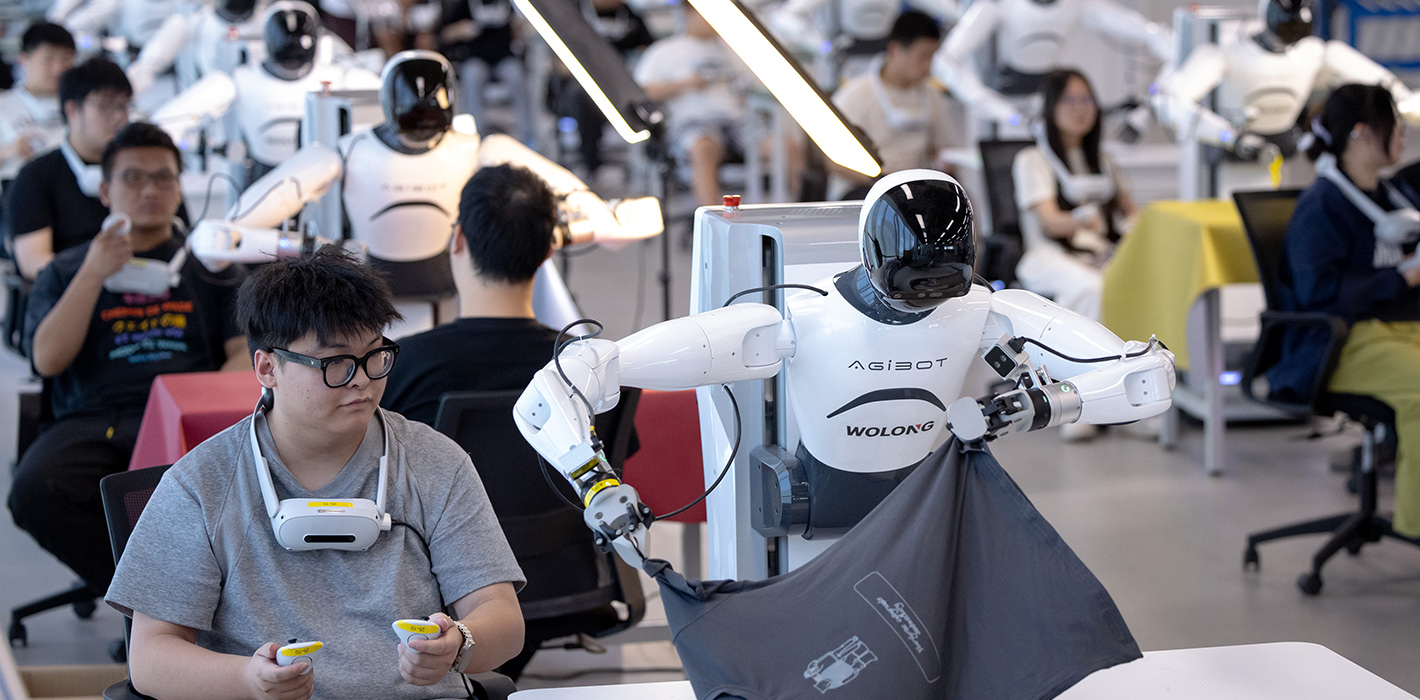
  • Humanoid robots follow technicians to learn job skills at the data collection area of an embodied AI robot innovation center on September 14, 2025 in Shaoxing, Zhejiang Province of China.
    Paper
    The AI Labor Debate: Three Views on the Future of Work

    AI could hollow out jobs, reshape them gradually, create entirely new ones—or do all three at once. The case for starting to act now doesn’t depend on knowing which.

      • Teddy Tawil

      Teddy Tawil

Get more news and analysis from
Carnegie Endowment for International Peace
Carnegie global logo, stacked
1779 Massachusetts Avenue NWWashington, DC, 20036-2103Phone: 202 483 7600
  • Research
  • Emissary
  • About
  • Experts
  • Donate
  • Programs
  • Events
  • Blogs
  • Podcasts
  • Contact
  • Annual Reports
  • Careers
  • Privacy
  • For Media
  • Government Resources
Get more news and analysis from
Carnegie Endowment for International Peace
© 2026 Carnegie Endowment for International Peace. All rights reserved.