

Commentary
Dinakar Peri
{
  "authors": [
    "Dinakar Peri"
  ],
  "type": "commentary",
  "centerAffiliationAll": "",
  "centers": [
    "Carnegie Endowment for International Peace",
    "Carnegie India"
  ],
  "englishNewsletterAll": "",
  "nonEnglishNewsletterAll": "",
  "primaryCenter": "Carnegie India",
  "programAffiliation": "",
  "projects": [
    "Security Studies"
  ],
  "regions": [
    "India"
  ],
  "topics": [
    "Technology",
    "Defense",
    "Military"
  ]
}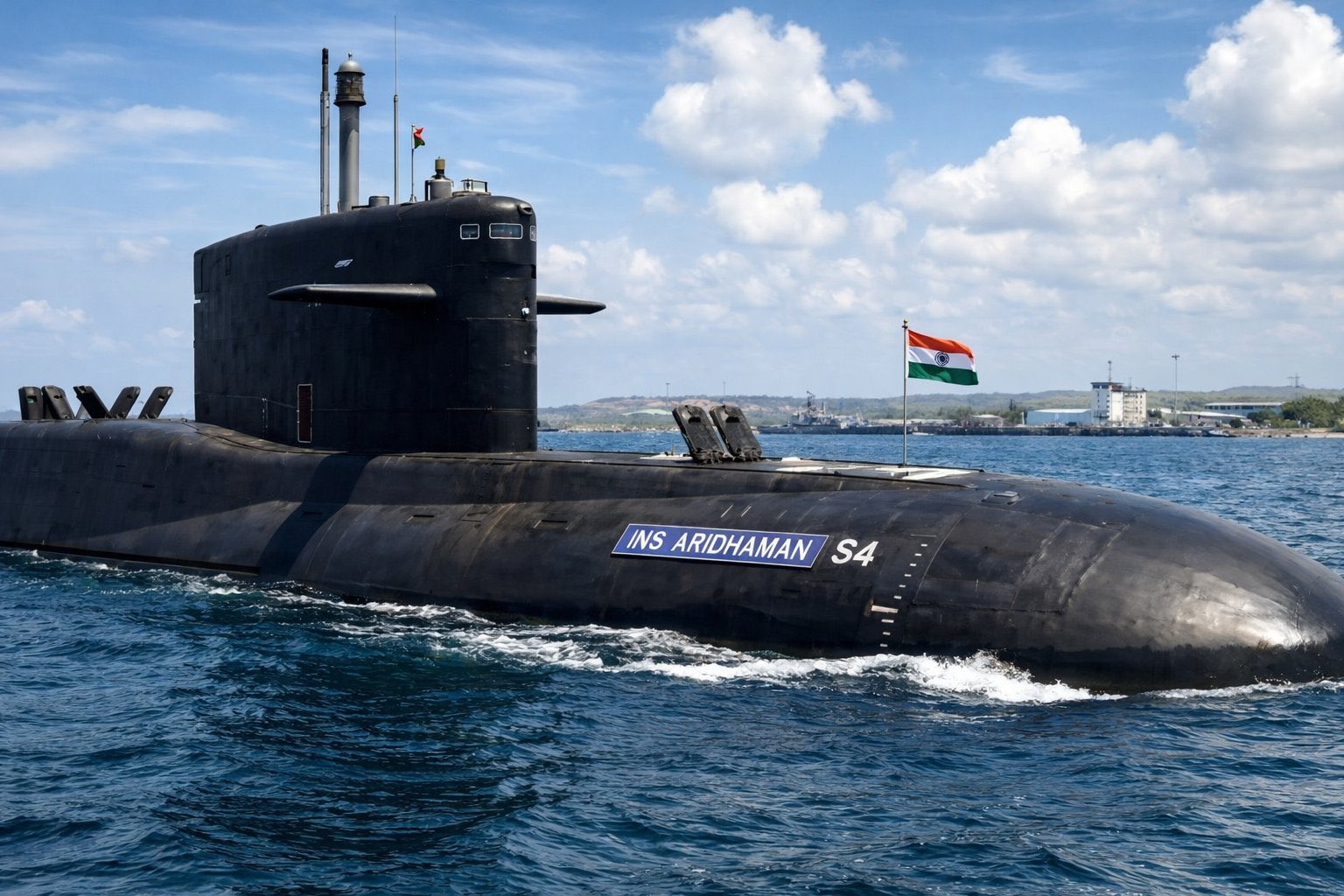
Source: JM_Scindia via X
The induction of INS Aridhaman, which features several technological enhancements, now gives India the third nuclear ballistic missile submarine to ensure continuous at-sea deterrent.
On April 3, 2026, India’s nuclear triad crossed a major milestone with the quiet commissioning of INS Aridhaman—the country’s third nuclear ballistic missile submarine or SSBN (Submersible Ship Ballistic Nuclear)—at the Ship Building Centre in Visakhapatnam in Andhra Pradesh.
While no formal announcement was made on the “boomer,” as SSBNs are referred to, defense minister Rajnath Singh posted a cryptic message in Hindi on X, loosely translated to “Not words but power, ‘Aridhaman’!” Officially, Singh was on a visit to the coastal city to oversee another naval commissioning—the fourth frigate of the Project-17A class.
This is significant for many reasons. Having an SSBN at sea is central to the assured retaliatory second strike, as espoused in the Indian nuclear doctrine announced in 2003 (which also commits to a nuclear no-first-use). To ensure round-the-clock operational deployment in the ocean, at least three submarines are required—one on patrol and the other two in maintenance or transit.
The induction of INS Aridhaman, which features several technological enhancements, now gives India the third submarine it needs for a continuous at-sea deterrent.
India’s first indigenous SSBN, INS Arihant, called S2, was developed as a technology demonstrator under the Advanced Technology Vessel program that began in the 1980s. Arihant, displacing 6000 tons and powered by an 83 MW reactor, was launched into water in 2009 by then Prime Minister Manmohan Singh and was quietly commissioned in August 2016. In November 2018, Prime Minister Narendra Modi announced on Twitter that INS Arihant had returned from its first deterrence patrol, meaning it was on deployment armed with nuclear-tipped missiles. This meant that India’s nuclear triad, consisting of missiles, aircraft, and submarines, was complete.
The second SSBN, INS Arighaat (S3), was commissioned in August 2024. The induction of INS Aridhaman, which features several technological enhancements, now gives India the third submarine it needs for a continuous at-sea deterrent.
Focus on Delivery Systems
India has long fielded the Prithvi and Agni series of ballistic missiles. The Agni-5 has the longest range of over 5,000 kilometers and is stored in a canister, which enhances the ease of storage, movement, and operation. In 2024, it was tested with Multiple Independent Re-entry Vehicles, that is, multiple warheads that can target different locations. Fighter aircraft capable of nuclear delivery include Mirage-2000s, Sukhoi-30MKI, and Rafales.
Among the three legs of the triad, however, nuclear submarines with long-range ballistic missiles are considered the most survivable and effective for retaliatory strikes in the event of a first strike.
All five recognized nuclear-armed countries have fielded SSBNs with intercontinental range Submarine Launched Ballistic Missiles (SLBM). In India’s case, an urgent gap remains to be addressed. The submarines are currently armed with the K-15 SLBM with a range of just 750km, so short that the submarine would have to go very close to an adversary’s coast to launch a counter strike. INS Arighaat and Aridhaman can carry the far more capable 3,500-kilometer range K-4 missile. While the missile has been tested several times, it is still not operationally deployed. Given that India’s submarine manufacturing capability has now reached a certain level of maturity, getting the K-4 combat-ready should be a priority.
The K-4 will be the mainstay of India’s undersea nuclear deterrence until the K-5, a 5,000-kilometer-range SLBM that is currently under development, is tested and fielded.
The fourth submarine in the series, the S4*, was launched in 2024 and is expected to be commissioned next year. While powered by the same reactor as the others, it is expected to be bigger with several advanced features. The S5 and the next submarines in line are expected to be even bigger, displacing around 13,500 tons and powered by a new, more powerful reactor.
The SSN Program
While the strategic nuclear program has maintained a certain tempo, a separate urgency demands attention—nuclear attack submarines, or SSNs. Nuclear attack submarines are critical for long range and endurance, especially for a country with a vast coastline and boasting a blue-water navy that is called the first responder in the Indian Ocean Region. Conventional diesel-electric submarines are optimal for operating in the Indian Ocean, given their ability to operate quietly and closer to the coast. Even on the conventional front, the Indian Navy is currently facing a major crunch in its submarine fleet, with just seventeen vessels and a majority of them waiting to be phased out.
In 2024, the Cabinet Committee on Security sanctioned the design and construction of two SSNs. The first of the submarines is only expected to be ready by 2036–37, followed by the second one a couple of years later. This is a long timeline given their critical role and in the context of India’s long history of building, operating, and maintaining nuclear submarines.
India has leased SSNs from Russia twice under the Chakra series for training, in 1988 for three years and in 2012 for ten. The agreement for another SSN was signed in March 2019, though the delivery was delayed due to Covid-19 and then the war in Ukraine. It will now be delivered by 2028 and is expected to keep the training and maintenance experience honed till the indigenous platforms are inducted.
In contrast, China, which already has the world’s largest Navy, has over sixty submarines, out of which at least twelve are nuclear-powered—six SSBNs and six SSNs. A major expansion is also already underway. According to estimates by the U.S. Office of Naval Intelligence (ONI), by 2035, half of the projected eighty attack boat fleet of the People’s Liberation Army Navy will be nuclear-powered.
Given the threat ecosystem, India has its task cut out as far as nuclear submarines are concerned. It must accelerate the deployment of long-range SLBMs and focus more attention on designing and developing SSNs.

Fellow, Security Studies Program
Dinakar Peri is a fellow in the Security Studies program at Carnegie India. Earlier, he was a journalist with The Hindu newspaper covering defense and strategic affairs for almost 11 years.
Recent Work
Dinakar Peri
Dinakar Peri
Carnegie does not take institutional positions on public policy issues; the views represented herein are those of the author(s) and do not necessarily reflect the views of Carnegie, its staff, or its trustees.

China has showcased its engineering prowess with small modular reactor demonstration projects. But turning these technological achievements into commercial success will be a greater challenge.

Tong Zhao
Why Pakistan, Saudi Arabia, and Turkey are joining forces on regional security.


Alper Coşkun, Amr Hamzawy

Scholars and policymakers increasingly use ecological metaphors such as “information environment” and “information ecosystem” to describe contemporary informational spaces. Ecology offers more than loanwords. Its concepts and frameworks can help researchers understand relationships among people, technology, content, and society.



Alicia Wanless, Claire Wardle, David Scales

The truth of the strategic situation is that Europe and Russia are extremely unlikely to be able to “turn the page” on their confrontation within the next two decades.

Arkady Moshes

Despite public disputes over trade and immigration, the strategic partnership’s foundations remain sturdy.

Sameer Lalwani