

Other
François Godement, Ashley J. Tellis
{
  "authors": [
    "François Godement"
  ],
  "type": "legacyinthemedia",
  "centerAffiliationAll": "dc",
  "centers": [
    "Carnegie Endowment for International Peace"
  ],
  "collections": [],
  "englishNewsletterAll": "asia",
  "nonEnglishNewsletterAll": "",
  "primaryCenter": "Carnegie Endowment for International Peace",
  "programAffiliation": "AP",
  "programs": [
    "Asia"
  ],
  "projects": [],
  "regions": [
    "Western Europe",
    "France"
  ],
  "topics": [
    "Democracy"
  ]
}
Source: Getty
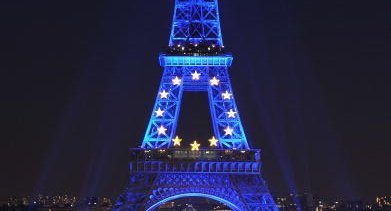
For the first time, France may have a clear electoral win for deeper European integration and a European sovereignty.
Source: Medium
Every one interested in food health knows about the « French paradox » that originates in South-west France, the home of all that duck confit and foie gras: people on that fairly greasy diet actually live long lives — but that’s because they ingest more fresh fruit and vegetable than anywhere else.
Something equivalent is happening with the French vote. Le Pen + Mélenchon + most fringe candidates: an overdose of negativity about either the « others » or « globalization » (read, competition from others) or « Europe », the scapegoat to indict for « the world we lost ». Negativity or anxiety create bad grease, and outside observers have been looking a lot at it. Few have been paying attention to the healthy part of the campaign, a mixture of diet recipes (« austerity ») from traditional conservatives to become lean and mean again, and the vegan and fusion food that Macron symbolizes so well (in truth, leftist Mélenchon had also understood the need to show some optimism and had publicized his own taste for quinoa).
What has happened is without precedent. Emmanuel Macron has been campaigning visibly and without reservation for Europe and even for deepening European institutions. Although it remained largely unnoticed, the unlucky candidate of the Socialist Party, Benoît Hamon, had an equally strong and positive European theme, tilted towards social issues as it was. Not even Giscard d’Estaing — the French president who has done most for Europe, during and after his term — had campaigned so directly on Europe (instead, he emphasized « novelty » and societal changes inside France). François Fillon — a former sovereignist at the time of the Maastricht referendum — also came out directly for Europe, even if it is an intergovernmental Europe where the European institutions seem relegated to the shadows.
To someone who remembers past campaigns, this has never happened. Typically, Chirac and Jospin would seek to present themselves as the best national advocates inside Europe — a 50/50 stand that did not do much to counter distrust. Giscard and Mitterrand emphasized peace and security — and therefore Franco-German relations, putting themselves in the shoe steps of De Gaulle. Sarkozy and Hollande were swallowed by the financial crisis and its aftermath. The first resorted to the Franco-German axis as a (losing) argument for his re-election campaign, the second has largely done Europe by stealth, unable to muster the courage to deal frontally with the issue.
In a campaign where national bunkers were said to flower like mushrooms, Macron dared to move forward even more — in Berlin, in English (!), and with challenges for everybody. For the unreformed French, certainly. But also for Germany, when he explained that « the euro today is a sort of weak Deutschmark ». And for all those who were ready to outlaw an « ever closer union » when he advocated a « Europe of sovereignty ». On treaty reforms — the new taboo of European politics — he has clearly said that they were unavoidable — from ending the unanimity rule to a quota for a European list of MPs.
The ideas above are generally judged to be killers in the national political debate. Two generations of national politicians have made theirs the notion that Europe wins no vote, and only direct advocacy and lobbying for national interests does. But these same politicians kept a sense of proportion — treating Europe as at least a necessary evil or as a useful prop for national interests. Macron’s and our luck is that this mix has gone out of kilt. The competitor emerging against Macron is Marine Le Pen, drawing all her recipes from a book of national exorcism and a list of union claims for benefits: even when they are moved by some of these themes (globalism is not about to erase French identity), a majority of the French know that they are impractical, and also that they reflect a deep historical pessimism.
By contrast, Emmanuel Macron represents the way out, the future, a hope in a country which polls have shown to be the most pessimistic of all Western democracies.
The run-off campaign will be short and merciless. There could be no deeper opposition inside national politics than between Marine Le Pen and Emmanuel Macron. Macron has not won yet. He has been remarkably short on the actual ways and means to deliver a more influential Europe AND one that helps to solve the national slump. He has clearly broached — to Germany in particular — the idea of a reciprocal deal: more French reforms and a less mercantilist German monetary and fiscal policy. That makes two targets to persuade: the French in favour of reform, when all others save the conservative Fillon would not entertain them. And Germany, which itself is nearing election time — never a good moment for a positive gesture to the outside world…
But let’s face it. The direct, thatcherian route to reform has been shut off because austerity and self-punishment are neither in the genes of French voters, nor apparently in the heart of those who advocated it. A Macron win on the bases sketched above would be a giant step forward for the deepening of the European core — and in fact a direct challenge for German leaders to make good the federalist and integrative steps that they sometimes exhibit. The converse — a « flexible » Europe as preached by Wolfgang Schaüble — is in fact a risk of eroding institutions, rules and consensus. We should hope that Macron gathers enough strength for his ideas, and not only because the current alternative is Le Pen. In many ways, that duel clears the fog and the ambiguity that most national politicians have lived in. For the first time, we may have a clear electoral win for deeper European integration and a European sovereignty. That chance should not be neglected.

Former Nonresident Senior Fellow, Asia Program
Godement, an expert on Chinese and East Asian strategic and international affairs, was a nonresident senior fellow in the Asia Program at the Carnegie Endowment for International Peace.
Recent Work
François Godement, Ashley J. Tellis
François Godement, Abigaël Vasselier
Carnegie does not take institutional positions on public policy issues; the views represented herein are those of the author(s) and do not necessarily reflect the views of Carnegie, its staff, or its trustees.

In supporting Europe’s far-right, MAGA and Russia both want the same thing: a weaker EU. Europe must defend itself without abandoning the openness these forces exploit.

Armida van Rij
Saied’s main accomplishment has been to destroy a decade’s worth of democratic progress.

Sarah Yerkes

As we close out another season of Strategic Europe, it is worth taking stock of the deep shifts underway.

Rym Momtaz
Even if the terms of a ceasefire or peace settlement are satisfactory to most Ukrainians, the country’s democracy will face its fair share of challenges.
Petro Burkovskyi, Olexiy Haran

The hybrid warfare landscape is evolving rapidly, leaving policymakers without clear strategies. To better inform their work in addressing emerging challenges, governments must dig deeper into the underlying dynamics at play.


Raluca Csernatoni, Alicia Wanless