

Research
- +10
Rosa Balfour, Frances Z. Brown, Yasmine Farouk, …
{
  "authors": [
    "Moisés Naím"
  ],
  "type": "legacyinthemedia",
  "centerAffiliationAll": "",
  "centers": [
    "Carnegie Endowment for International Peace",
    "Carnegie China"
  ],
  "collections": [],
  "englishNewsletterAll": "",
  "nonEnglishNewsletterAll": "",
  "primaryCenter": "Carnegie Endowment for International Peace",
  "programAffiliation": "",
  "programs": [],
  "projects": [],
  "regions": [
    "North America",
    "South America"
  ],
  "topics": [
    "Political Reform",
    "Democracy",
    "Civil Society"
  ]
}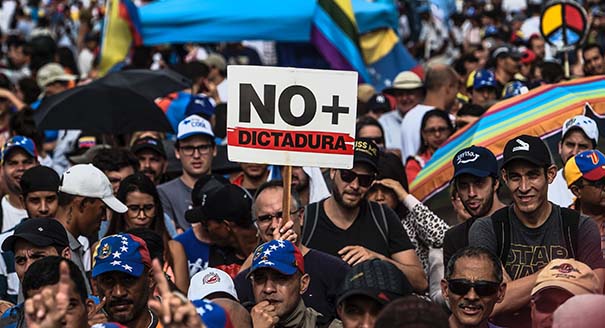
Source: Getty
Maduro doesn’t really matter. He is simply a useful idiot, the puppet of those who really control Venezuela: the Cubans, the drug traffickers, and Hugo Chavez’s political heirs.
Source: Atlantic
It's hard to pick the Venezuelan president’s greatest flaw. Which is more serious: his cruel indifference to the suffering of his people, or his brutal autocratic behavior? Which is more outrageous: his immense ignorance or the fact that he dances on television while his henchmen murder defenseless young protesters in the streets? The list of Nicolas Maduro’s failings is long, and Venezuelans know it; over 80 percent of them oppose him. And it's not just Venezuelans. The rest of the world has also discovered—at last!—his despotic, corrupt, and inept character.
And yet … Maduro doesn’t really matter. He is simply a useful idiot, the puppet of those who really control Venezuela: the Cubans, the drug traffickers, and Hugo Chavez’s political heirs. Those three groups effectively function as criminal cartels, and have co-opted the armed forces into their service; this is how it is possible that every day we see men in uniform willing to massacre their own people in order to keep Venezuela’s criminal oligarchy in power.The most important component of this oligarchy is the Cuban regime. Three years ago I wrote: “Venezuelan aid is indispensable to prevent the Cuban economy from collapsing. Having a government in Caracas that maintains such aid is a vital objective of the Cuban State. And Cuba has accumulated decades of experience, knowledge, and contacts that allow it to operate internationally with great efficacy and, when necessary, in a way that is almost invisible.” Havana’s priority remains controlling and plundering Venezuela. The supply of oil from Venezuela to Cuba is no longer as steady as it once was, due to the production troubles of the state-run oil company PDVSA. But the flows, while intermittent, have continued. Moreover, Cuban companies are the intermediaries of choice for many critical imports of foods and medicines to Venezuela.
And Cuba’s leaders know how to keep their Venezuelan allies in power—namely by exporting their own successful military-control strategies to Venezuela. Cubans have perfected the techniques of the police state at home: constant but selective repression, extortion and bribery, espionage, and persecution. Above all, the Cuban regime knows how to protect itself from a military coup: That is the main threat to any dictatorship, so controlling the armed forces is an indispensable requirement for a self-respecting dictator.
The Venezuelan regime has adopted these tactics. The effects are obvious: Officers who do not sympathize with the Maduro regime have been neutralized, while those who support it have gotten rich. It is no coincidence that there are more generals in Venezuela today than in NATO or the United States. Or that many high-ranking officials are exiled, imprisoned, or killed. That is why the hope that a group of patriotic, democratic, and honest officers will defend the nation, and not those who plunder it, has so far been only a hope.
But, in addition, Cuba—in stumbling across Venezuela—happened upon one of the most unprecedented gifts in the annals of geopolitics: Maduro’s predecessor Hugo Chavez, the president of a petro state who happily invited a bankrupt dictatorship to exert enormous influence in some of his country’s vital functions, from elections, economic policy, and politics to, of course, military and citizen surveillance. Cuban “advisers” were deployed at critical government agencies and soon started vetoing the decisions of the Venezuelan officials and in some instances imposing their views. The Venezuelans who resisted them were transferred or fired. The surprising influence that Cuba gained in Venezuela was essentially due to the close political alliance and deep emotional attachment that Chavez developed toward Fidel Castro. But even today, more than four years after Chavez’s death, the Venezuelan government makes few important decisions that are not stealthily influenced by the Cuban regime.
Another important player in today’s Venezuela is the drug traffickers, whose power is also a constraint on Maduro. Venezuela is one of the main drug routes to the U.S. and Europe. This status is worth billions of dollars, and the country is home to a vast network of people and organizations that control the illicit trade and the enormous amount of money it generates. According to U.S. officials, one such person is Vice President Tareck El Aissami, and so are a large number of military officers and other relatives and members of the ruling oligarchy.
This oligarchy, made up of Chavez's political heirs, is the third major component of the real power in Venezuela. Of course, Maduro; his wife, Cilia Flores; and many of his relatives and associates are part of that oligarchy. In this elite there are different “families,” “cartels,” and groups that compete for influence on government decisions, for political appointments, and for the control of illicit markets—ranging from human trafficking to money laundering. The smuggling and selling of food, medicines, and all kinds of products are just a few of the many other corrupt activities that enrich the Maduro oligarchy as well as the Cubans, the military, and their civilian accomplices.
Getting rid of Maduro is necessary. But it's not enough as long as three criminal cartels—who are intermingled in business, corruption, and the exercise of power—continue to control Venezuela.

Distinguished Fellow
Moisés Naím is a distinguished fellow at the Carnegie Endowment for International Peace, a best-selling author, and an internationally syndicated columnist.
Recent Work



Rosa Balfour, Frances Z. Brown, Yasmine Farouk, …
Moisés Naím
Carnegie does not take institutional positions on public policy issues; the views represented herein are those of the author(s) and do not necessarily reflect the views of Carnegie, its staff, or its trustees.

China’s political future will be shaped between now and next October. As the Communist Party enters its intense “campaign season” to prepare for a major political transition in 2027, reading Beijing's actions and responses may become more difficult as domestic politics weigh on its behavior more than usual.

Damien Ma

Putin’s conservative staffing policies and search for ever greater control have cemented parliament’s transformation into a bureaucratic appendage of the executive branch.

Andrey Pertsev
Despite its flop at the box office, the film raises important questions for the climate community to answer.
Leonardo Martinez-Diaz

Ex-president Gurbanguly Berdimuhamedov remains interested in politics, but his son Serdar, Turkmenistan’s current president, is becoming increasingly independent and willing to break with his father’s legacy. If their covert rivalry goes too far, both risk losing power.

Galiya Ibragimova

A notable degree of participative democracy has firmly arrived in Europe. But to have more far-reaching impact, democratic deliberation needs to move into a radically new phase.

Richard Youngs