

Article
C. Raja Mohan, Darshana M. Baruah
{
  "authors": [
    "C. Raja Mohan"
  ],
  "type": "legacyinthemedia",
  "centerAffiliationAll": "dc",
  "centers": [
    "Carnegie Endowment for International Peace",
    "Carnegie India"
  ],
  "collections": [],
  "englishNewsletterAll": "ctw",
  "nonEnglishNewsletterAll": "",
  "primaryCenter": "Carnegie India",
  "programAffiliation": "SAP",
  "programs": [
    "South Asia"
  ],
  "projects": [],
  "regions": [
    "South Asia",
    "Afghanistan",
    "India"
  ],
  "topics": [
    "Foreign Policy"
  ]
}
Source: Getty
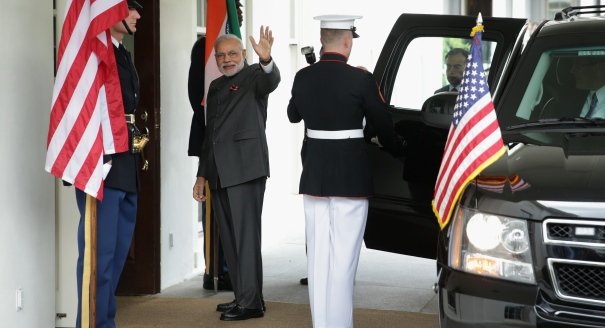
If Trump believes that an exhausted United States must step back from being the first responder to Eurasian crises, Modi has talked up the idea of India as a leading power that must take greater regional and international responsibilities.
Source: Indian Express
Amidst the low expectations surrounding Prime Minister Narendra Modi’s first face-to-face encounter with President Donald Trump next week in Washington, there is one likely area of convergence the two leaders could explore. It is the prospect of America supporting a larger Indian role in securing the Subcontinent and the Indian Ocean.The shared interest in an Eurasian balance of power and a complementarity between an America shedding its global burdens under domestic pressure and a rising India taking larger responsibilities is not difficult to see. But here is the problem. The Washington establishment bristles at the idea of retrenchment and in Delhi, the strategic community wrings its hands at the thought of going beyond the Subcontinent. But Trump’s policies might compel both to think differently.
The effort to construct an India-US strategic partnership in the last two decades was based on the assumption that the American unipolar moment will endure. America looked at partnering a rising India to sustain US primacy in the Indo-Pacific. Delhi acknowledged American primacy, but was afraid of becoming a “junior” partner. It was concerned that US strategic indulgence towards Pakistan and China — the two main sources of India’s security challenges —may make Washington an unreliable partner.
As a result, the hype about India-US security cooperation never really lived upto its potential. As Trump challenges the traditional assumptions about America’s global role, there is an opportunity, slim though it might be, for Modi to explore a new framework for strategic cooperation with the United States. If Trump believes that an exhausted America must step back from being the first responder to Eurasian crises, Modi has talked up the idea of India as a leading power that must take greater regional and international responsibilities.
During his recent visit to Europe, Modi strongly committed India to the 2015 Paris accord on climate mitigation, after Trump walked out, claiming it imposes too many costs on the US economy. In Washington, though, the PM is unlikely to touch on climate change and other global issues. For “globalism” is a pejorative word in Trump’s lexicon.
But Modi can, and must, explore with Trump the theme of redistributing international security burdens. Trump thinks the US does too much, and Modi thinks India could do a lot more. Trump does not think that America is forever obliged to defend its friends at any cost. He wants the allies to spend more on building their own national defence capabilities or financially compensate America for its heavy lifting. Making it worse, from Trump’s perspective, is the proposition that while riding free on security cover, allies like Germany and Japan have run major trade surpluses with the United States.
For Trump, at least, this present arrangement is unacceptable. Trump may not have the political strength to radically alter the post-war arrangements amidst the intense hostility in Washington. But he may have unleashed a process that could lead to a major restructuring of US alliance burdens in Eurasia in the medium term.
While Trump’s personal style has put off many of America’s allies, they have begun to get the message. Both the German Chancellor Angela Merkel in Europe and the Australian Prime Minister Malcolm Turnbull in the Pacific have recently talked of the need to take charge of their destiny, and not rely only on America. Some are not waiting. Saudi Arabia, for example, has begun to act on its own in the Gulf and the Middle East.
Where does that leave Delhi? Until now, India has been hesitant to take on a regional security role beyond the Subcontinent. Its talk of “a net security provider” in the Indian Ocean had a nice ring to it; but not enough operational substance, thanks to the deep political and institutional resistance in the Indian establishment.
Twice before when the world beckoned India to take on a larger regional role, Delhi refused. In the aftermath of independence, there was the opportunity of India working with Britain for a regional order under the rubric of the Commonwealth. Although Pandit Nehru accepted the responsibilities of the Raj for the Subcontinent’s security, he was unwilling to back a Commonwealth military framework.
Two decades later, when Britain ended its security commitments “east of the Suez”, the post-Nehru India had neither the political will, nor the material resources to consider regional security leadership. Its preference was to indulge in vacuous collective security rhetoric. As the Indian Ocean went through multiple convulsions from the 1970s, India has remained a mere bystander.
The US, which replaced Britain as the dominant power in the Indian Ocean in the 1970s, may now be headed to its own “east of Suez” moment, thanks to Trump. This retrenchment is unlikely to be orderly or brief. As America’s domestic politics becomes volatile and its international orientation unpredictable, the transition will be chaotic and extended. For the PM, this might be a good time to begin a conversation on whether and how America might reinforce a larger role for Delhi in the Indian Ocean littoral.
This article was originally published in the Indian Express.
Former Nonresident Senior Fellow, Carnegie India
A leading analyst of India’s foreign policy, Mohan is also an expert on South Asian security, great-power relations in Asia, and arms control.
Recent Work

C. Raja Mohan, Darshana M. Baruah


Alexander Gabuev, Paul Haenle, C. Raja Mohan, …
Carnegie does not take institutional positions on public policy issues; the views represented herein are those of the author(s) and do not necessarily reflect the views of Carnegie, its staff, or its trustees.

The Bureau of Industry and Security needs to adjust its focus and practices to maintain its position as the U.S. government’s primary champion of international technological competition.

Geoffrey Irving

European Commission President Ursula von der Leyen is about to give her annual address on the state of the EU. Here’s what she won’t—but should—say.

Rym Momtaz

The books, podcasts, and films that explain the world it made.

Andrew Leber

U.S. trading partners in Asia are closely watching the dispute for signs of how it may affect their own interests.

Barbara Weisel

The aftermath of the Ceuta crisis shows Europe has drawn the wrong lessons. Rather than doubling down on failed migration policies, the EU needs to address the underlying roots of such episodes.

Richard Youngs