

• Research
  • Emissary
  • About
  • Experts
Carnegie Global logoCarnegie lettermark logo
DemocracyIran
  • Donate
{
  "authors": [
    "Vipin Narang",
    "Ankit Panda"
  ],
  "type": "other",
  "centerAffiliationAll": "dc",
  "centers": [
    "Carnegie Endowment for International Peace"
  ],
  "collections": [
    "Korean Peninsula"
  ],
  "englishNewsletterAll": "ctw",
  "nonEnglishNewsletterAll": "",
  "primaryCenter": "Carnegie Endowment for International Peace",
  "programAffiliation": "NPP",
  "programs": [
    "Nuclear Policy"
  ],
  "projects": [],
  "regions": [
    "East Asia",
    "North Korea"
  ],
  "topics": [
    "Nuclear Policy"
  ]
}

Source: Getty

Other

Command and Control in North Korea: What a Nuclear Launch Might Look Like

For a new nuclear state like North Korea, questions concerning strategic implementation abound.

Link Copied
By Vipin Narang and Ankit Panda
Published on Sep 15, 2017
Program mobile hero image

Program

Nuclear Policy

The Nuclear Policy Program aims to reduce the risk of nuclear war. Our experts diagnose acute risks stemming from technical and geopolitical developments, generate pragmatic solutions, and use our global network to advance risk-reduction policies. Our work covers deterrence, disarmament, arms control, nonproliferation, and nuclear energy.

Learn More

Source: War on the Rocks

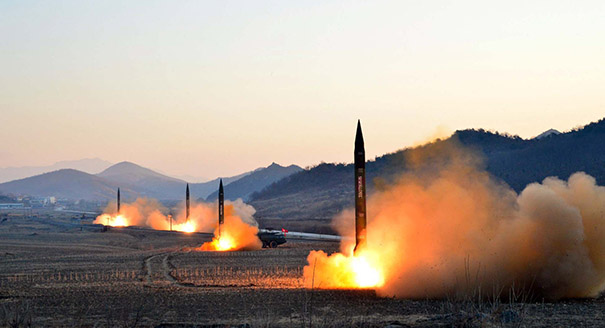
A new nuclear state, in a major crisis with a conventionally superior nuclear-armed adversary, contemplates and prepares to move nuclear assets in the event it has to use them. Who controls the nuclear forces? Who decides when they might be assembled, mated to delivery vehicles, moved, and launched? Who has nominal authority to order those decisions? Who has the physical ability to implement them even without proper authorization? How experienced are the relevant units in these operations? What could go wrong?

These were the questions that bedeviled Pakistan in the 1999 Kargil War and again in the 10-month standoff with India in 2001-2002. They are the same challenges and issues that confront North Korea today.

As the mountain of dust settles after North Korea’s purported thermonuclear bomb, intermediate-range ballistic missile, and intercontinental-range ballistic missile (ICBM) tests this summer and it becomes an increasingly operational nuclear state, one of the many deadly serious challenges it faces is how it manages its nuclear forces, or what command and control arrangement it erects. These arrangements are the transmission belt that makes a state’s nuclear strategy operational — how and when nuclear weapons are managed and might actually be employed. As a nuclear weapons power, North Korea now has to think about how precisely it wants to implement its “asymmetric escalation” strategy. And so does the United States, since these arrangements have very real implications for when nuclear weapons might be used intentionally — or unintentionally — in a conflict.

This article was originally published in War on the Rocks

Read the article

About the Authors

Vipin Narang

Former Nonresident Scholar, Nuclear Policy Program

Vipin Narang was a nonresident scholar in the Nuclear Policy Program at the Carnegie Endowment for International Peace.

Ankit Panda

Stanton Senior Fellow in the Nuclear Policy Program at the Carnegie Endowment for International Peace

Ankit Panda is the Stanton Senior Fellow in the Nuclear Policy Program at the Carnegie Endowment for International Peace.

Authors

Vipin Narang
Former Nonresident Scholar, Nuclear Policy Program
Ankit Panda
Stanton Senior Fellow in the Nuclear Policy Program at the Carnegie Endowment for International Peace
Ankit Panda
Nuclear PolicyEast AsiaNorth Korea

Carnegie does not take institutional positions on public policy issues; the views represented herein are those of the author(s) and do not necessarily reflect the views of Carnegie, its staff, or its trustees.

More Work from Carnegie Endowment for International Peace

  • Commentary
    Diwan
    Corrupted by Absolute Power

    In an interview, Marc Lynch discusses his new book decrying the post-1990 U.S.-dominated order in the Middle East.

      Michael Young

  • people looking at damage
    Commentary
    Emissary
    Two Wars Later, Iran’s Nuclear Question Is Still on the Table

    Tehran may conclude that its ability to disrupt the global economy via the Strait of Hormuz provides enough deterrence to begin quietly rebuilding its nuclear program.

      • Jane Darby Menton
      • Mohammad Ayatollahi Tabaar

      Jane Darby Menton, Mohammad Ayatollahi Tabaar

  • Commentary
    Carnegie Politika
    Could the Iran War Push Japan to Restore Russian Oil Imports?

    Tokyo would have to surmount a lot of obstacles—not least Western sanctions—if it wanted to return Russian oil imports to even modest pre-2022 volumes.

      Vladislav Pashchenko

  • Aerial view of Chernobyl damage
    Commentary
    Emissary
    Chernobyl Is Still a Current Event, Forty Years Later

    The 1986 incident showed that a nuclear accident anytime is a nuclear accident for all time.

      Corey Hinderstein

  • Article
    From Labor Scarcity to AI Society: Governing Productivity in East Asia

    The debate over AI and work too often centers on displacement. Facing aging populations and shrinking workforces, East Asian policymakers view AI not as a threat, but as a cross-sectoral workforce strategy.

      Darcie Draudt-Véjares, Sophie Zhuang

Get more news and analysis from
Carnegie Endowment for International Peace
Carnegie global logo, stacked
1779 Massachusetts Avenue NWWashington, DC, 20036-2103Phone: 202 483 7600
  • Research
  • Emissary
  • About
  • Experts
  • Donate
  • Programs
  • Events
  • Blogs
  • Podcasts
  • Contact
  • Annual Reports
  • Careers
  • Privacy
  • For Media
  • Government Resources
Get more news and analysis from
Carnegie Endowment for International Peace
© 2026 Carnegie Endowment for International Peace. All rights reserved.