

Q&A
Darshana M. Baruah, Satyendra Prasad, Denghua Zhang
{
  "authors": [
    "Darshana M. Baruah"
  ],
  "type": "legacyinthemedia",
  "centerAffiliationAll": "",
  "centers": [
    "Carnegie Endowment for International Peace",
    "Carnegie China",
    "Carnegie India"
  ],
  "collections": [],
  "englishNewsletterAll": "",
  "nonEnglishNewsletterAll": "",
  "primaryCenter": "Carnegie India",
  "programAffiliation": "",
  "programs": [],
  "projects": [],
  "regions": [
    "Asia",
    "South Asia",
    "India",
    "East Asia",
    "Japan"
  ],
  "topics": [
    "Foreign Policy"
  ]
}
Source: Getty
While New Delhi and Tokyo realize their limitations in competing with China-led initiatives, there is an unmatched intent and willingness in the Indo-Japanese relationship to collaborate on new areas across the region.
Source: Livemint
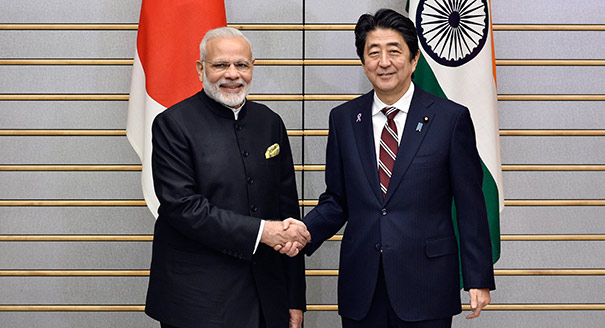
The India-Japan relationship is rapidly gathering momentum, taking shape faster than any of New Delhi’s current strategic partnerships. The 2017 annual summit on 13-14 September highlighted the strategic underpinnings of this partnership. While developments in the relationship led by Prime Ministers Shinzō Abe and Narendra Modi continue to be rapid, the partnership post the 2016 summit began to take a bolder tone and approach to the changing security environment. Japan and India, today are beginning to outline a framework to shape and lead the region.
From discussing the importance of a rules-based order, New Delhi and Tokyo today are outlining their “central role in such a rules-based order”. Speaking at an India-Japan colloquium just a few days before Abe’s visit to India, foreign secretary S. Jaishankar provided a significant insight into the future of this relationship. He noted, “Today, the two countries clearly see each other much more strategically (the relationship before Modi and Abe was primarily economically dominated)... realize the importance of shaping Asia’s architecture promoting its growth, development, and stability.” Underlining the importance attached to this relationship, he continued, “From just comparing notes, we have now moved on to explore the possibilities of collaborating on projects in third countries... The agenda for India-Japan relations has elements today that could not have been contemplated some years ago.” There is no overstating the comfort and trust in the India-Japan relationship. New Delhi has discussed and ventured into collaborations with Tokyo on areas that are new and sensitive.
A foundational pillar of this relationship is connectivity. New Delhi is perhaps one of the sharpest and loudest critics of China’s Belt and Road Initiative. Japan was the first country to come out in India’s support during the Doklam standoff. The trust and support in the relationship is advancing this strategic partnership into a new avenue.
Apart from development on the domestic front, such as the inauguration of the Ahmedabad-Mumbai high-speed rail project, India and Japan are now projecting this partnership at a regional level, beginning in South Asia, expanding into the Indian Ocean and onwards to Africa. Where India struggled to meet its domestic requirements on infrastructure development, it is now outlining regional strategic connectivity and infrastructure investments in partnership with Japan.
Abe in August 2016 had talked about a “free and open Indo-Pacific strategy” in Kenya. The joint statement post the 2016 annual summit in November the same year laid the ground for a broad Indo-Japanese vision for the Indo-Pacific. The two leaders discussed the strategy and announced their intention to build a maritime corridor connecting Asia and Africa. The idea was simple: to provide seamless connectivity between the two continents with immense infrastructure and commercial potential. The pace of developments since these announcements have been rapid and significant given the technicalities in bureaucratic negotiations. The idea to build a sea corridor resulted in the “Asia-Africa Growth Corridor” in May this year, a week after India refused to join China’s Belt and Road Forum.
The 2016 summit also saw the leaders underlining their intent to enhance connectivity in northeast India, develop “smart islands” and joint collaboration in the port of Chabahar. The 2017 summit significantly advanced their initiative to develop the northeast which shares international borders with China, Bangladesh and Myanmar, with a territory contested by China (Arunachal Pradesh).
While the idea of building smart islands is interpreted as developing India’s sensitive Andaman and Nicobar Islands, any real commitments are yet to be seen. The 2017 summit though reinforces Indo-Japanese commitment for developing smart islands to boost connectivity. However, if Indo-Japanese collaborations in the northeast is any sign, Tokyo would perhaps be New Delhi’s first preference should India decide to engage a foreign partner.
The Japanese ambassador to India, Kenji Hiramatsu, travelled to the northeastern state of Manipur in May with 38 Japanese companies in India, urging them to invest in the region. It was the first visit by a Japanese ambassador to the region on the commemoration of the 73rd anniversary of the Battle of Imphal, World War II, where the Japanese army fought the Allied forces in 1944. In August, New Delhi and Tokyo took a step forward with the launch of the “Japan-India Coordination Forum for Development of Northeastern Region”. This is perhaps the only dedicated forum between India and a foreign government on the development of the northeast—a region that physically connects India to southeast Asia. India’s decision to engage Japan in the northeast underlines New Delhi’s pragmatism and a shift toward a bolder foreign policy engagement.
There is unmatched intent and willingness in the Indo-Japanese relationship to collaborate on new areas and across the region. New Delhi and Tokyo realize their limitations in competing with China-led initiatives. However, Beijing’s assertive behaviour, both at sea and its continental border with India, created a platform for deeper collaboration between India and its partners. New Delhi and Japan realized the need to act on the changing security dynamics to secure their interests and strategic ambitions. Instead of competing with China’s ambitious commercial activities backed by unrivalled capital, India and Japan began creating an alternative narrative—aiming at stabilizing the region in times of uncertainty. Having outlined the vision and intent, New Delhi and Tokyo will now have to consolidate their economic engagements and expand strategic partnership with specific projects, goals and deliverables.
The key will be in maintaining the steam in this relationship. The bureaucracy on both sides will have to tap into this political will to implement and realize the initiatives that have been laid out. The partnership must identify infrastructure projects in countries like Sri Lanka, Myanmar and Bangladesh in the Bay of Bengal. India and Japan also share a regional view in the Indian Ocean and beyond. New Delhi and Tokyo must also deepen their trilateral relationships with the US, Australia and France to shape the security architecture consistent with their vision and goals.

Former Nonresident Scholar, South Asia Program
Darshana M. Baruah was a nonresident scholar with the South Asia Program at the Carnegie Endowment for International Peace where she directs the Indian Ocean Initiative.
Recent Work

Darshana M. Baruah, Satyendra Prasad, Denghua Zhang
Darshana M. Baruah
Carnegie does not take institutional positions on public policy issues; the views represented herein are those of the author(s) and do not necessarily reflect the views of Carnegie, its staff, or its trustees.

The United States ignores the region’s lived experience—and the tough political and social trade-offs the war has produced—at its peril.

Evan A. Feigenbaum

The GDP measure is an attempt to measure value creation in an economy. This measure, however, can vary greatly between economies that have disciplinary mechanisms that force them to recognize investment losses quickly and economies that don’t, and can postpone this recognition for many years.

Michael Pettis
Neither the Abraham Accords nor the presence of large U.S. bases are enough to protect Arab Gulf states.

Marwan Muasher
Not only does the fighting jeopardize regional security, it undermines Russian attempts to promote alternatives to the Western-dominated world order.

Ruslan Suleymanov

The U.S.-sponsored TRIPP deal is driving the Armenia-Azerbaijan peace process forward. But foreign and domestic hurdles remain before connectivity and economic interdependence can open up the South Caucasus.



Thomas de Waal, Areg Kochinyan, Zaur Shiriyev