

Paper
James M. Acton, Ankit Panda
{
  "authors": [
    "James M. Acton"
  ],
  "type": "legacyinthemedia",
  "centerAffiliationAll": "dc",
  "centers": [
    "Carnegie Endowment for International Peace",
    "Carnegie Russia Eurasia Center"
  ],
  "collections": [
    "Korean Peninsula"
  ],
  "englishNewsletterAll": "ctw",
  "nonEnglishNewsletterAll": "",
  "primaryCenter": "Carnegie Endowment for International Peace",
  "programAffiliation": "NPP",
  "programs": [
    "Nuclear Policy"
  ],
  "projects": [],
  "regions": [
    "East Asia",
    "North Korea"
  ],
  "topics": [
    "Nuclear Policy"
  ]
}
Source: Getty
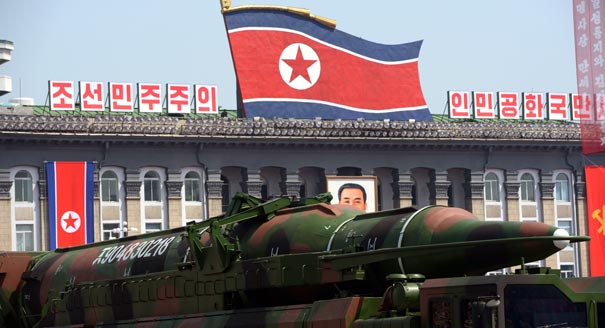
Deterring North Korea is less risky than a preventative war.
Source: Diplomat
War between the United States and North Korea has begun to seem like a real possibility. Within hours of the Sunday, September 3 test of what Pyongyang claimed was a thermonuclear weapon, President Donald Trump tweeted that the North Koreans “only understand one thing.” The next day, his ambassador to the United Nations, Nikki Haley, claimed that North Korea’s leader, Kim Jong-un, was “begging for war.” Then on Thursday, Trump described military action – using “new and beautiful equipment, the best in the world” – as “something certainly that could happen.”
The Trump administration seems to be considering military action because it appears to recognize that there is now little chance of denuclearizing North Korea and is concerned that “North Korea might not be able to be deterred.” But it is focused on the wrong question. The right question is not whether North Korea can be deterred, but rather how the risks of trying to do so compare to the risks of the alternative – a preventative war. When these risks are weighed up, deterrence turns out to be the less dangerous option.
Military action would run the risk of nuclear strikes against U.S. bases in South Korea, Japan, and Guam, as well as American cities. The U.S. intelligence community has reportedly assessed that North Korea is now capable of fitting a nuclear warhead onto a ballistic missile. Launching military action in the hope that Kim did not yet have a functioning nuclear arsenal would be insanity.
This article was originally published in the Diplomat.

Jessica T. Mathews Chair, Co-director, Nuclear Policy Program
Acton holds the Jessica T. Mathews Chair and is co-director of the Nuclear Policy Program at the Carnegie Endowment for International Peace.
Recent Work

James M. Acton, Ankit Panda
James M. Acton
Carnegie does not take institutional positions on public policy issues; the views represented herein are those of the author(s) and do not necessarily reflect the views of Carnegie, its staff, or its trustees.

The nuclear relationship between China and the United States is increasingly shaped by widening perception gaps rather than deliberate strategic design.

Tong Zhao

A look at why states without nuclear weapons are seeking naval nuclear propulsion, whether they can legally and technically deliver it, what it will cost them, and what responsible stewardship of the capability would look like.

Jamie Kwong

U.S. trading partners in Asia are closely watching the dispute for signs of how it may affect their own interests.

Barbara Weisel
Congress should ask tough questions about the agreement’s more unique features and whether they advance U.S. interests or compromise them.

Jane Darby Menton
Nuclear and maritime communities face a long and challenging journey to deploy commercial nuclear applications at sea.

Jamie Kwong, Toby Dalton