

Research
- +4
Milan Vaishnav, Rahul Verma, Rukmini S., …
{
  "authors": [
    "Christophe Jaffrelot"
  ],
  "type": "legacyinthemedia",
  "centerAffiliationAll": "dc",
  "centers": [
    "Carnegie Endowment for International Peace"
  ],
  "collections": [],
  "englishNewsletterAll": "ctw",
  "nonEnglishNewsletterAll": "",
  "primaryCenter": "Carnegie Endowment for International Peace",
  "programAffiliation": "SAP",
  "programs": [
    "South Asia"
  ],
  "projects": [],
  "regions": [
    "South Asia",
    "India"
  ],
  "topics": [
    "Economy"
  ]
}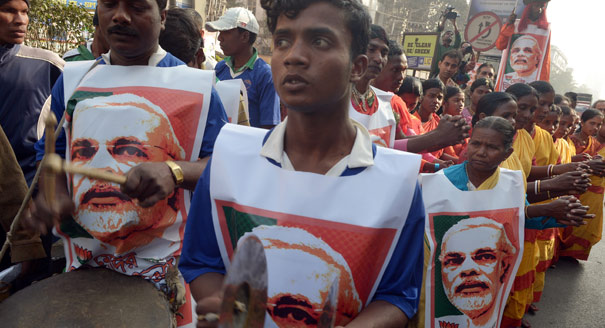
Source: Getty
The “Gujarat model” of investment—characterized by efforts to generate growth by attracting investors—has failed to turn investment into jobs. This economic failure may have implications for the BJP’s continued dominance in the state.
Source: Indian Express
For the first time since 2002, the BJP’s supporters, including the Patels, have criticised the party’s rule in Gujarat because of its economic performance. The urban youth resent that the number of educated-unemployed — 6.12 lakh in 2016 — has increased and the farmers argue that their daily income — Rs 264 in 2016 — is Rs 77 less than the national average.
This attitude has been precipitated by the impact of demonetisation and GST but it is also the legacy of policies harking back to the early days of BJP rule in the state, which were designed for big corporate houses. The industrial policy of 2003 is a case in point. A large number of industries were exempted from obtaining no-objection certificates from the Pollution Control Board and the release of agricultural land for industrial use was made easier.
In 2004, the state assembly passed the Gujarat Special Economic Zones Act that made land acquisition easier and labour laws less strict. Five years later, the Gujarat Special Investment Region Act was passed to promote “mega projects”. Gujarat’s Industrial Policy of 2009 was designed to make the state “the most attractive investment destination not only in India but also in the world”.
The Gujarat Industrial Development Corporation (GIDC) gave land to industrial units on 99-year leases and created more SEZs. In 1990-2001 it had acquired 4,620 hectares (ha), this figure rose to 21,308 ha between 2001 and 2011 — at times, at the expense of the state’s agricultural capabilities. Land was usually sold to industrialists at less than the market price.
To attract big investors, the Gujarat government also gave them significant concessions in terms of fiscal subsidies. Sales tax incentives, and deferment, Rs 1,253.56 crore per year between 1990-1991 and 1999-2000, jumped by almost five times during the period from 2000-2001 to 2006-2007 — they amounted to Rs 5,966.72 crore per year. Tata Motors’ Nano plant benefited from such tax deductions, in addition to a soft loan and land at a price lower than the market value.
Gujarat became very popular among Indian businessmen in the early years of the 2000s. The Adani Port and SEZ was developed on 3,585 ha of land in Mundra — it became India’s number one private port. Reliance developed a petroleum refinery with a capacity of 27 million metric tonnes per annum — over the years, this expanded to 62 million tons per annum. Essar also set up a steel plant of 11 million tonnes per annum capacity.
These investments meant that Gujarat was behind only Maharashtra and Haryana in terms of state domestic product (if one does not consider city-states like Delhi). But these investments did not create many jobs. The petrochemical industry and the chemical industry are cases in point. These sectors generate 34 per cent and 15 per cent of Gujarat’s industrial output, but are not labour-intensive.
Manufacturing is more labour-intensive, but automatisation is gaining momentum in the large factories. For instance, for an investment of Rs 2,900 crore, the Nano plant never had more than 2,200 employees — in other words, a ratio of more than Rs 1.3 crore per job created directly.
In 2013, Gujarat’s industry represented 17.7 per cent of India’s fixed capital but only 9.8 per cent of the factory jobs in the country, whereas industry in Tamil Nadu — a small and medium enterprise-oriented state — represented 9.8 per cent of the country’s fixed capital but 16 per cent of its factory jobs.
This is partly due to the crisis of the Gujarati SMEs which are four times more labour-intensive, on an average, than the big companies. The share of the MSMEs (micro, small and medium enterprises) credit as a percentage of the gross bank credit has declined from 12.98 per cent in 1997-98 to 6.34 per cent in 2006-07. It did rise to touch 10 per cent in 2009-10, but that isn’t sufficient.
The financial turmoil, partly caused by a crisis in the district cooperative banks, jeopardised the future of many MSMEs. According to the Union Ministry of MSMEs, the number of sick units has jumped from 4,321 in 2010-11 to 20,615 in 2012-13 and 49,382 in 2014-15. Between 2004 and 2014, 60,000 MSMEs shut down in Gujarat.
Moreover, formal employment has remained almost stagnant (+0.3 per cent) between 1999-2000 and 2009-2010. In contrast, informal employment has increased by 4 per cent — which, too, is not sufficient to cope with the demand.
According to the National Sample Survey (NSS), in 2009-10, the informal sector represented 84.1 per cent of the work-force in Gujarat. This informalisation is in sync with the stagnation of wages in the state. One reason for industrialists investing in Gujarat is the low level of wages in the state. According to the 2011 NSS report, Gujarat has the third lowest average daily wages for casual labourers in urban areas.
While the Gujarat government gave several fiscal exemptions to industrialists, many companies did not pay taxes. As a result, the state’s fiscal liabilities have increased, making Gujarat one of India’s most indebted states. The lack of resources partly explains the low level of social expenditure in Gujarat. Between 2001-2002 and 2012-2013, Gujarat spent 13.22 per cent of its budget on education — the national average was slightly above 15 per cent. It did little better in so far as public health was concerned.
With 4.2 per cent of its budget devoted to health-related expenditure, Gujarat ranked seventh out of 17 large states in 2010-11. But Gujarat lags behind states like Tamil Nadu with respect to vaccination, infant mortality rate, child undernourishment and literacy. These are symptoms of rising inequalities between caste groups as well within them (see ‘Alienation of the Patels’, IE, October 25)
The “Gujarat model” has, therefore, been characterised by attempts at attracting big investors who generate growth but few jobs (and even fewer good jobs), at the expense of the exchequer. It is also characterised by disappointing social indicators reflecting comparatively low social expenditures. But 40 to 50 per cent of the Gujaratis kept voting for the BJP over the past 15 years anyway — for other reasons. Will they continue to do so?
This article was originally published in the Indian Express.
Former Nonresident Scholar, South Asia Program
Jaffrelot’s core research focuses on theories of nationalism and democracy, mobilization of the lower castes and Dalits (ex-untouchables) in India, the Hindu nationalist movement, and ethnic conflicts in Pakistan.
Recent Work


Milan Vaishnav, Rahul Verma, Rukmini S., …
Christophe Jaffrelot
Carnegie does not take institutional positions on public policy issues; the views represented herein are those of the author(s) and do not necessarily reflect the views of Carnegie, its staff, or its trustees.

The domestic impacts of how long it is taking to end the war in Ukraine have pushed the French electorate to the political extremes and compromised the country’s diplomatic capacity.

Rym Momtaz

A deep dive into the policy ecosystems behind battery development in China, South Korea, Japan, the European Union (including some of its member states), the United States, Canada, and India.



Milo McBride, Herbert Crowther, Darcie Draudt-Véjares, …

The Plaza Accord was not an externally imposed punishment of Japan but part of a broader restructuring that Japanese economists and policymakers themselves recognized was necessary. Its effects were undermined, however, when Tokyo responded to the resulting slowdown with policies that exacerbated investment, credit expansion, and the very imbalances the adjustment was intended to resolve.

Michael Pettis

A summer of escalation in the Black Sea has hurt Ukraine economically and is exacerbating world food security. A truce is needed—as is a broader reframing of Europe’s Ukraine strategy.

Thomas de Waal

The Bureau of Industry and Security needs to adjust its focus and practices to maintain its position as the U.S. government’s primary champion of international technological competition.

Geoffrey Irving