

Commentary
Trump has promised Belarus a massive potash deal. But Minsk is seeking something greater: restored Western transit and greater room for maneuver from Russia.
Balázs Jarábik
{
  "authors": [
    "Richard Sokolsky",
    "Aaron David Miller"
  ],
  "type": "legacyinthemedia",
  "centerAffiliationAll": "",
  "centers": [
    "Carnegie Endowment for International Peace",
    "Malcolm H. Kerr Carnegie Middle East Center"
  ],
  "collections": [],
  "englishNewsletterAll": "",
  "nonEnglishNewsletterAll": "",
  "primaryCenter": "Carnegie Endowment for International Peace",
  "programAffiliation": "",
  "programs": [],
  "projects": [],
  "regions": [
    "North America",
    "United States",
    "Middle East",
    "Iran"
  ],
  "topics": [
    "Foreign Policy"
  ]
}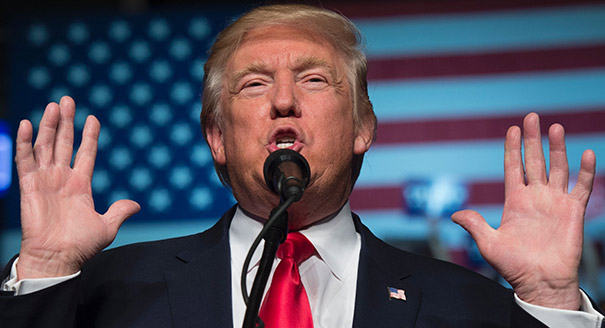
Source: Getty
When it comes to Iran, Donald Trump’s foreign policy looks like a scene out of Robert Louis Stevenson’s The Strange Case of Dr. Jekyll and Mr. Hyde.
Source: Real Clear World
When it comes to Iran, Donald Trump’s foreign policy looks like a scene out of Robert Louis Stevenson’s The Strange Case of Dr. Jekyll and Mr. Hyde.
Driven by domestic politics, Trump very much wants to be the un-Obama. He projects himself as tough, muscular and risk-ready -- the polar opposite of his predecessor, whom he and much of his base believe to be Satan’s finger on earth.
Yet over the last year, due to pressure from his advisers and to his own risk-aversion, Trump’s actions against Iran have not matched his tough words. Indeed, this is one example where the gap between his blustery rhetoric and his restraint and prudence actually serves U.S. interests. We’re betting that his approach to Iran continues to reflect this tension; and while he toughens up sanctions and tries to work with Congress to do the same, Trump will stick with the deal on Tehran’s nuclear program -- at least for now.
When it comes to talking about Iran, Trump is Obama’s very opposite. While the Obama administration negotiated the Joint Comprehensive Plan of Action with Iran and the so-called P5+1 group, former Secretary of State John Kerry developed a channel of communication with his Iranian counterpart. Obama subordinated the toughness of his approach to Iran’s regional and domestic policies to the need to seal the nuclear agreement, and he remained largely silent in response to the so-called Green Revolution in Iran in 2009. By contrast, Trump has lacerated the nuclear agreement, calling it “an embarrassment to our country" and “one of the worst and most one-sided transactions the United States has ever entered into." He boasted incessantly on the campaign trail that he would have negotiated a much better deal. He treats Iranian officials with the greatest disdain, and the regime as evil incarnate. In his September speech at the U.N. General Assembly, Trump publicly excoriated Iran as a “murderous regime,” and after branding it a “corrupt dictatorship,” he called on the entire world to “join us in demanding that Iran end its pursuit of death and destruction.” In a tweet responding to the recent protests in Iran, Trump claimed that the mullahs in Tehran were “failing at every level” and declared that it was time to change the regime. There may have been officials in the Obama administration who shared these views privately, but when it came to talking publicly about Iran they all stayed on message.
Despite all of Trump’s vows to toughen up U.S. Iran policy, his actions reflect indecision, hesitation, and a good deal of caution. Indeed, in the three areas that constitute U.S. policy toward Iran -- what to do about its repressive human rights behavior, its aggressive policies in the region, and the nuclear agreement -- Trump has been much more risk-averse than risk-ready.
To be sure, he has imposed more sanctions, tried unsuccessfully to marshal European support to join him, and ramped up support for a disastrous Saudi campaign against the Iran-backed Houthis in Yemen. Much more consequential, though, is what Trump hasn’t done. He has in effect colored within the lines set by his predecessors. In response to the recent protests, he has certainly spoken out earlier and more loudly than his predecessor did. But he has avoided sustained calls for regime change and urging demonstrators out into the streets. The Trump administration has talked about rolling back Iran’s expansionist designs in the region, and yet in Syria, Iraq, and Lebanon there’s been more acceptance than pushback. The idea that the anti-ISIS campaign would morph into an anti-Assad or anti-Putin effort in Syria has remained a thought experiment. And with regard to the JCPOA itself, Trump chose not to certify one element last October, but willfully decided in major speech to the nation to stay in the agreement.
The reasons for the split persona on Iran seem pretty clear. The adviser he respects above all others, Secretary of Defense James Mattis, has argued for restraint when it comes to the JCPOA. The other advisers, Chairman of the Joint Chiefs of Staff Joseph Dunford, Secretary of State Rex Tillerson, and National Security Adviser H.R. McMaster, have argued along the same lines, both in public and privately to the president. And while a Republican-controlled Congress and more than a few Democrats have no love for the accord or for the Iranian regime, key voices on both sides of the aisle have reinforced the advice of the national security team.
Second, the Iran issue never resonated with the Trump base as other issues such as immigration, the proposed border wall, and trade deals that in Trump’s view have ripped off American workers. But polls consistently show that most Americans continue to support the United States remaining in the nuclear deal with Iran.
Finally, when it comes to the actual use of military force in Syria, Trump has acted with restraint. He has not made new commitments to end the Assad regime and to expunge Iran’s influence and its proxy forces from the region. As a general rule, driven perhaps by his America First outlook, Trump has avoided getting the United States into new wars and military conflicts and has avoided interference in other countries' civil wars and nation-building efforts.
Presidents ought to say what they mean and mean what they say. If they don’t, U.S. credibility can suffer badly. There are clear disadvantages when Trump’s rhetoric on Iran exceeds his willingness and capacity to act -- among other things it may create unrealistic expectations of U.S. policy that influence the policies and actions of other countries. Nonetheless, if bluster is required as a safety valve to blow off steam or cater to his base, so be it. Let Trump play at being the un-Obama in his speeches, so long as his actions toward Iran further U.S. interests. For now, that means staying with the nuclear agreement so long as Iran does, challenging Iran when it undermines U.S. goals, and cooperating with Tehran when its interests align with our own.
Nonresident Senior Fellow, Russia and Eurasia Program
Richard Sokolsky is a nonresident senior fellow in Carnegie’s Russia and Eurasia Program. His work focuses on U.S. policy toward Russia in the wake of the Ukraine crisis.

Senior Fellow, American Statecraft Program
Aaron David Miller is a senior fellow at the Carnegie Endowment for International Peace, focusing on U.S. foreign policy.
Carnegie does not take institutional positions on public policy issues; the views represented herein are those of the author(s) and do not necessarily reflect the views of Carnegie, its staff, or its trustees.

Trump has promised Belarus a massive potash deal. But Minsk is seeking something greater: restored Western transit and greater room for maneuver from Russia.

Balázs Jarábik

The real test may come after the leaders leave the room.



Sheena Chestnut Greitens, Oriana Skylar Mastro, Yukon Huang, …

The Horn of Africa countries are among those facing a new security calculus.


Andrew Leber, Lesley Anne Warner

The new U.S.–Denmark–Greenland agreement will help Washington exert political, economic, and financial dominance under the guise of security. Yet, it acknowledged Copenhagen’s and Nuuk’s sovereignty on the island.

Marc Pierini

The nuclear relationship between China and the United States is increasingly shaped by widening perception gaps rather than deliberate strategic design.

Tong Zhao