

Commentary
The Bureau of Industry and Security needs to adjust its focus and practices to maintain its position as the U.S. government’s primary champion of international technological competition.
Geoffrey Irving
{
  "authors": [
    "Alexander Dunaev"
  ],
  "type": "commentary",
  "centerAffiliationAll": "",
  "centers": [
    "Carnegie Endowment for International Peace",
    "Carnegie Russia Eurasia Center"
  ],
  "collections": [],
  "englishNewsletterAll": "",
  "nonEnglishNewsletterAll": "",
  "primaryCenter": "Carnegie Russia Eurasia Center",
  "programAffiliation": "",
  "programs": [],
  "projects": [],
  "regions": [],
  "topics": [
    "Economy"
  ]
}
Source: Getty
Virtually all of Italy’s political forces want to increase cooperation with Russia. But the Kremlin would be unwise to read too much into this. Rome values preserving mutual understanding with the European Union and the United States over advocating for lifting sanctions. A positive relationship with Italy is an important asset for Russian foreign policy, but it isn’t a game-changer.
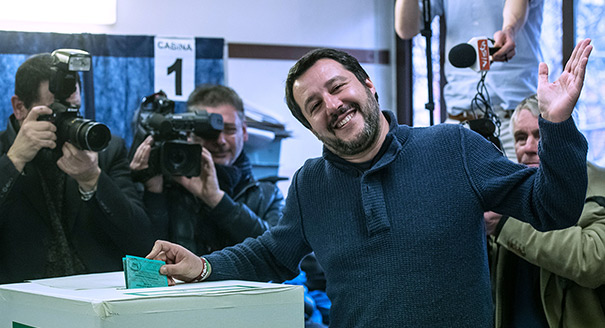
They called it “a triumph of chaos” and “a landmark upheaval.” The results of the parliamentary elections in Italy surprised and even scared many. The familiar pendular system—in which coalitions of parties from the right and the left take turns in power—has now collapsed.
The populist Five Star Movement came in first place, pulling off a conclusive victory in Italy’s south. And the Northern League surprised many by surpassing former prime minister Silvio Berlusconi’s Forza Italia!—its coalition ally—and achieving impressive results in the north.
In contrast, Italian media have described the incumbent Democratic Party’s results as a “train wreck.” It received far fewer votes than expected from pre-election surveys, and its coalition allies’ results fell within the margin of error. Matteo Renzi has already announced that he is retiring from his post as party chair and heading off to ski.
Now, arduous negotiations to form a coalition cabinet begin. But regardless of who emerges victorious in this struggle, the situation looks like an all-around win for Moscow: all of the parties take a sympathetic view of Russia.
However the Kremlin should not overestimate Italian affinity for Russia. It has its limits, and Italian politicians face more critical concerns than building ties with Moscow or sanctions relief.
On the surface, we see Italy’s positive attitude toward Russia in the behavior of its leading politicians. Silvio Berlusconi is an old friend of Russian President Vladimir Putin, with whom he regularly socializes. During his time as prime minister, Matteo Renzi met with Putin on multiple occasions and became one of the only G7 leaders to visit the St. Petersburg Economic Forum in 2016.
The Northern League’s Salvini openly laments that Italy does not have its own Putin (and maybe dreams of playing the part). He often visits Moscow, meets with high-ranking Russian officials, and one year ago he even signed a collaboration agreement with the ruling United Russia party. Based on this, local media claim that Salvini is financed by the Russian government. And the Atlantic Council has even added the Northern League to its list of the Kremlin’s Trojan Horses in Italy. The think tank put Five Star leader Beppe Grillo in the same group, as he also supports lifting sanctions and delegations from his movement have been frequent guests in Moscow since 2016.
But, in truth, all major Italian parties would like to lift the sanctions. Italy, which is the fifth most important importer in Russia (and second from the EU after Germany), was hurt by the sanctions, possibly more than anyone else. Italian exports to Russia in 2015 fell by one-third compared to the pre-sanctions levels of 2013. The north was hit particularly hard. And the 2014 abandonment of South Stream came as another major setback: 20 percent of the gas pipeline project belonged to Italian company Eni.
Italian entrepreneurs estimate that, by the middle of 2017, they had lost 10 billion euros and thousands of jobs to the EU’s “schizophrenia.” In the last year, trade turnover began to recover, but has not yet reached its former glory.
Sanctions are also a problem because Italy remains politically set on cooperation, not confrontation, with Russia. The Italian Foreign Ministry reckons the Russian authorities went a tad far with the Crimea annexation, but open dialogue on a wide spectrum of issues must still be maintained. And collaboration is required to solve key international challenges—first and foremost, terrorism. Ministers of both countries hold meetings practically every month. Last May, Prime Minister Paolo Gentiloni even visited Sochi and promised to communicate Russia’s position on key international issues to the G7, whose members were meeting several days later in Taormina.
Rome doesn’t see a military threat in Russia, and spends under 1.4 percent of its GDP on defense—less than in 2013, and visibly lower than the notorious NATO 2 percent. Discussions of all-powerful Russian hackers and bots are met with indifference, despite periodic warnings from across the ocean.
Former U.S. vice president Joe Biden claimed that the Russians tried to influence the 2016 referendum, which lost Matteo Renzi his prime minister’s seat. And U.S. Democratic Senator Ben Cardin warned that the Kremlin might interfere in the March elections. However, Italian intelligence agencies claimed that Biden’s statement had no basis in fact.
Thus, on the surface, all the conditions appear right for Italy to join the fight to lift sanctions on Russia. Businessmen and politicians want this. Ordinary Italians relate favorably to Russia. Surveys show that over half of Italians support sanctions relief, and three-fourths are convinced Italy must cooperate with Russia in the fight against global terrorism.
Most Italian parties stress the importance of developing relations with Russia. Forza, Italia! has criticized the sanctions and believes it is necessary to cooperate with Moscow on the global stage. The Five Star Movement speaks of Russia’s important role in the international arena and of the harm that anti-Russian sanctions have done to Italy, promising to lift them after coming to power. The Northern League goes so far as to assert that Russia should be perceived as a partner, not a threat, because it is part of Western civilization and will help defend its values.
This all sounds promising, but there are serious caveats.
First, Italian politicians frequently talk about lowering the tax burden, aid for families and workers, pensions, migrants, and whether Italy needs more or less of Europe. By comparison, foreign policy—especially regarding Russia—is not a priority.
Second, few in Italy believe the sanctions can be overcome so long as Europe wants to maintain them. Although Italy is Europe’s third largest economy and a G7 member, it has less political weight than the pro-sanctions camp, in which the key players are Berlin and Brussels.
And Rome understands not to cross these two centers of European power. In 2011, Berlusconi learned this the hard way. He attempted to avoid harsh budgetary measures demanded by the “big three”—the European Commission, the European Central Bank (ECB), and the International Monetary Fund. In response, then chairman of the ECB Jean-Claude Trishe, president of the European Council Herman Van Rompuy, and commissioner of finance Olli Ren simply gave Italy an ultimatum.
Berlusconi had enough wile to last three months, but in November of 2011 he unexpectedly lost the support of the majority of the deputies and was forced to retire. His technical replacement, Prime Minister Mario Monti—a previous member of the European Commission—did everything Brussels wanted. His successors Enrico Letta, Matteo Renzi, and Paolo Gentiloni have continued this practice.
The country’s administration, which has learned from Berlusconi’s unfortunate experience, prefers to avoid conflicts with European powers. So, it won’t fight to lift sanctions on Russia—at least not so long as the EU heavyweights support the measures. The most Rome has done is oppose the automatic extension of sanctions and impede efforts to ratchet up pressure on Russia.
In essence, Italy supports Russia, but more in words than in actions. The rhetoric of Foreign Minister Angelino Alfano is telling. A year ago, he said that “we cannot not wish for Russia to return to the G8 and for an end to the Cold War atmosphere.” He also asserted: “We think that we can affect serious political pressure from within the EU” to facilitate a stronger relationship with Russia. The expressions “we cannot not wish” and “we think we can” are an excellent distillation of Rome’s positive but weak position on Moscow.
Even Italy’s most pro-Russia political forces—the Five Star Movement and the Northern League—make it clear that despite their rhetoric, lifting sanctions probably won’t be a priority. During his visit to Washington last summer, Five Star’s di Maio called the United States Italy’s most important ally. By contrast, he referred to Russia as only a “historical interlocutor.” The Northern League’s election materials stress that expanding connections with Russia should not be done to the detriment of relations with the United States.
A positive relationship with Rome is an important asset for Russian foreign policy. It can certainly be useful if Europe ever reevaluates its sanctions on Moscow. But there should be no illusions. Italy values its ties with Russia, but it values mutual understanding with key EU nations and the United States more. Italy won’t sacrifice that for the Kremlin, no matter who comes to power in Rome.
Alexander Dunaev
Carnegie does not take institutional positions on public policy issues; the views represented herein are those of the author(s) and do not necessarily reflect the views of Carnegie, its staff, or its trustees.

The Bureau of Industry and Security needs to adjust its focus and practices to maintain its position as the U.S. government’s primary champion of international technological competition.

Geoffrey Irving

Depleted financial reserves and a shrinking tax base mean it is no longer possible to simultaneously deliver high defense spending, price stability, and economic growth.

Alexandra Prokopenko

U.S. trading partners in Asia are closely watching the dispute for signs of how it may affect their own interests.

Barbara Weisel

Amid celebrations of bilateral ties was a deeper focus on stability in the Middle East.

Amr Hamzawy
Xi, Putin, and other regional leaders are back-slapping in Bishkek, but the SCO has yet to answer the most serious questions about continental Asia's economic future.

Evan A. Feigenbaum