

Commentary
U.S. trading partners in Asia are closely watching the dispute for signs of how it may affect their own interests.
Barbara Weisel
{
  "authors": [
    "Alyssa Ayres",
    "Michael Fuchs",
    "Dhruva Jaishankar",
    "Tom West"
  ],
  "type": "legacyinthemedia",
  "centerAffiliationAll": "dc",
  "centers": [
    "Carnegie Endowment for International Peace"
  ],
  "collections": [],
  "englishNewsletterAll": "ctw",
  "nonEnglishNewsletterAll": "",
  "primaryCenter": "Carnegie Endowment for International Peace",
  "programAffiliation": "SAP",
  "programs": [
    "South Asia"
  ],
  "projects": [],
  "regions": [
    "United States",
    "South Asia",
    "India"
  ],
  "topics": [
    "Security",
    "Military",
    "Foreign Policy"
  ]
}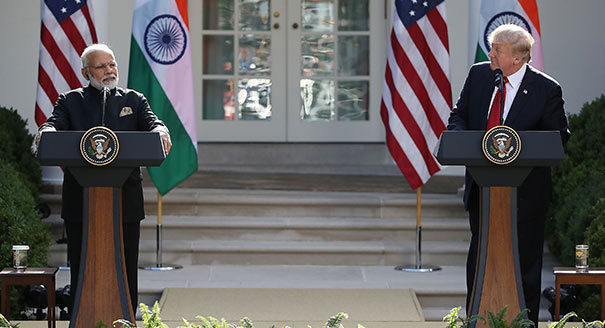
Source: Getty
The India-U.S. strategic partnership is still hobbled by parallel bureaucracies that do not yet move in sync. A few important steps could help advance security cooperation further.
Source: Times of India
The Indo-Pacific region is today the primary locus of global growth and opportunity, but its security and stability are increasingly under duress. China’s rise, while beneficial to international prosperity, has occurred in a manner that continues to generate mistrust and anxiety across the region – and the concerns are only growing. Beijing regularly attempts to consolidate its control of disputed seas, airspace, and land, in the South China Sea and in the Himalayas.
China also continues to flout established international norms of cyber security and non-proliferation, and its international economic policies are likely to leave many countries with unsustainable debt. Meanwhile in Pakistan and Afghanistan, Islamist terrorist organisations continue to destabilise the region and strike international targets, with little end in sight.
India and the US, as the world’s two largest democracies with two of the largest military forces, have a shared interest in ensuring a stable security order in the Indo-Pacific. This shared interest has propelled India-US security ties dramatically forward over the past decade.
Each has something important to offer the other. The US can greatly assist India’s capacity building efforts. India has the potential and willingness to shoulder regional security responsibilities, as evidenced by increased patrols in the Indian Ocean, aid to South Asia, and humanitarian assistance activities. But the India-US strategic partnership is still hobbled by parallel bureaucracies that do not yet move in sync. The US often seeks tangible short-term returns on its investment in India’s capabilities and success, while India wants continued assurances that US support will be neither fickle nor overbearing. A few important steps could help advance security cooperation further.
One, the US could – with Indian inputs – create a Strategic Advantage Initiative. Having designated India a Major Defence Partner, the US could develop an initiative with the explicit objective of enabling India to prevail in contested domains. This government-wide programme would ensure that all US agencies take the appropriate steps to enhance defence cooperation with India and that US commitments become ingrained in policy under future administrations. Among other steps, this could involve refining export licence regulations, offering India access to platforms and equipment that boost its maritime security capabilities, and creating joint mechanisms to identify specific capabilities necessary for various pressing security contingencies.
Two, the countries could better coordinate humanitarian assistance and disaster relief (HADR) operations in the Indian Ocean region, including planning and training. HADR is an area in which India has proven remarkably adept in recent years. Creating a joint India-US Indo-Pacific HADR cell might be one way of accomplishing this objective.
Three, for its part, India could create a more efficient and transparent defence procurement process. This would not only benefit India-US relations but also accelerate India’s self-reliance in defence and thereby improve its ability to effectively perform a range of security functions. Integration of international supply chains and joint defence R&D could help to achieve the vision of Make in India. Currently, despite the US having considerably eased the process for India to acquire sensitive military technologies, India’s procurement process and military industrial base often inhibit the absorption of these technologies.
Finally, India and the US could finalise a joint defence implementation agreement that facilitates information sharing, interoperability and capacity building efforts within the two countries’ comfort zones. This might encompass some long-pending bilateral defence agreements. Such an agreement could provide India disproportionate benefits, including better communications systems, access to more intelligence, and enhanced operational capabilities.
Considerable progress has been made in improving India-US strategic and security relations. Officials from the two countries talk more frankly on more issues than at any time in the past. Military exercises are frequent and defence commerce has increased significantly. But through a handful of key initiatives, India and the US can yet improve their ability to meet the increasingly pressing challenge of preserving stability across the Indo-Pacific.
Ayres is Senior Fellow at the Council on Foreign Relations, Fuchs is Senior Fellow at the Center for American Progress (CAP), Jaishankar is Fellow at Brookings India, and West is Nonresident Scholar at Carnegie Endowment. The writers are members of the CAP Task Force on US-India Relations from whose report this article is adapted
This article was originally published in the Times of India.

Alyssa Ayres
Council on Foreign Relations
Alyssa Ayres is dean of the Elliott School of International Affairs and professor of history and international affairs at George Washington University.
Michael Fuchs
Center for American Progress
Dhruva Jaishankar
Brookings India
Former Nonresident Scholar, South Asia Program
Tom West was a nonresident scholar in the South Asia Program at the Carnegie Endowment for International Peace and an associate vice president at the Cohen Group.
Carnegie does not take institutional positions on public policy issues; the views represented herein are those of the author(s) and do not necessarily reflect the views of Carnegie, its staff, or its trustees.
U.S. trading partners in Asia are closely watching the dispute for signs of how it may affect their own interests.

Barbara Weisel

The aftermath of the Ceuta crisis shows Europe has drawn the wrong lessons. Rather than doubling down on failed migration policies, the EU needs to address the underlying roots of such episodes.

Richard Youngs
By abandoning past U.S. pro-democracy policies and adopting several lines of pro-autocratic action, the Trump administration has fundamentally repositioned the United States vis-à-vis democracy in the world.

Thomas Carothers
Chinese strategists are once again debating whether American power is declining and whether U.S. hegemony is experiencing irreversible decay.
Wu Xinbo
Congress should ask tough questions about the agreement’s more unique features and whether they advance U.S. interests or compromise them.

Jane Darby Menton