

Commentary
Alexander Gabuev
{
  "authors": [
    "Alexander Gabuev"
  ],
  "type": "commentary",
  "centerAffiliationAll": "",
  "centers": [
    "Carnegie Endowment for International Peace",
    "Carnegie Russia Eurasia Center"
  ],
  "collections": [],
  "englishNewsletterAll": "",
  "nonEnglishNewsletterAll": "",
  "primaryCenter": "Carnegie Endowment for International Peace",
  "programAffiliation": "",
  "programs": [],
  "projects": [],
  "regions": [],
  "topics": [
    "Economy"
  ]
}
Source: Getty
The Russian authorities refrain from engaging with the West’s military and political intellectual elite at the Munich Security Conference and similar forums because they’re convinced that the Russophobe audiences there will never change their minds. This belief is more a reflection of the Russian political system, in which the government doesn’t really consider expert and public opinion when formulating its foreign policy. This approach is to a large extent responsible for the miscalculations and errors that led to the current situation in Russia’s relations with the West.
Russian President Vladimir Putin’s recent address to both chambers of the Russian parliament called on the West to recognize that “Russia couldn’t be contained” and to engage in a dialogue with Moscow on the new European military and political order in which Russia would be treated as a global power. The problem is that the number of Western politicians who are prepared to talk to Moscow—especially about broad and long-term issues—is rapidly shrinking, particularly in the United States, but also in Europe.
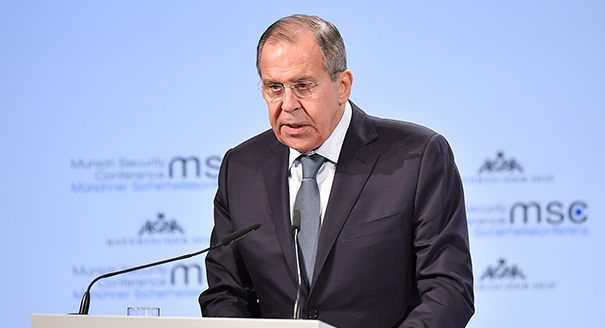
The Munich Security Conference (MSC) that took place on February 16–18 clearly revealed the change in tone struck by the Western military and political elite toward Russia.
The prevailing mood among the Munich audience is that during the past year, Russia has become a full-fledged adversary of the West. They believe Russia genuinely thinks it will benefit from a weakened West, and is cynically lying that it wants to improve bilateral relations if it gets the respect it deserves. Russian interference in the U.S. elections and Moscow’s flirting with Euroskeptics of all stripes have played a decisive role in shaping these attitudes.
This take on Russia varies from seeing it as a country that turns to external aggression to ensure its survival to a much more nuanced view that sees the problem beyond Putin. After all, most Russians wholeheartedly support their president’s political course, and no one can guarantee that Russian policies will be more appealing to the West after Putin leaves office.
There is no universal agreement on what to do about Russia in the future. The West doesn’t know where Russia will end up in five to ten years, but it’s a little clearer on what should not be done.
First, there should be no expectations that the start of a new Russian political cycle will lead to a change in foreign policy. Everyone understands that the split between hawks and doves in the Russian political establishment is symbolic: there are simply more or less competent foreign policy officials subordinated to the unrestrained command of Putin.
The West believes that the military and security services have increasing influence on the president’s thinking and on Russia’s foreign policy, and that they oppose the United States and the West on ideological grounds. So no significant changes will occur, even if senior members of the foreign policy team (such as the foreign minister or the president’s foreign policy advisor) are replaced by people who understand the West well and have an extensive network of contacts in Europe and the United States.
Second, everyone understands that economic sanctions will have no immediate impact. The logic established by former U.S. president Barack Obama’s team remains in effect: sanctions should inconvenience Russia, rather than provoke the Kremlin to take drastic steps that might destabilize the global economy.
This doesn’t mean that sanctions have no effect whatsoever: in the long run, Russia will become weaker, and its regime will have access to fewer resources, especially as new technologies transform the global economy. While sanctions punish Russia for its stance toward the West, they also prompt Moscow to contemplate policy change. If Russia doesn’t change its policies, the situation in the country will only get worse.
Third, there should be no connection between the situation in Ukraine and the West’s treatment of Russia. Europe is growing tired of the Ukrainian authorities. Few Europeans believe that the Petro Poroshenko government is committed to deep structural reforms, and there is not much optimism about many current trends in Ukrainian society, either.
But the stalled Ukrainian modernization project and alarming trends in Ukrainian political life won’t make the West run to the Kremlin for help in stabilizing the situation.
Moscow has already decided that an unstable, divided, and even hostile Ukraine is better for Russia than a Ukraine that is slowly drifting toward Europe. Likewise, the Europeans are prepared to accept instability in Ukraine rather than negotiate the country’s fate with Putin. After all, they have learned to live with instability in Syria, and aren’t trying to negotiate with President Bashar Assad and his foreign sponsors. Ukraine will, therefore, remain a source of tension and conflict.
Fourth, the West has decided not to take what Russian officials say seriously. It won’t be offended by Russian sarcasm, nor will it trust the Russians. Russian Foreign Minister Sergey Lavrov used his speech at this year’s Munich Conference to effectively compare the EU’s Eastern policy to the 1938 Munich Agreement, which conceded Nazi Germany’s annexation of parts of Czechoslovakia. The comparison won no new supporters for the Russian position on Syria and Ukraine, and conference participants later suggested off the record that Lavrov would have fared far better if he had simply asked the audience to consider Russia’s interests in the post-Soviet space instead.
Lavrov’s statements no longer surprise Western military officials and diplomats. Coming to Munich in order to lecture the Europeans on history and reproach them for the events of 1938 while saying nothing about the Molotov-Ribbentrop Pact between Nazi Germany and the Soviet Union is in fact vintage Lavrov, which is why the audience didn’t react to his offensive remarks. Many said later that they had heard the same thing for the third time in a row, and that it was getting boring.
In reality, Lavrov delivered a peaceful and relatively constructive speech last year, since at the time the Kremlin was still hoping to cooperate with the newly elected Donald Trump’s White House. But the European misperception is very telling, and it will be increasingly difficult for Russia to be listened to by the West.
Another problem is that no one in the Russian government is trying to listen, digest what they heard, or think critically about the long-term effect of their actions. Just as before, the Russian authorities refrain from engaging the West’s military and political intellectual elite at MSC and similar forums because they’re convinced that no one there can make any important decisions.
Russians also offer another explanation for not using MSC as an opportunity to engage the Western foreign policy community. They say that the Russophobe crowd in Munich will never change its mind. This belief is more of a reflection of the Russian political system, in which the government doesn’t really consider expert and public opinion when formulating foreign policy (experts and ordinary people are just expected to enthusiastically approve of government policies). This approach is to a large extent responsible for the miscalculations and errors that led to the current situation in Russia. This is not to say that the West has made no mistakes; indeed, it has made quite a few blunders. It simply means that Russia continues to miss opportunities to avoid making similar mistakes.


Director, Carnegie Russia Eurasia Center
Alexander Gabuev is director of the Carnegie Russia Eurasia Center. Gabuev’s research is focused on Russian foreign policy with particular focus on the impact of the war in Ukraine and the Sino-Russia relationship. Since joining Carnegie in 2015, Gabuev has contributed commentary and analysis to a wide range of publications, including the Financial Times, the New York Times, the Wall Street Journal, and the Economist.
Recent Work
Alexander Gabuev
Alexander Gabuev
Carnegie does not take institutional positions on public policy issues; the views represented herein are those of the author(s) and do not necessarily reflect the views of Carnegie, its staff, or its trustees.

The domestic impacts of how long it is taking to end the war in Ukraine have pushed the French electorate to the political extremes and compromised the country’s diplomatic capacity.

Rym Momtaz

The Plaza Accord was not an externally imposed punishment of Japan but part of a broader restructuring that Japanese economists and policymakers themselves recognized was necessary. Its effects were undermined, however, when Tokyo responded to the resulting slowdown with policies that exacerbated investment, credit expansion, and the very imbalances the adjustment was intended to resolve.

Michael Pettis

A summer of escalation in the Black Sea has hurt Ukraine economically and is exacerbating world food security. A truce is needed—as is a broader reframing of Europe’s Ukraine strategy.

Thomas de Waal

The Bureau of Industry and Security needs to adjust its focus and practices to maintain its position as the U.S. government’s primary champion of international technological competition.
Geoffrey Irving

Depleted financial reserves and a shrinking tax base mean it is no longer possible to simultaneously deliver high defense spending, price stability, and economic growth.

Alexandra Prokopenko