

Article
Apoorva Jadhav
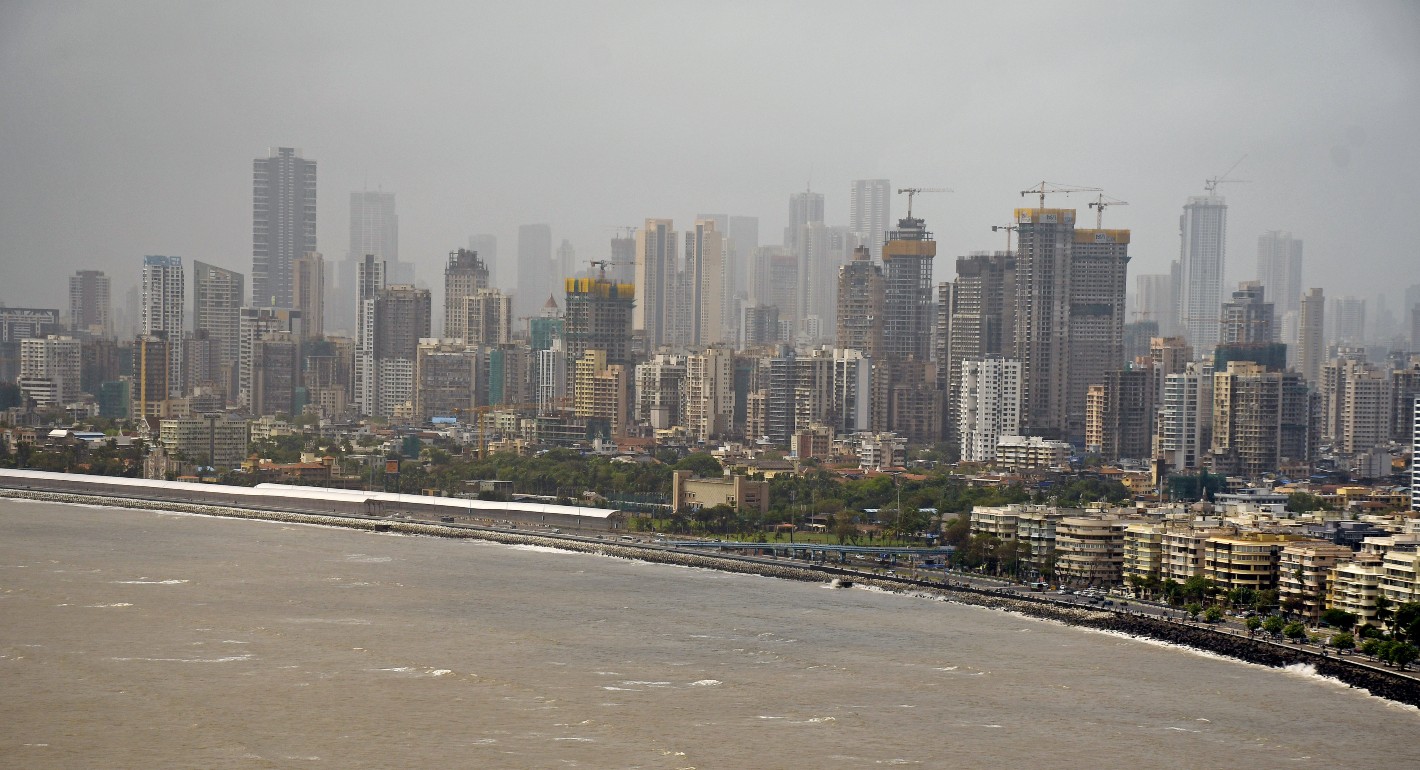
Aerial view of buildings in South Mumbai close to Arabian sea (Photo by Ashish Vaishnav/SOPA Images/LightRocket via Getty Images)
As India undergoes a demographic transition, its cities will be its economic powerhouse—but only if it accurately captures city growth and empowers cities to support their citizens.
This article is part of a new Carnegie series called “India’s Unfinished Demographic Dividend.” India’s demographic transition should be a historic advantage, but structural constraints are limiting its potential. This series examines the six key barriers that could cap India’s growth trajectory—and the pathways to unlocking its demographic potential. The first article in the series is available here.
Nowhere will India’s demographic dividend be more visible than in its cities. Beyond the veneer of modern skylines, cities are vibrant cultural and social epicenters and are the essential engines of economic growth. NITI Aayog, the Indian government’s in-house think tank, notes that cities occupy just 3 percent of the nation’s land but contribute a disproportionally enormous 60 percent to gross domestic product (GDP). As established by the first piece in this series on how India’s economic growth will be affected by its age structure (the demographic dividend), India’s favorable, youthful age structure does not guarantee an automatic economic windfall; it is a rigorous test of state capacity. The country’s total dependency ratio will reach its lowest and most beneficial ratio of about 44 dependents per 100 workers between 2030 and 2040.
Converting the power of those workers into economic growth depends on generating high-quality, productive employment at a massive scale. That scale can only be generated in cities. Urban agglomeration, or the benefits that arise when firms and people locate near one another together in cities and industrial clusters, is critical to fostering economic dynamism. Research suggests that doubling city size in India is associated with a 12 percent increase in nominal productivity. These nominal gains do not, however, translate into true economic efficiency. Instead, real-world returns are aggressively eroded by crippling congestion, systemic pollution, and fragmented labor markets. For India, the ultimate test of state capacity will be to ensure its cities are dense and productive, not just crowded.
For India, the ultimate test of state capacity will be to ensure its cities are dense and productive, not just crowded.
Yet, India governs this urbanizing economy through administrative, statistical, and fiscal frameworks designed for an agrarian landscape, drawn up at a time when most Indians lived in rural areas. While this mismatch may seem like a single point of failure, it instead masks three compounding failures. First, India does not know how urban it is because current statistical methodologies have not caught up to reality nor to future projections. Second, the cities that are recognized are not as empowered as they could be, perpetually starved of authority and money. Finally, India’s cities exacerbate inequalities. Each mismatch ends up suppressing the productivity gains that population density in cities should deliver, acting as a bottleneck to a historic demographic opportunity.
The stakes could not be higher. The Economic Survey 2023–2024, the Ministry of Finance’s flagship annual economic assessment, notes that the Indian economy needs to generate an average of nearly 7.85 million jobs annually until 2030 in the nonfarm sector alone to cater to the rising workforce. These jobs will be sought disproportionately by young people from what I have called the Youthful Engine1 states: Assam, Bihar, Gujarat, Madhya Pradesh, Odisha, Rajasthan, and Uttar Pradesh, where the demographic window will open last. That frustration is no longer hypothetical: In the summer of 2026, tens of thousands of young people occupied central Delhi for weeks protesting irregularities in college entrance exams and the scarcity of secure work, a reminder of how quickly a thwarted generation’s aspirations can turn to anger. Whether these young people find productive work depends on how India’s cities receive them. Currently, India’s cities are woefully underprepared.
India’s official urbanization statistic is based on the most recent census, conducted in 2011, and stands at 31.2 percent—much lower than comparable low-middle-income countries, which average 53 percent. The number is also, almost certainly, wrong.
The Indian census recognizes two kinds of urban settlement areas. The first are statutory towns, or places that state governments have formally recognized as urban and contain an urban local body such as a municipality, corporation, cantonment board, or notified town area committee. The second are census towns, which must meet three simultaneous criteria: a minimum population of 5,000 people, at least 75 percent of the male main workers engaged in nonagricultural pursuits, and a population density of at least 400 persons per square kilometer. India’s statistical definition of urban settlements literally does not count women’s work. The criteria both reflect and reinforce the structural norms and invisibility of female labor in Indian statistics. Any strategy to reap a demographic dividend will underestimate its true potential if the census continues to erase the economic contributions of half the population. For now, it appears that the upcoming (long-delayed and much-needed) census in 2027 will retain the antiquated definition of census towns.
Any strategy to reap a demographic dividend will underestimate its true potential if the census continues to erase the economic contributions of half the population.
Between 2001 and 2011, the number of census towns nearly tripled, accounting for 30 percent of total urban growth. These places are classified as urban but are treated, administratively, as rural. They are governed by a gram panchayat (village government) under the rural provisions of the Constitution with no municipal body, no urban planning mandate, and most distressingly, no obligation to provide urban services. This anomaly persists because rural status pays. A conversion from census town to statutory town introduces regulations, property taxes, loss of access to rural employment schemes, and more.
Local businesses and elites resist municipalization for these reasons, and state governments, who would ordinarily bear the cost of organizing and managing new municipalities, are happy to oblige. By treating dense nonagricultural hubs as agrarian villages, census towns are starved of the structural governance required to build high-capacity public utilities, modern transit, and industrial zones. The 12 percent nominal productivity gain of agglomeration is traded away for unmanaged, congested survival. That is why, to help manage the transition, the Sixteenth Finance Commission Report recommended a one-time grant to local municipal bodies to support the merging of peri-urban villages into existing urban local bodies (ULBs), with funding equal to 2,000 rupees per person (roughly $20) based on the incorporated area’s 2011 census population.
The UN’s 2025 urbanization estimates use a methodology called the Degree of Urbanization (DEGURBA), which overcomes the limitations of varying national definitions by applying uniform density and size thresholds globally. It divides the world into one-square-kilometer grid cells, classifies each by population size and density using satellite-derived settlement data, and sorts territory into “cities” (contiguous, high-density clusters of 50,000 or more people), “towns and semi-dense areas” (clusters of 5,000 or more people), and “rural areas.” Effectively, it is a definition of “urban” that only asks where and how densely people live.
Figure 1 shows that India’s national definition of urban (the dark blue line) neatly tracks only with the UN’s designation of cities (the red line). Towns, semi-dense areas, semi-dense towns, and dense towns—represented by the ballooning yellow band (top) and yellow/tan/brown bands (bottom)—are, in fact, “urban” under the UN definition and house the vast majority of the population, but are not treated as such by Indian authorities.
Government authorities in India demonstrate a growing awareness of this mismatch. Recently, the Economic Survey 2025–2026 acknowledged that India’s actual level of urbanization (63 percent in 2015) was roughly double the official level stated in the 2011 census, and the Prime Minister’s Economic Advisory Council has written openly about the implications of India’s “hidden urbanization.”
The counting mismatch is symbolized perfectly when considering megacities (cities with more than 10 million people). The UN projects that the number of global megacities will rise from thirty-three to thirty-seven by 2050, and one of the four new entrants, alongside Addis Ababa, Dar es Salaam, and Kuala Lumpur, is Hajipur. Most Indians, including many policymakers, have likely never considered Hajipur as a major city, let alone a megacity in waiting (see figure 2).
Hajipur, a city in the northern state of Bihar, is administratively a statutory town, with the 2011 census listing the nagar parishad (urban) population at 147,688. But the UN methodology comes to a different conclusion because it considers the contiguous, high-density, built-up area. Hajipur is connected to a massive, unbroken chain of dense towns and rapidly growing semi-urban corridors stretching across Vaishali into Muzaffarpur, so the UN’s data model has aggregated multiple distinct cities, towns, and massive rural-urban clusters into a single, giant urban center, named, as it happens, for one of its smaller constituent towns. Patna, the state’s capital and actual urban core, which is many times larger than Hajipur, registers as a separate center only because the Ganges River breaks up the built-up continuity between them.
While this specific designation is an artifact of data modeling, the results reflect a profound phenomenon: Even though these areas are politically and administratively classified as separate towns (including Hajipur, Lalganj, and Mahnar Bazar) or gram panchayats, they are physically morphing into an unbroken high-density population. This is a landscape where millions of people live at urban densities but lack formal urban infrastructure, sewage systems, or municipal governance because they are still legally considered villages.
Whether Hajipur becomes one megacity or a dozen merged towns, India’s statistical system currently has no way of anticipating its growth, and its administrative system has no body responsible for planning it. The first failure of the urban dividend is that the state cannot manage what it cannot, or what it refuses, to measure.
The first failure of the urban dividend is that the state cannot manage what it cannot, or what it refuses, to measure.
If the first failure is statistical, the second pertains to the enforcement of constitutional mandates. The 74th Constitutional Amendment Act of 1992, or the Nagarpalika Act, gave constitutional status to municipalities and established ULBs as a third tier of government. It mandated elected municipal councils with five-year terms, ward committees in larger cities, metropolitan planning committees for the largest agglomerations, and state finance commissions to devolve money every five years from state coffers to urban areas. Additionally, it listed eighteen essential functions that were expected to devolve from states to municipalities: from urban planning and urban poverty alleviation to water supply and public health. The actual devolution, however, has mostly happened only on paper. The Comptroller and Auditor General’s performance audits between 2014 and 2021 found that, across states, only four of the eighteen were “effectively devolved with complete autonomy”: burial grounds, public amenities, prevention of cruelty to animals, and regulation of slaughterhouses. Urban planning, the function on which everything else depends, was the least devolved.
The structural variations across India’s state-level demographic transitions are inherently linked to how governance within a state is legally and financially organized. To map how effectively power has actually moved to the local level, Praja’s Urban Governance Index 2024 measures the structural empowerment of city governments across four core pillars: empowered city elected representatives (the authority of mayors and councils), empowered city administration (control over staffing and execution), fiscal empowerment (independent revenue generation), and empowered citizens (grievance systems and formal public participation). Together, these pillars describe whether a city can act on its own behalf—plan its land, raise its own revenue, direct its own staff, and answer to its own residents—which is precisely the capacity required to turn density into productivity rather than congestion.
Mapping demographic groupings against these four decentralization pillars reveals a critical disconnect: The administrative capacity of ULBs is detached from the demographic pressures they are expected to manage (see box 1). State governments are systematically misallocating institutional power, starving cities of either political authority or basic administrative muscle exactly when they need it the most.
India’s states and territories are at different stages of their demographic transitions. The tripartite classification utilized here is based on the number of years it took each state or territory to reach the demographic leader Kerala’s threshold of survival (life expectancy of sixty-two, reached in 1973) and fertility (based on a total fertility rate of 2.1, reached in 1988). These states and territories are then clustered into three groupings, requiring distinct policy responses:
Aging Frontier (Andhra Pradesh, Kerala, Karnataka, Maharashtra, Punjab, Tamil Nadu): These states converged on advanced health and low-fertility benchmarks relatively early. Their early demographic success, reflected in older, longer-living populations, has created significant fiscal pressures: high debt, persistent deficits, rising pension and welfare commitments, and modest revenue growth.
Transitioning Middle (Haryana, Himachal Pradesh, Jammu and Kashmir, West Bengal): These states and territories achieved rapid gains in life expectancy, reaching the benchmark within roughly twenty-five years of Kerala, but their fertility rate decline lagged considerably. The mismatch between lower mortality and higher fertility means they retain sizable working-age populations while simultaneously facing rising aging-related care needs.
Youthful Engine (Assam, Bihar, Gujarat, Madhya Pradesh, Odisha, Rajasthan, Uttar Pradesh): These states are characterized by large and growing youth populations requiring sustained investment in health, education, and skill development. They experienced significant delays in mortality decline, often twenty-five to thirty-five years behind Kerala, with fertility transitions lagging even further.
The Aging Frontier states possess significant fiscal muscle but operate on a thin administrative base and stagnant local political autonomy. In powerhouse economic zones, this institutional architecture leaves key technological and agrarian hubs structurally paralyzed just as their demographic windows contract and eldercare liabilities mount.
The Transitioning Middle states and territories stand at a crucial crossroads but are in danger of letting their narrow window for structural adaptation slip away. They balance highly engaged citizens with an absence of the localized financial agility needed to scale public health and urban infrastructure before dependency ratios climb.
Finally, the Youthful Engine states remain deeply fragmented. They are experiencing an unprecedented surge in youth migration and project an impressive civic voice despite being starved of municipal staff. In the very places where youthful density will peak over the next two decades, municipal administrations lack the baseline civil service capacity or human resource control to execute targeted local health, education, and skilling interventions. If the legal and fiscal capacity to manage urban mandates remains guarded at the state level, the localized investments necessary to leverage India’s closing demographic window will remain entirely out of reach (see figure 3).
The World Bank estimates that India needs $840 billion in urban infrastructure investment by 2036 to meet the demands of its growing urban population, with roughly half for basic municipal services (such as water supply, sewage, storm water drainage, urban roads, and streetlighting) and the rest for mass transit. These needs are significantly higher than current levels of investment but well below international comparators. Notably, India’s urban infrastructure investment needs are a mere 0.6 percent of GDP compared to China’s 2.8 percent. According to the Reserve Bank of India’s Report on Municipal Finances (2022), municipal revenues/expenditures in India have stagnated at around 1 percent of GDP for over a decade. In contrast, they account for over 7 percent in Brazil and 6 percent in South Africa, countries that took their urban transitions seriously.
The Sixteenth Finance Commission recently recommended roughly $37 billion for ULBs over 2026–2031, approximately tripling the previous commission’s allocation. This represents a deliberate rebalancing of local-body grants toward cities, as urban areas will now receive about 45 percent of local grants, up from roughly a third. Critically, the fiscal transfers come with entry conditions: Local bodies must be duly constituted, accounts must be publicly disclosed, and state finance commissions must be established on time. For the first time in three decades, the central government is using its largest fiscal lever to make the 74th Amendment’s promises a precondition for funds rather than an aspiration. Whether states respond by genuinely empowering municipalities, or by minimally complying while parastatals keep the real power, will determine whether the urban dividend’s fiscal foundation gets laid during the demographic window or after it closes.
India’s urban dividend cannot be unlocked by infrastructure alone; it is the people that live in those cities that will drive it. And therein lies a third mismatch. The physical and economic anatomy of an Indian city actively works against its own workforce. This is a compounding crisis where prohibitive barriers for women and climate-induced heat and flood risks converge with a massive informal labor market (as high as 80 percent in urban areas).
And this mismatch matters for outcomes. While aggregate statistics paint cities as hubs of superior healthcare, disaggregated data reveal that the urban poor frequently face worse neonatal, infant, and under-five mortality outcomes than their rural counterparts. Decades of targeted rural health campaigns have steadily raised the floor for India’s villages, but unmanaged urban pockets have been left to stagnate. Starved of nearby public primary clinics, urban slum residents are forced into a predatory private market, facing higher out-of-pocket expenditures and lower health insurance coverage than rural citizens. Unplanned cities are actively degrading the human capital of the very workforce that is expected to drive growth.
Unplanned cities are actively degrading the human capital of the very workforce that is expected to drive growth.
The nuances of the sociological and ecological mismatch present in Indian cities will be considered more systematically in future essays in this series. But it is worth briefly previewing their contours.
The city’s exclusions and constraints on the demographic dividend are sharpest when considering that in 2024, only 28 percent of working-age urban women were in the labor force compared to nearly half of their rural counterparts. This is an improvement from 2017–2018 (20 percent), but still the lowest of any other major economy. To be sure, women’s economic inclusion is a core goal of Prime Minister Narendra Modi’s Viksit Bharat (Developed India) vision, which sets an ambitious target of 70 percent women’s workforce participation. One 2017 estimate suggested that the Indian economy could grow by an additional 60 percent by 2025, adding $2.9 trillion to GDP, if women were represented in the formal economy at the same rate as men (76 percent). While the contraction of the agricultural sector should have catalyzed a massive shift of women into urban service roles, a combination of rigid social customs and structural skill mismatches has left them behind. Even where urban growth has generated female employment, most notably in the booming domestic work sector, these jobs remain informal, stripping women of baseline labor rights and making a sustainable urban career trajectory harder to reach.
A growing body of evidence demonstrates that the physical design of the city itself functions as a tax on women’s work. Women in Delhi routinely choose worse colleges than their test scores merit in exchange for safer commutes and are willing to pay roughly double the average annual tuition for a safer route. The quality they give up for safety translates to a 17 percent decline in the present discounted value of their post-college earnings. This physical tax is starkly reflected in urban transit data, which reveal that men outnumber women commuters by nearly five to one. Furthermore, Indian women perform about 289 minutes per day of unpaid domestic work against 88 for men, and the public infrastructure that could redistribute some of that burden is shrinking. As India’s population grows older in the coming years, more of that unpaid care work will also fall on women.
Perhaps the factor that will likely exacerbate inequalities the most is climate change. The relationship is bidirectional: Urbanization has led to an overall 60 percent increase in warming in Indian cities (referring to extra warming relative to surrounding nonurban areas), particularly in the east, while the effects of climate change and heat are also borne disproportionately by city dwellers. A 2025 study mapping informal settlements found that India has more than 158 million slum residents living in flood-prone areas—the most in the world. The World Bank estimates that over two-thirds of India’s urban residents already face surface-flood risk. This risk is concentrated among workers in the informal economy, and disproportionately among Dalit (low caste) and Adivasi (tribal) communities, because formal land markets and caste-sorted neighborhoods exclude them from safer areas. Heat stress is the more diffuse climate emergency, registering less as disaster than as a steady drain on the capacity to work, and it also discriminates by occupation. The International Labour Organization projects that India will lose the equivalent of 34 million full-time jobs to heat stress by 2030—the most of any country—with losses concentrated in construction and outdoor work.
The Aging Frontier states are already the most urbanized, and their demographic windows are closing; these states need cities productive enough to fund the aging societies they are becoming. The Transitioning Middle states and territories must expand employment and formalize labor markets now if they are to translate their still-favorable age structures into productivity gains. Their cities will be crucial to this transformation; they must become engines of female labor force participation and skills-based employment precisely as these states move toward smaller, aging populations.
The Youthful Engine states hold the country’s demographic future, the lowest urbanization rates on paper, and, as the satellite data reveal, some of the country’s fastest actual urbanization, almost all of it unrecognized, ungoverned, and unplanned. The corridor between these three Indias runs through the city: Millions of young workers from the Youthful Engine will spend their working lives in settlements that will either equip them to be productive or quietly squander the only demographic window India will ever get.
These mismatches require corresponding solutions to begin to unlock the urban dividend. First, India must count its cities accurately. The government can use the upcoming 2027 census to publish DEGURBA-compatible settlement statistics alongside administrative categories so that India can measure its own urbanization. As part of this revision, the government should retire the male-worker criterion that writes women out of the definition of an urban unit and create a time-bound, fiscally cushioned pathway to convert census towns into statutory municipalities.
Second, India needs to empower its cities. To do so, the central government can treat the Sixteenth Finance Commission’s tripled, conditional urban grants as a lever to enforce the entry conditions strictly and pair central money with the reforms states have dodged for thirty years. These reforms would include empowered mayors with five-year terms, municipal control over planning and staffing, functioning state finance commissions, and serious property-tax modernization so that cities grow their own revenue rather than wait for transfers.
Third, India must plan for the cities that already exist, as opposed to those that exist only on paper. This would place the onus on urban governments to ensure basic services are available for all residents; to design transit, lighting, sanitation, and childcare around the mobility of care, so the city stops taxing women’s participation; and to turn heat action plans and flood-zone upgrading into the test of whether cities are serious about climate adaptation.
India’s demographic window will close around mid-century irrespective of whether its cities are ready. The first essay in this series asked whether the state has the foresight and capacity to count, govern, and equitably support its population through the demographic transition. The city is where that becomes concrete, and where, so far, all three tasks remain unfinished.
This piece benefited greatly from the guidance and support of Milan Vaishnav, Andy Robaina, and Haley Clasen at Carnegie. I am also indebted to Amanda Branom for her expert help in developing the figures.

Nonresident Scholar, South Asia Program
Apoorva Jadhav is a nonresident scholar in the Carnegie South Asia Program. Her work centers on translating complex global demographic trends—specifically fertility changes, population aging, and migration—into actionable frameworks for governments and international institutions.
Recent Work
Apoorva Jadhav
Carnegie does not take institutional positions on public policy issues; the views represented herein are those of the author(s) and do not necessarily reflect the views of Carnegie, its staff, or its trustees.

Despite public disputes over trade and immigration, the strategic partnership’s foundations remain sturdy.

Sameer Lalwani
Economic recovery has brought Sri Lanka a modicum of stability, but domestic strains and great-power rivalry could test how long it lasts.

Avinash Paliwal

There is a transnational far-right populist movement that links middle powers in a global movement that extends well beyond Trump.



Christopher S. Chivvis, Rohan Mukherjee, Milan Vaishnav

Unresolved tensions within the AfD may ultimately constrain the its potential as a leader among European and global populist forces.
Jeremy Cliffe

Turkish right-wing populists have been trying to advance the country’s middle-power goals based on perceptions of what the public wants, but they have been doing so in ways that reinforce their project of autocratic political consolidation.

Murat Somer