

Commentary
Dmitri Trenin
{
  "authors": [
    "Dmitri Trenin"
  ],
  "type": "commentary",
  "centerAffiliationAll": "",
  "centers": [
    "Carnegie Endowment for International Peace",
    "Carnegie Russia Eurasia Center"
  ],
  "collections": [],
  "englishNewsletterAll": "",
  "nonEnglishNewsletterAll": "",
  "primaryCenter": "Carnegie Russia Eurasia Center",
  "programAffiliation": "",
  "programs": [],
  "projects": [],
  "regions": [],
  "topics": [
    "Economy"
  ]
}
Source: Getty
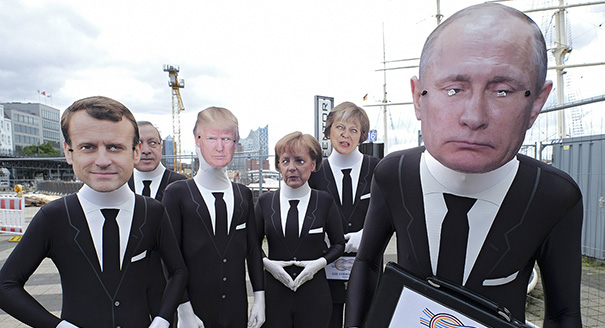
Russians have become skeptical about a truly global order. At best, interactions with Western countries will be transactional, based on national interests when those happen to coincide or come close.
This is the fourth article in a series looking ahead at the drivers of Russian foreign policy from 2017 to 2022.
In the next five years, Russia’s relations with the United States and Europe will be competitive and tense. Russia will not invade NATO territory unprovoked, but incidents along the new front line, stretching from the Arctic to the Baltic to the Black Sea and elsewhere, may occasionally endanger peace between Russia and the United States and its allies. Operating from a position of weakness vis-à-vis its adversaries, Russia will continue to resort to a number of equalizers. These will range from increased reliance on nuclear deterrence to the creation of local balances in Moscow’s favor; from swift decisionmaking and bold action, including the use of force, to ambiguity and hybrid operations; and from the fact that the stakes for Russia in this resumed rivalry are higher than for Western countries to Russia’s willingness to run greater risks and suffer more losses than its opponents.
Managing Russian-Western conflict under these circumstances will be of utmost importance. Key issues are preventing incidents involving military aircraft and naval ships by means of confidence-building measures; ensuring that channels of communication function properly, including at the military-to-military level; and having groups of trusted individuals on both sides capable of engaging in confidential and constructive dialogue on contentious topics and on matters of common concern, such as strategic stability.
In the general environment of confrontation, Russia’s interaction with Western countries will be at best transactional, based on national interests when those happen to coincide or come sufficiently close. Rather than shying away from partnering with the West, Moscow will be ready to work with Washington and its allies on those issues. However, Russia will only engage when it is satisfied that the United States treats it as an equal and takes Russian interests into account. For the Kremlin, this is the ultimate foreign policy goal. It is unlikely that this view will be shared by the U.S. administration.
Specifically, attaining this goal would require getting the West to honor Russia’s security space by ruling out NATO membership for Ukraine, Moldova, Georgia, or any other former Soviet republic; giving those countries a neutral status between Russia and NATO; managing international crises jointly under the aegis of the UN Security Council, in which Russia has veto power; and restoring normal economic ties between the West and Russia while resolving the issue of the Donbass on the basis of the Minsk II agreement and finding a formula for recognizing Crimea as part of Russia, in accordance with the wishes of Crimean residents.
On the issues on which Russia and the West basically agree, Russia should, in the Kremlin’s view, be a full partner of Washington. When they fundamentally disagree, their differences should be bracketed, so as not to block cooperation when it is possible—as with the status of Abkhazia and South Ossetia during the short period of the U.S.-Russian reset attempted in 2009. On all issues in between, mutually acceptable compromise should be sought. This clearly contrasts with the prevailing view of the relationship in Washington.
On broader issues of world order, Russia has offered no alternative design to what exists today and no comprehensive reform blueprint. It is not the world order as such that Moscow has challenged, but the U.S. domination of that order. Thus, Moscow’s claims have been more procedural than substantive. The Russians have wanted a permanent seat at the high table, with de facto or de jure veto power—such as at the UN Security Council. Russia has desired to be a part of the rule-making mechanism, not sit at the receiving end simply taking the rules developed by the U.S.-led international community. Therefore, the UN Security Council has always been the right model for the Russians, while the NATO-Russia Council, in which Russia was confronted by 28 allies bound by alliance solidarity, has disappointed them.
After the break that occurred in 2014, however, few Russians expect the West to make room for them. With the confrontation and alienation becoming more deeply entrenched with each passing year, the Russians have become more skeptical about a truly global order. In their view, this order is being replaced by regional arrangements: the United States’ reassertion of its positions in Europe and East Asia, China’s One Belt, One Road initiative, and so on. The sanctions imposed by the West have demolished the One World concept that they bought into at the end of the Cold War. Thus, Russia has started paying more attention to regional and subregional compacts: the BRICS group, the SCO, the EEU the Collective Security Treaty Organization (CSTO), and others. Of the remaining global councils, the UN Security Council and the G20 are still considered useful.
However, whether Russia’s foreign policy will achieve its objectives at whatever level will depend primarily on the success or failure of Russia’s economic relaunch. The next five years will probably not provide a definite answer to this question, but will bring us much closer to a verdict.

Former Director, Carnegie Moscow Center
Trenin was director of the Carnegie Moscow Center from 2008 to early 2022.
Recent Work
Dmitri Trenin
Dmitri Trenin
Carnegie does not take institutional positions on public policy issues; the views represented herein are those of the author(s) and do not necessarily reflect the views of Carnegie, its staff, or its trustees.
The Bureau of Industry and Security needs to adjust its focus and practices to maintain its position as the U.S. government’s primary champion of international technological competition.
Geoffrey Irving

Depleted financial reserves and a shrinking tax base mean it is no longer possible to simultaneously deliver high defense spending, price stability, and economic growth.

Alexandra Prokopenko
U.S. trading partners in Asia are closely watching the dispute for signs of how it may affect their own interests.
Barbara Weisel
Amid celebrations of bilateral ties was a deeper focus on stability in the Middle East.

Amr Hamzawy
Xi, Putin, and other regional leaders are back-slapping in Bishkek, but the SCO has yet to answer the most serious questions about continental Asia's economic future.

Evan A. Feigenbaum