Source: USA Today
In the wonderful 1976 media satire Network, the frustrated and emotionally unhinged anchor Howard Beale, facing termination, goes on air and shouts “I’m mad as hell and I’m not going to take this anymore.”
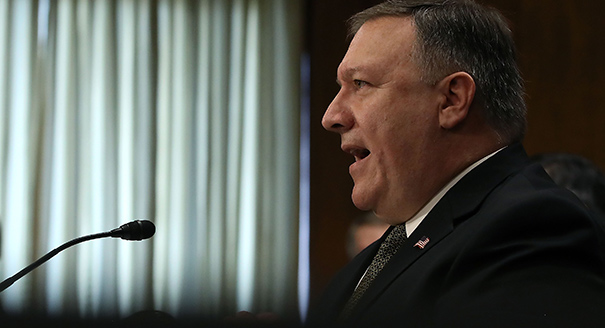
In his speech Monday on President Trump’s “new” Iran strategy, it seemed that Secretary of State Mike Pompeo was channeling Beale. He led with a tough series of “no mores” — no more wealth creation for Iranian kleptocrats, no more missile attacks in Saudi Arabia or the Golan Heights, and no more cost-free expansion of Iranian power.
Our bottom line: The speech laid out fantastical demands which Iran will almost certainly reject and the administration lacks the capacity to achieve. Here are our main takeaways.
Words over deeds. Like so many administration initiatives, Pompeo’s speech was long on rhetoric and short on specifics. In Trump-land the president sets high aspirational bars like the “ultimate deal” for Israeli-Palestinian peace and the “complete, irreversible, verifiable denuclearization” of North Korea. But the administration is clueless about how to achieve them, because they are unrealistic goals. Pompeo recited the litany of Iran’s malign activities yet summed up how they'd be addressed in a relatively short to-do list. There is a detailed plan for squeezing the regime economically and financially, but it offers nothing on how to deter Iran’s regional aggression and stop its human rights violations.
Regime change lite. Make no mistake: Pompeo’s speech was a call for regime change. The U.S. can inflict serious economic pain on Iran, but it involves a good deal of magical thinking to believe that it can bring the regime to its knees or provoke a mass popular movement to overthrow the government. The regime is prepared to demand more suffering from the Iranian people and it will use its ruthless security apparatus if the Iranian people take to the streets. How will the administration react if there is another Green Revolution? Most likely by lending moral but not material support to encourage the Iranian people to rise up — once again proving, as it has in its dealings with other countries, that the administration is a paper tiger.
Alone together. Pompeo appealed for the support of other countries for a campaign of economic warfare against Iran. He may get help from some of America’s regional allies like Israel, Saudi Arabia and the United Arab Emirates, which are happy to drag the U.S. into fighting their battles against Iran, but have little to contribute to this campaign. He made no mention in his speech, and with good reason, of China, Europe or Russia, which will treat regime change like the plague. The Trump administration can and probably will try to use its economic leverage to bludgeon our European allies into cooperating, causing another major fracture in the transatlantic relationship. But Russia and China have options for continuing trade and investment in Iran, diluting the impact of sanctions.
Where’s the beef? Talk is cheap. Trump is good at chest-thumping rhetoric, but when the going gets tough he typically acts like a “chicken hawk.” Pompeo reaffirmed the administration’s goal of containing and rolling back Iran’s influence and military presence throughout the region. But he offered no comprehensive or sustainable strategy to achieve it, and had nothing to say about how the U.S. would respond when Iran, rather than cry uncle, actively resists these efforts with the considerable assets and allies they can bring to bear throughout the region. The Pompeo plan, if the U.S. actually follows up on it, promises only more tension, instability and conflict throughout the region and possibly a U.S. war with Iran.
Politics, not policy. Finally, the post-Iran deal strategy (Trump's "Plan B") reveals the triumph of campaigning and domestic politics over sound national security policy. Whether it is withdrawing from the Trans-Pacific Partnership on trade and the Paris climate agreement, imposing travel bans, slapping tariffs on steel and aluminum exports from allies, or abandoning the nuclear deal with Iran, the Trump administration seems adept at coming up with solutions to problems America doesn’t have and damaging the national interest to deliver on campaign promises and show that Trump is not Obama.
Dwight Eisenhower, who planned and organized the allied invasion of Europe during World War II, famously remarked that, “in preparing for battle I have always found that plans are useless but planning is indispensable.” It will soon be revealed that Pompeo’s plan is not worth the paper it is written on and it will be back to the drawing board for a Plan C. The administration has nowhere to go but up.
This article was originally published in USA Today.