

Commentary
Konstantin Skorkin
{
  "authors": [
    "Konstantin Skorkin"
  ],
  "type": "commentary",
  "centerAffiliationAll": "",
  "centers": [
    "Carnegie Endowment for International Peace",
    "Carnegie Russia Eurasia Center"
  ],
  "collections": [],
  "englishNewsletterAll": "",
  "nonEnglishNewsletterAll": "",
  "primaryCenter": "Carnegie Russia Eurasia Center",
  "programAffiliation": "",
  "programs": [],
  "projects": [],
  "regions": [],
  "topics": [
    "Economy"
  ]
}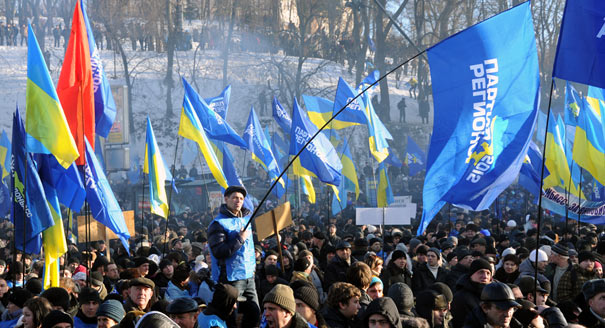
Source: Getty
Ukraine’s pro-Russian opposition is targeting next year’s parliamentary elections, not the presidential ones—so is Russia. But they cannot agree among themselves on who their leader should be and what their strategy is.
Disoriented since the downfall of former president Viktor Yanukovych, the parts of Ukraine’s opposition more sympathetic to Russia have not disappeared. They are regrouping, with an eye mainly to next year’s parliamentary elections, seeing the presidential election as all but lost. But they have yet to find a common leader or unifying idea.
Up until 2014, the Party of Regions was Ukraine’s all-powerful ruling party, with a clear leader in Yanukovych and a loyal electorate in the south and east of the country. The party did not just claim to stand for the interests of the population of southeastern Ukraine, it served as a landing place for the nomenklatura and their affiliated business interests from the country’s industrial regions.
The Maidan uprising and the downfall of the Yanukovych regime should have meant the end for the party. Its structures began to crumble, and some of its more detested politicians fled to Russia. Others joined the winning side. Most Party of Regions alumni had nowhere to run as all of their business and political interests were deeply embedded in Ukraine. The country’s new political course, aimed at a break from Russia, was still unacceptable not only to them but also to most of their former supporters, who still needed political representation.
By September 2014, the Party of Regions alumni had created an Opposition Bloc from the wreckage of the old party. At its core was a pact between two powerful political-industrial groups: that of Donetsk-based oligarch Rinat Akhmetov, the richest man in Ukraine and the former main sponsor of the old party, and that of oligarch Dmytro Firtash and his partner Yuriy Boyko. A third slightly more detached supporter was Viktor Medvedchuk, Russia’s main “agent of influence” in Ukrainian politics and a personal friend of President Vladimir Putin. In the last parliamentary elections, the bloc’s performance was very modest, ending up with just 43 seats out of 450 in the Verkhovna Rada.
With presidential and parliamentary elections imminent in 2019, what are its chances of doing better this time? The bloc is already struggling with its big first challenge in agreeing on an opposition candidate for the presidential election next March. Firtash’s group wants to nominate the faction’s co-chair Yuriy Boyko, who hails from the Donbas. Akhmetov’s group is backing Oleksandr Vilkul, the former governor of Dnipropetrovsk region.
Recent opinion polls give Boyko the support of around 9 percent of voters, but with a significant regional variation, as he leads in eastern and southern regions of Ukraine. Boyko’s chances of being a unifying opposition candidate have dipped, however, since he announced an alliance with the For Life! party and its controversial leader, Vadim Rabinovich. Rabinovich is an oligarch and media magnate with a criminal past, who is also close to the controversial Medvedchuk.
The mastermind of this alliance is Yanukovych’s former chief of staff Serhiy Lyovochkin. His main objective is not the presidential election, which Boyko will clearly lose, but the parliamentary elections, where the aim is for a united opposition bloc to make a comeback and try to limit the powers of the president. But Boyko’s move was strongly opposed by Akhmetov’s group in the bloc. Akhmetov himself has other irons in the fire, also supporting both the populist Radical Party of Oleh Lyashko and Arseniy Yatsenyuk’s People’s Front.
The Kremlin is not enthusiastic about the Party of Regions veterans, seeing them as too prone to compromise. Yet it has few other options available, as the Opposition Bloc is the only viable pro-Russian organized movement in Ukraine. Moscow has also set its sights on parliamentary elections rather than the presidential ones. Some believe that a broad opposition coalition could accelerate the resolution of the Donbas conflict and reduce the confrontation with Russia.
How likely are the members of the former Party of Regions to make a comeback? They still have a solid base of support in the industrial regions of the country and will win over some voters disillusioned with Poroshenko. They can call on wealthy funders and friendly media outlets such as the popular Inter and Ukraine television channels.
Yet they almost certainly underestimate how much Ukraine has changed since they left office. After all the traumatic and bloody events of recent years, from the shootings on the Maidan in 2014 to the war in the Donbas, the pro-Maidan segment of the Ukrainian population would react very negatively to a comeback by former members of the Party of Regions. That outcome could lead to civic unrest or even violence.
Moreover, their chances are poor so long as they remain divided. One of the main advantages of the former Party of Regions was its united front, which helped it overcome fragmented Ukrainian national democrats—which is why Akhmetov insists on maintaining that unity. Internal conflicts or individual ambitions of party leaders were generally swept under the rug. Its supporters liked this unity, which appealed to their Soviet-era mentality of consensus, rudiments of which are particularly strong in the industrial centers of Ukraine.
The opposition is unlikely to fare well, moreover, unless and until it can find a leader with a profile comparable to Yanukovych. However contradictory and clichéd his persona might have been, Yanukovych’s portly and clumsy presence and his rough proletarian manners allowed him to present himself as “a man of the people.” He cultivated the image of a self-made man who had fought his way to the top despite a difficult childhood and a criminal record. The sleek top managers and suave bureaucrats who currently head the Opposition Bloc can offer nothing like that.

An independent journalist.
Recent Work
Konstantin Skorkin
Konstantin Skorkin
Carnegie does not take institutional positions on public policy issues; the views represented herein are those of the author(s) and do not necessarily reflect the views of Carnegie, its staff, or its trustees.

A summer of escalation in the Black Sea has hurt Ukraine economically and is exacerbating world food security. A truce is needed—as is a broader reframing of Europe’s Ukraine strategy.

Thomas de Waal

The Bureau of Industry and Security needs to adjust its focus and practices to maintain its position as the U.S. government’s primary champion of international technological competition.

Geoffrey Irving

Depleted financial reserves and a shrinking tax base mean it is no longer possible to simultaneously deliver high defense spending, price stability, and economic growth.

Alexandra Prokopenko
U.S. trading partners in Asia are closely watching the dispute for signs of how it may affect their own interests.
Barbara Weisel
Amid celebrations of bilateral ties was a deeper focus on stability in the Middle East.

Amr Hamzawy