

Paper
James M. Acton, Ankit Panda
{
  "authors": [
    "James M. Acton"
  ],
  "type": "questionAnswer",
  "centerAffiliationAll": "dc",
  "centers": [
    "Carnegie Endowment for International Peace"
  ],
  "collections": [
    "Entanglement"
  ],
  "englishNewsletterAll": "ctw",
  "nonEnglishNewsletterAll": "",
  "primaryCenter": "Carnegie Endowment for International Peace",
  "programAffiliation": "NPP",
  "programs": [
    "Nuclear Policy"
  ],
  "projects": [],
  "regions": [],
  "topics": [
    "Nuclear Policy"
  ]
}
Source: Getty
It is not a good idea to mix nuclear and non-nuclear weapon systems. What are the risks, and why are countries still doing it?
Entanglement describes how militaries’ nuclear and non-nuclear capabilities are becoming dangerously intertwined.
In a conventional war, for example, one state could use non-nuclear weapons to attack its adversary’s nuclear weapons or their command-and-control systems. Such strikes could pressure the country being attacked into using its nuclear weapons before they were disabled.
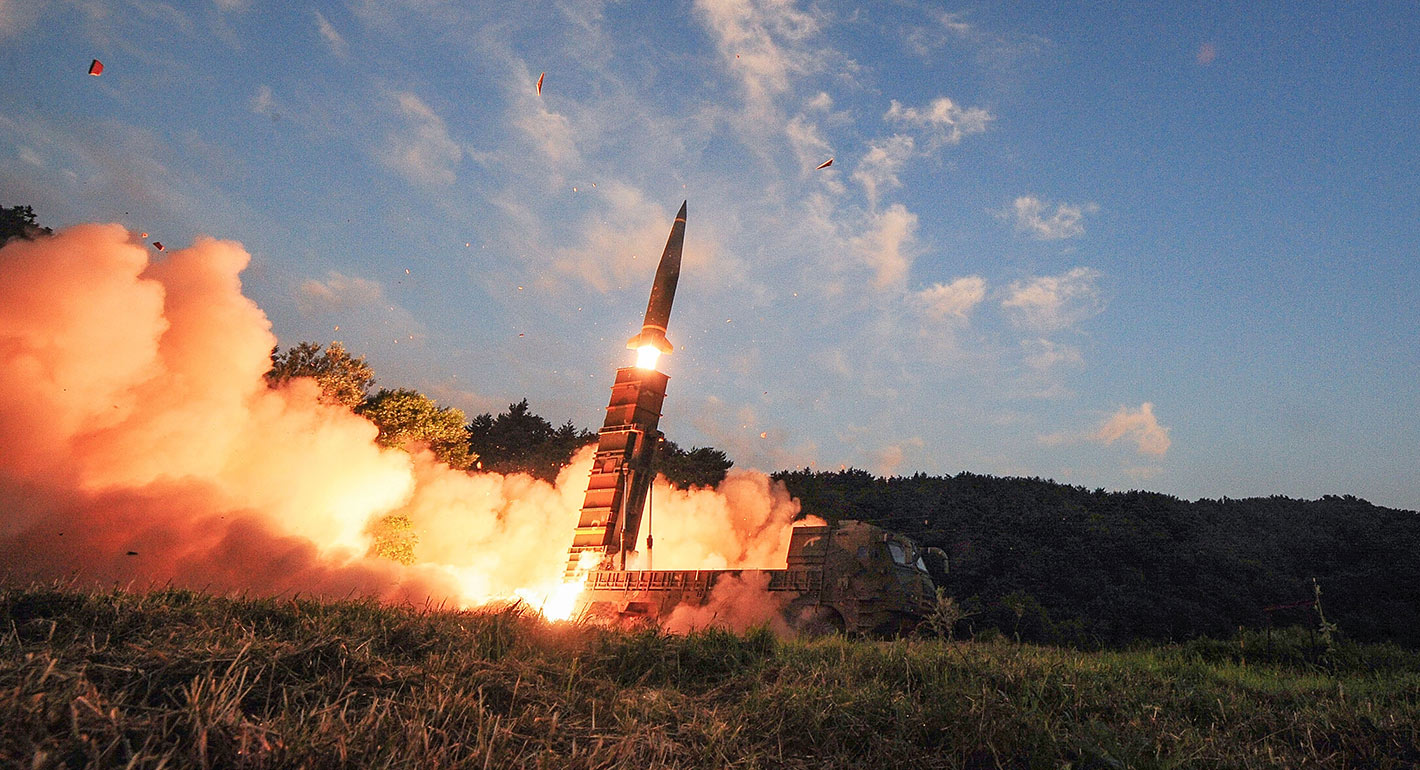
To give another example, several states, including China and Russia, are developing and deploying increasingly long-range missiles that can carry nuclear or nonnuclear warheads. Such missiles create the risk that a nuclear weapon could be mistaken for a non-nuclear weapon, or vice versa. In a conflict, if one state mistook nuclear-armed missiles as nonnuclear and attacked them, the targeted country might wrongly conclude that its nuclear forces were under threat and use them.
As best I can tell, the term “entanglement” was first used by the American political scientist John Steinbruner in 2000. Others had written on the same subject previously, but hadn’t used that word.
Steinbruner was describing how a U.S.-Russian conflict might escalate. He pointed out that assets vital to Russia’s nuclear deterrent, such as early-warning radars, would be located close to a military confrontation in Central Europe. Because of this proximity, these nuclear-related assets could be attacked by non-nuclear weapons, in even a minor conflict.
Entanglement makes it more likely that a non-nuclear conflict could turn nuclear.
My research highlights the dangers of using important command-and-control capabilities for both nuclear and nonnuclear operations.
To give one example, U.S. early-warning satellites are used both to detect both nuclear and non-nuclear attacks, and can trigger ballistic missile defenses. In a conventional conflict, if U.S. defenses were effective in intercepting Russian non-nuclear missiles fired against targets in Europe, Russia might attack U.S. early-warning satellites to blunt these defenses.
However, because such an attack would also degrade the United States’ ability to detect incoming nuclear strikes, Washington could interpret it as the prelude to a Russian nuclear attack – potentially resulting in escalation. The United States has explicitly threatened to use nuclear weapons if its nuclear command-and-control is attacked with non-nuclear weapons.
Almost certainly. China and Russia reveal much less about their nuclear command-and-control systems than the United States does. That said, it appears likely that both countries also rely on at least some dual-use command-and-control capabilities, which the United States might attack in a conventional conflict.
What’s more, both China and Russia worry that, in a conflict, the United States might seek to destroy their nuclear forces using conventional weapons. Even if these fears are unfounded, in a conflict, this possibility could put enormous pressure on Beijing or Moscow to launch their nuclear weapons while they still could.
The risks associated with entanglement have, I suspect, not been widely recognized within militaries and ministries of defense. As a result, there has been little pressure to reduce the extent of entanglement.
And even if governments could be convinced that disentanglement was a good idea, the process would be complex and expensive. For example, countries would need to buy more satellites, if each satellite could be used for communicating with either nuclear forces or non-nuclear forces, but not both.
Technological innovations are exacerbating the extent—and the risks—of entanglement.
For example, command-and-control systems rely increasingly on complex computer technology, which is effectively impossible to secure perfectly. As a result, they could be vulnerable to being disabled in a cyber attack. Satellites, meanwhile, could be seriously threatened by rapidly improving anti-satellite weapons, including ground-based missiles and lasers, as well as other satellites.
In an ideal world, states with nuclear weapons would jointly develop ways to reduce the risks. They could agree, for example, to limit the use of weapons that were especially threatening to nuclear command-and-control systems.
Unfortunately, politics is not conducive to such cooperation right now, because there is so much mistrust between leaders in Washington and their counterparts in Beijing and Moscow. Given this reality, the most promising way forward is for countries to take steps on their own. Building more resilient nuclear command-and-control systems, for example, could help to mitigate the consequences of attacks on them.
Perhaps the most important independent step that countries could take, though, would be to raise the awareness of military and civilian defense leaders about the risks associated with entanglement. After all, in a conflict, states might act with greater restraint if such leaders were aware of the risks that their intentions could be misinterpreted if, for example, they ordered non-nuclear attacks on dual-use command-and-control systems.

Jessica T. Mathews Chair, Co-director, Nuclear Policy Program
Acton holds the Jessica T. Mathews Chair and is co-director of the Nuclear Policy Program at the Carnegie Endowment for International Peace.
Recent Work

James M. Acton, Ankit Panda
James M. Acton
Carnegie does not take institutional positions on public policy issues; the views represented herein are those of the author(s) and do not necessarily reflect the views of Carnegie, its staff, or its trustees.

China has showcased its engineering prowess with small modular reactor demonstration projects. But turning these technological achievements into commercial success will be a greater challenge.

Tong Zhao

The nuclear relationship between China and the United States is increasingly shaped by widening perception gaps rather than deliberate strategic design.
Tong Zhao

A look at why states without nuclear weapons are seeking naval nuclear propulsion, whether they can legally and technically deliver it, what it will cost them, and what responsible stewardship of the capability would look like.

Jamie Kwong
Congress should ask tough questions about the agreement’s more unique features and whether they advance U.S. interests or compromise them.

Jane Darby Menton
Nuclear and maritime communities face a long and challenging journey to deploy commercial nuclear applications at sea.

Jamie Kwong, Toby Dalton