

Article
C. Raja Mohan, Darshana M. Baruah
{
  "authors": [
    "C. Raja Mohan"
  ],
  "type": "legacyinthemedia",
  "centerAffiliationAll": "",
  "centers": [
    "Carnegie Endowment for International Peace",
    "Carnegie India"
  ],
  "collections": [],
  "englishNewsletterAll": "",
  "nonEnglishNewsletterAll": "",
  "primaryCenter": "Carnegie India",
  "programAffiliation": "",
  "programs": [],
  "projects": [],
  "regions": [
    "United States",
    "Southeast Asia",
    "Indo-Pacific"
  ],
  "topics": [
    "Foreign Policy"
  ]
}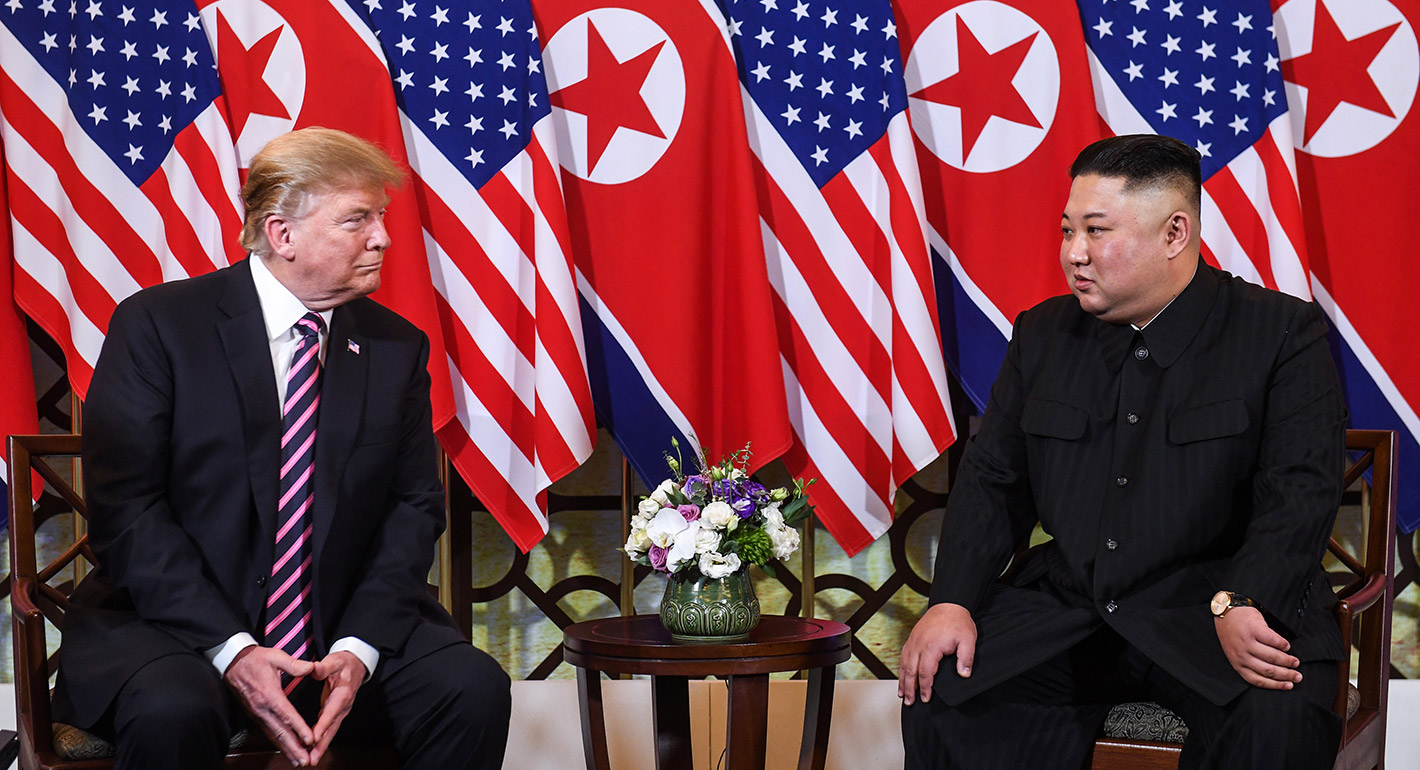
Source: Getty
The first summit between Trump and Kim enhanced Singapore’s reputation as Asia’s emerging diplomatic centre. For Hanoi, the second summit is a big opportunity to showcase Vietnam’s dramatic economic transformation in recent years.
Source: Indian Express
Vietnam’s capital Hanoi is as improbable a place as Singapore for this week’s summit between US President Donald Trump and the North Korean leader, Kim Jong-un. There was a time when the big Asian peace talks were held in European capitals like Geneva. Five decades ago, negotiations to end the American war against Vietnam took place in Paris. Two decades ago, when the Taliban was ousted from Kabul in the wake of the 9/11 attacks on New York and Washington, the new framework for governing Afghanistan was hammered out in Bonn, Germany. Now Asian problems are being resolved in Asia itself.
It is no small thing that the US president is traveling to Singapore and Hanoi to sit down with Kim. It is even more significant that Trump is willing to gamble on striking a nuclear deal with Kim and braving the charge of appeasement. Even limited success for Trump could set in motion profound structural changes in East Asia.
For nearly seven decades, Washington’s conventional wisdom argued that it is impossible to unfreeze the Korean Peninsula’s geopolitics. The end of the Cold War did not change that perception. The addition of the nuclear layer to the conflict — with the Kim family’s quest for nuclear weapons in the 1990s — made the Korean problem more salient and intractable at the same time.
Whatever Trump’s critics might say, the hopes for peace in the Korean Peninsula have never been as high as they are today. Many in the West had trashed the Singapore summit — the first ever between an American president and a Korean leader — as a failure. Sceptics continue to insist that the Hanoi summit might not be very different; many others fear that Trump might end up making a “bad deal”.
Trump has over-ruled his advisers to introduce more flexibility into the US negotiating position. Some Republicans and many Democrats in the US Congress are critical of Trump’s engagement with Kim. Speaking to reporters last week, Trump said he is no hurry for the “denuclearisation” of the Korean Peninsula and hinted that he could live with a nuclear freeze for now. As his officials discuss a range of nuclear steps from Kim, Trump is offering possibilities for progress in three other areas.
The first relates to agreeing to what is being called a peace regime in the Korean Peninsula. The Korean War during 1950-53, that followed the partition of the Korean Peninsula at the end of World War II, did not end with a peace accord, but a ceasefire signed by the three main parties, China, North Korea and an international coalition led by the US. Both Kim and the South Korean president want a formal declaration of peace. Trump appears ready.
The second relates to the improvement of US-North Korea bilateral relations. Since the last summit, Kim has stepped up efforts to find and return the remains of some American soldiers killed or unaccounted for during the Korean War. In return for concrete North Korean steps on denuclearisation, Trump might offer something Kim has long wanted — diplomatic relations with America. There is speculation that the two leaders might agree to set up liaison offices in Washington and Pyongyang.
The third relates to the easing of international economic sanctions that is at the top of Kim’s priorities. While Washington is averse to lifting the principal leverage against Pyongyang, Trump may be willing to carve out an exception to South Korea, whose leader, President Moon Jae-in, believes economic incentives are critical for getting Kim to move faster towards denuclearisation.
In moving America from an exclusive focus on “denuclearisation” to a more balanced approach that factors in peace and prosperity, Trump has generated unprecedented optimism about unfreezing the geopolitics of the Korean Peninsula. Until recently, Washington insisted that progress must be “sequential” — denuclearisation must precede any liberalisation of political and economic sanctions against North Korea. Trump is now open to “simultaneous” movement on all tracks.
Trump has also recognised the importance of addressing the Kim family’s original rationale for building a nuclear arsenal — the fear of American military presence in the peninsula and Washington’s temptations for “regime-change” in the North. Trump’s change of approach — founded in part in his own conviction that America must begin to end its “forever wars” around the world — has opened enormous space for diplomacy with Kim.
Trump’s new strategy could not have come this far without strong support from Moon, who is determined to explore a historic political reconciliation with the North and more than eager to facilitate the engagement between Washington and Pyongyang. While there is much distance to be covered, Trump, Kim and Moon have demonstrated that it is possible to imagine a political rearrangement of the Korean Peninsula.
Not everyone is taking a benign view of the “ménage et trois” between Trump, Kim and Moon. Some in Beijing worry that Trump’s diplomacy is not about “denuclearisation” but prising North Korea away from China. After all, Chinese leaders see the Korean Peninsula as their front yard. They insist Beijing must be the final arbiter of Korean politics. Tokyo is equally worried that Trump is going ahead with Korean peace plans without paying heed to Japan’s interests. Tokyo has nightmares about a potential Trump decision to live with North Korean nuclear weapons and its awful security implications for Japan.
Not all Asian countries are unhappy though. The first summit between Trump and Kim enhanced Singapore’s reputation as Asia’s emerging diplomatic centre. For Hanoi, the second summit is a big opportunity to showcase Vietnam’s dramatic economic transformation in recent years. Trump, in turn, hopes that the rise of capitalist Singapore and communist Hanoi might encourage Kim to see the virtues of giving up nukes and opening up to America and the world.
This article was originally published in the Indian Express.
Former Nonresident Senior Fellow, Carnegie India
A leading analyst of India’s foreign policy, Mohan is also an expert on South Asian security, great-power relations in Asia, and arms control.
Recent Work

C. Raja Mohan, Darshana M. Baruah


Alexander Gabuev, Paul Haenle, C. Raja Mohan, …
Carnegie does not take institutional positions on public policy issues; the views represented herein are those of the author(s) and do not necessarily reflect the views of Carnegie, its staff, or its trustees.

The EU can impose sanctions but struggles to enforce them without the United States. With Washington increasingly disinterested in backing European interests, the bloc must now fend for itself.


Nicu Popescu, Tiago Antunes
Global and rising powers will need to engage with Africa’s priorities and agency in order to secure the continent’s increasingly attractive partnerships.
Fonteh Akum
Rubio’s recent visit brought welcome attention, but more capital requires governance changes that may be a hard sell for regional governments.

Jennifer B. Murtazashvili

America’s foreign-policy objectives have grown more demanding while Americans have demanded greater focus on their own affairs.

Stephen Wertheim

Japan’s long-term security policy is driven by concerns about China, and there is little appetite for (or interest in) pursuing a confrontation with Moscow.

James D.J. Brown