

Article
C. Raja Mohan, Darshana M. Baruah
{
  "authors": [
    "C. Raja Mohan"
  ],
  "type": "legacyinthemedia",
  "centerAffiliationAll": "",
  "centers": [
    "Carnegie Endowment for International Peace",
    "Carnegie India"
  ],
  "collections": [],
  "englishNewsletterAll": "",
  "nonEnglishNewsletterAll": "",
  "primaryCenter": "Carnegie India",
  "programAffiliation": "",
  "programs": [],
  "projects": [],
  "regions": [
    "India"
  ],
  "topics": [
    "Domestic Politics",
    "Foreign Policy"
  ]
}
Source: Getty
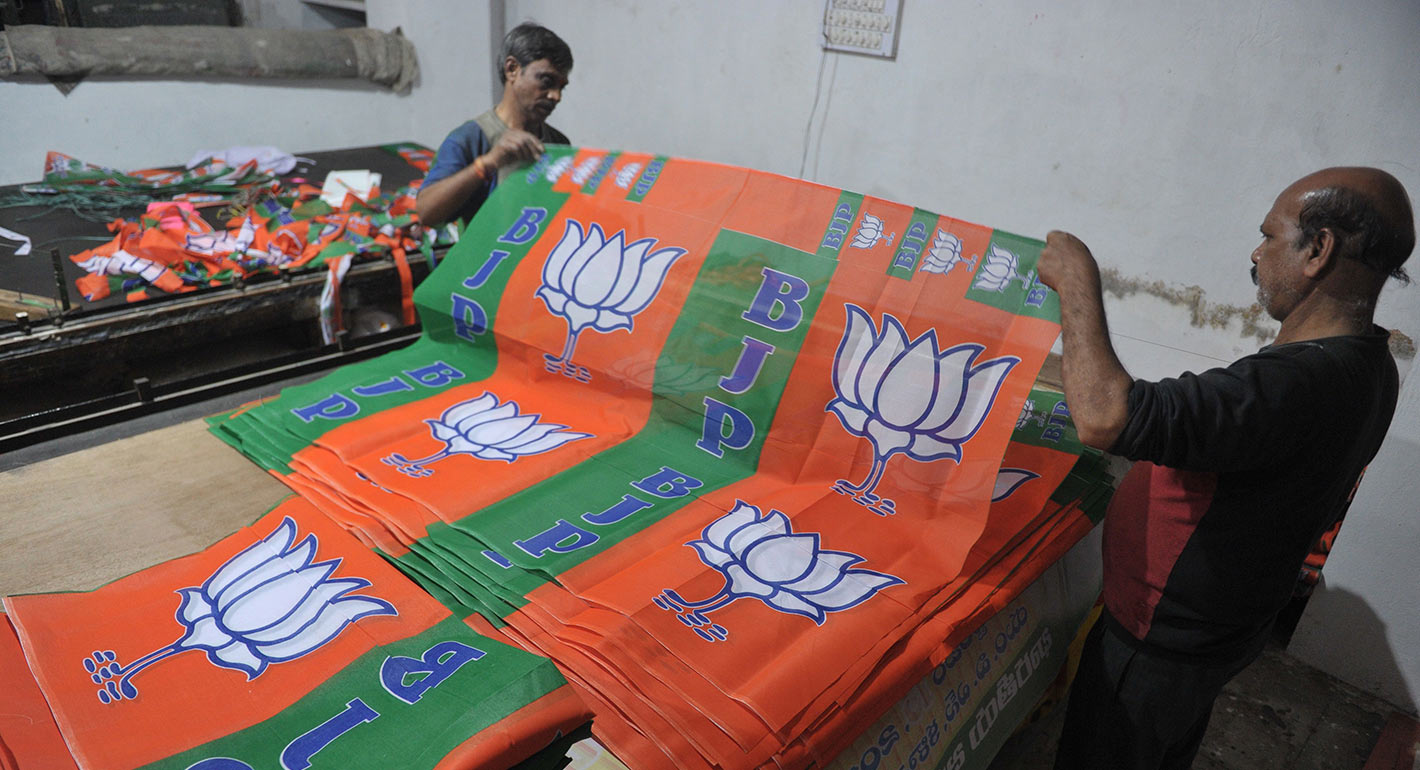
The problem is not the lack of big ideas within Indian political class. There are a host of other reasons that limit public engagement on foreign policy. Few parties believe foreign policy is of any importance in winning elections.
Source: Indian Express
“Absence of evidence”, former US defence secretary Donald Rumsfeld had said famously, is not “evidence of absence”. Rumsfeld was answering questions about the US inability to find weapons of mass destruction in Iraq. Washington, you might recall, had cited Iraq’s WMD as the principal justification for ousting Saddam Hussein’s regime in early 2003. While Rumsfeld was elegant in his evasion, there is a kernel of truth in his formulation.
Consider the question of Indian foreign policy. Looking at the foreign policy sections of the election manifestos, you might be forgiven for thinking that the Indian political class is barely interested in the world beyond its shores. On the face of it, this seems odd. After all, India’s relative weight has rapidly risen in the last two decades. India’s aggregate GDP, in nominal terms, is now close to $3 trillion and is ranked fifth in the world. India’s total annual trade, in goods and services, is now little over $1 trillion. India’s economic exposure has never been as large as it is today.
India’s role in shaping the global balance of power, shaping global regimes on areas ranging from trade and environment to the maritime and outer space domains has also steadily risen. No wonder chancelleries across the world, think tanks and academia pay lots of attention to the sources and consequences of India’s international orientation. Yet, Indian political parties seem reluctant to discuss either the changing world around us or the ways in which India can secure and advance its interests in it.
There was a time when communists began any national assessment with a discussion of the “global correlation of forces”. But the CPM manifesto has little analysis of the changing global situation. It has clear answers though: India should distance itself from the US, revise the India-US nuclear agreement and defence cooperation arrangements, promote global nuclear disarmament, multipolarity and reactivate the SAARC. One can surely disagree with this somewhat static worldview. But there is no question that it puts across clear positions.
If the CPM is too explicit in what it would like to do with foreign policy, the Congress and BJP carefully avoid taking definitive positions. As parties seeking to govern, they think ambiguity is better than clarity. Consider the following: The Congress says “We will work closely with all countries of the world, and particularly India’s neighbours and the G-20 countries, in various multilateral forums and institutions.” You can’t quarrel with that. But what does that mean in the real world?
The BJP frames the foreign policy section of the manifesto in terms of a rising India playing a larger role. But it quickly moves on to the comforting generalisation that “the ancient Indian vision of ‘Vasudhaiva Kutumbakam’ will form the basis in our global co-operation for progress, prosperity, peace and security, especially with friendly countries and neighbours”.
Does this mean the leadership of the two main parties is unaware or unwilling to focus clearly on foreign policy challenges? The lack of evidence, however, is not evidence of absence. If you give credit where it’s due, you will note that India’s political classes have successfully navigated the demanding international environment when the Cold War came to an end in 1991 and the national economy went broke. While the bureaucracy remained naturally conservative, it was the political leadership which pushed through a range of initiatives.
The nuclear tests of 1998 and the diplomacy pursued by three successive governments to end India’s prolonged global nuclear isolation is one example. The effort to find lasting solutions to the boundary dispute with China and the Kashmir question with Pakistan was another. Although it did not succeed, it opened the door for some creative thinking about India’s most difficult strategic legacies. The political class has also tried to recast India’s engagement with its near and extended neighbourhoods. It has compelled Delhi’s land-lubbers to start thinking maritime.
The problem is not the lack of big ideas within our political class. There are a host of other reasons that limit public engagement on foreign policy. Few parties believe foreign policy is of any importance in winning elections. Pakistan might look like an exception; but then, it is really about domestic politics. Although general elections are a good moment to reflect on the world, the foreign policy sections of the manifestos are at best an afterthought and give no guidance on what the Congress or the BJP might do when in power.
The reluctance to set formal public goals on foreign policy, however, makes it harder to form an elite consensus within parties and across them. This, in turn, means suboptimal outcomes in Indian diplomacy. The differences within the Congress, for example, severely complicated India’s engagement with the US during the UPA rule.
The BJP led by Atal Bihari Vajpayee had invented the phrase that the US is a “natural ally” of India, but the party under the leadership of L K Advani began to undermine the logic of that proposition when it sat in Opposition. Differences within the BJP and Congress also prevented the Vajpayee and Manmohan Singh governments respectively from pursuing effective negotiations with Pakistan. A more substantive public debate on foreign policy goals might have expanded popular support for these initiatives and allowed India to better leverage the external opportunities that came its way.
The next government in Delhi will confront many challenges, including the unpredictable trajectories of China and America. Delhi’s responses will be generated on the run, through improvisation, by the instinct of key personalities and the quality of bureaucratic advice. That is a recipe for India’s continuing underperformance on the global stage.
This article was originally published in the Indian Express.
Former Nonresident Senior Fellow, Carnegie India
A leading analyst of India’s foreign policy, Mohan is also an expert on South Asian security, great-power relations in Asia, and arms control.
Recent Work

C. Raja Mohan, Darshana M. Baruah


Alexander Gabuev, Paul Haenle, C. Raja Mohan, …
Carnegie does not take institutional positions on public policy issues; the views represented herein are those of the author(s) and do not necessarily reflect the views of Carnegie, its staff, or its trustees.

In Ukraine, Gaza, and Iran, AI warfare has come to dominate, with barely any oversight or accountability. Europe must lead the charge on the responsible use of new military technologies.

Raluca Csernatoni

It’s true that many Armenians would vote for anyone just to be rid of Pashinyan, whom they blame for the loss of Nagorno-Karabakh, but the pro-Russia opposition is unlikely to be able to channel that frustration into an electoral victory.

Mikayel Zolyan

Orbán created an image for himself as virtually the only opponent of aid to Ukraine in the entire EU. But in reality, he was simply willing to use his veto to absorb all the backlash, allowing other opponents to remain in the shadows.

Maksim Samorukov
Montenegro and Albania are frontrunners for EU enlargement in the Western Balkans, but they can’t just sit back and wait. To meet their 2030 accession ambitions, they must make a strong positive case.


Dimitar Bechev, Iliriana Gjoni
By reorganizing federal disaster policy around the rights of displaced people, the United States could unlock additional federal resources, accelerate the rebuilding of lives and livelihoods, and reduce suffering and economic disruption.

Kayly Ober