

Commentary
- +3
Marwan Muasher, Amr Hamzawy, Rain Ji, …
{
  "authors": [
    "Yasmine Farouk"
  ],
  "type": "commentary",
  "centerAffiliationAll": "dc",
  "centers": [
    "Carnegie Endowment for International Peace",
    "Malcolm H. Kerr Carnegie Middle East Center"
  ],
  "collections": [],
  "englishNewsletterAll": "menaTransitions",
  "nonEnglishNewsletterAll": "",
  "primaryCenter": "Carnegie Endowment for International Peace",
  "programAffiliation": "MEP",
  "programs": [
    "Middle East"
  ],
  "projects": [],
  "regions": [
    "Middle East",
    "Iran",
    "Saudi Arabia",
    "Gulf"
  ],
  "topics": [
    "Security",
    "Foreign Policy"
  ]
}
Source: Getty
Far from being backed into a corner by Iran, Saudi Arabia has options. It may seem counter-intuitive, but Riyadh could reap rewards from a policy of smart restraint toward Iran.
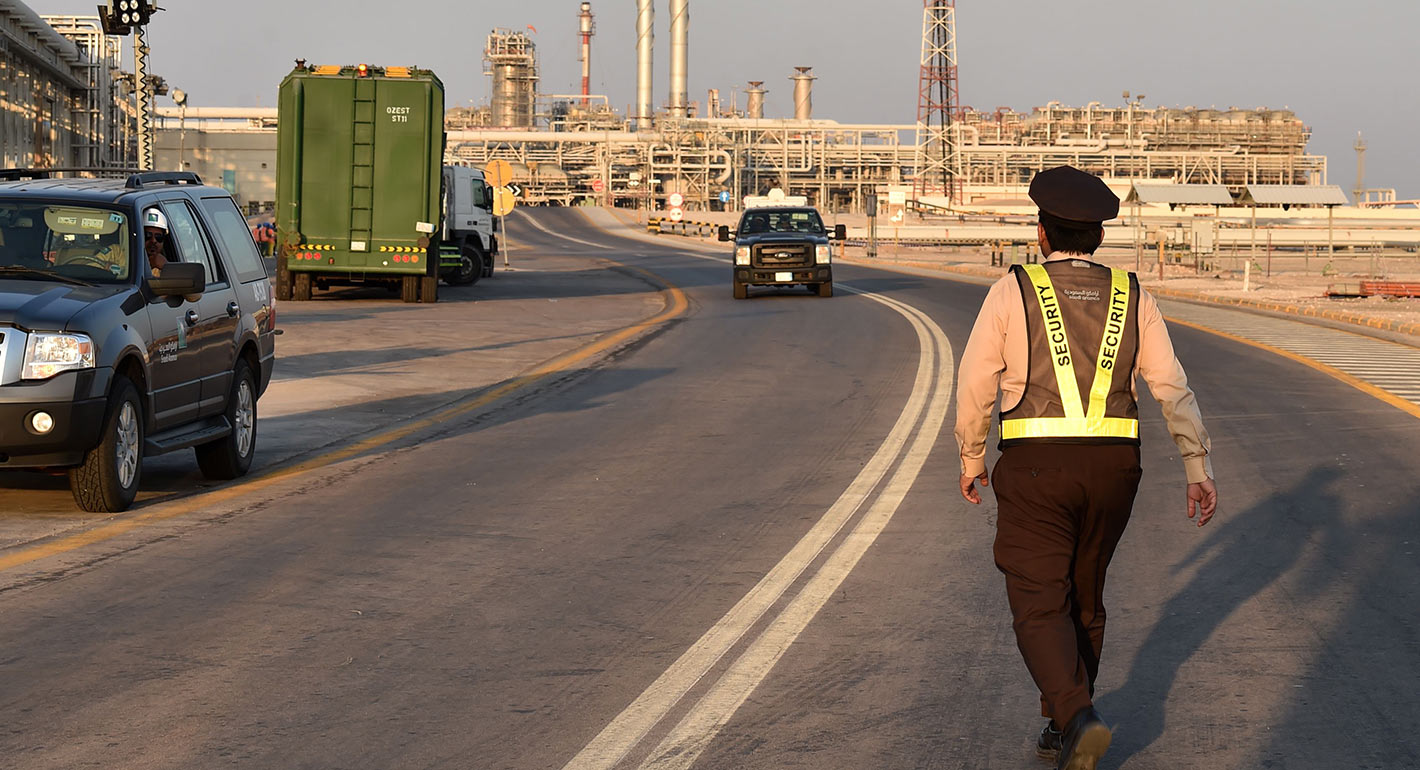
The September 14 2019 attacks on Saudi Arabia’s oil processing plants were unprecedented. Saudi officials quickly stated that all options for response are on the table. But one option is better than the alternatives: a non-aggression arrangement with Iran. Despite the kingdom’s confrontational rhetoric on Iran, a non-aggression arrangement may be both more likely and more useful than one would expect.
The Saudi crown prince, Mohamed Bin Salman, has said that he “hopes not” to order “a military response” and that “the political and peaceful solution is much better than the military one.” He even welcomed the idea of a meeting between U.S. President Donald Trump and Iranian President Hassan Rouhani to craft a new deal, saying: “absolutely. This is what we all ask for.” His answer might signal a slight yet promising departure from the usual combative Saudi rhetoric on Iran.
Saudi leaders shouldn’t deny themselves the option of sitting with Iranian leaders to negotiate their own deals. Yet opening a channel with Iran after the attacks bears a political cost for Riyadh. It could be seen as a sign of weakness, not only by Iran, but also by the Saudi regime’s foes and friends, at home and abroad.
Saudi Arabia could start by reaching a non-aggression arrangement with Iran. It doesn’t have to be public, nor does it necessarily require immediate direct talks between the two sides. It could rather be approached as a measure to build trust and mobilize international support, before opening an official direct channel of negotiations, which is what Iran seems to be seeking. In exchange, Saudi Arabia could delay publishing the results of the ongoing investigations of the attacks against Aramco, which would implicate Iran. So far, Saudi Arabia has indeed avoided accusing Iran of being the launch site of the attacks.
Such an arrangement, which relies on the mediation of third parties, would test the credibility of the Iranian president, who made non-aggression one of two “fundamental principles” of his “coalition for hope”, a vision for regional stability officially called the Hormuz Peace Endeavor.
It wouldn’t be the first time that Riyadh used such a strategy. The kingdom applied the same arrangement after the Iranians sponsored the Khobar Towers bombings in Saudi Arabia in 1996. Instead of retaliation, Saudi leaders took the Iranian president up on his call for a rapprochement, opening the door for security cooperation between the two countries.
Saudi Arabia’s greatest leverage in the conflict with Iran is its global network of friends. This allowed the kingdom to achieve a diplomatic victory at the United Nations General Assembly (UNGA) in September 2019, when, in addition to U.S. support, three leading European powers, all signatories of the Iran nuclear deal or JCPOA, issued a statement confirming that the attacks “concern all of us” and that “Iran bears responsibility”.
Yet Riyadh shouldn’t read such assurances as an endorsement of the U.S. maximum pressure strategy, to which the kingdom adheres. The European statement called for “de-escalation through sustained diplomatic efforts and engagement with all parties.”
Both the U.S. and European responses should dampen the kingdom’s expectations for military support from its friends in the face of Iranian escalation.
However, both the United States and Europe could find it in their interests to back a Saudi-Iranian non-aggression arrangement, especially if Saudi Arabia lent support to the Europeans’ diplomatic efforts at the same time. French President Emmanuel Macron specifically addressed Saudi concerns in the parameters he laid out in his speech before UNGA. He also said that any upcoming negotiations with Iran should bring regional powers to the table. Most importantly, he explicitly laid emphasis on resolving the conflict in Yemen.
Saudi Arabia could involve other permanent members of the Security Council, Russia and China, in the making of this non-aggression arrangement. If the evidence that charges Iran with the attacks is not published, Russian and Chinese investigators could even be invited to the sites of the attacks.
Beijing has an interest in supporting a Saudi-Iranian arrangement, at least privately, in accordance with its strictly economic involvement in the Gulf. Russia seems less genuinely interested in de-escalation, and Riyadh knows it.
Yet Russian President Vladimir Putin will visit Saudi Arabia this month for the first time since 2007, likely in pursuit of more influence in the Gulf. Granting a request for Russian support for Saudi de-escalation endeavors may fall within the Kremlin’s plan for security in the Gulf. That means it could draw a more constructive engagement from Moscow.
It is possible that Russian and Chinese air defense systems could brace Saudi defense capacities against the kind of attacks that took place on September 14. The prospect of military cooperation could attract both countries to support Riyadh’s de-escalation efforts. The Trump administration is so far tolerating a degree of similar military cooperation.
Iran’s regional influence is partly built on exploiting divisions between and inside other Arab countries. In the past two years, Saudi Arabia’s policies in the Arabian Peninsula, the Red Sea, and the Arab-Israeli conflict have created tensions even with its traditional Arab allies, including Kuwait, Egypt, Morocco and Jordan. Reconciling Saudi Arabia’s interests with those of its friends would provide Saudi Arabia with a wider Arab coalition to counterbalance Iran’s regional influence. Finding a compromise with Qatar and Oman could also reduce the effectiveness of Iranian damage to Saudi Arabia’s regional influence.
In the medium term, a revision of Riyadh’s regional policies will restore Saudi Arabia’s leadership status in the Middle East. A Saudi investment in regional security frameworks would offer an alternative to external proposals, on which Saudi Arabia has less influence.
While Saudi Arabia continues to cast the attacks as “against the world and not just Saudi Arabia,” Trump framed them as “an attack on Saudi Arabia… that wasn’t an attack on us.” Trump has proven more than once that the United States won’t get involved in a military escalation, even when U.S. policy is the trigger. In fact, after the attacks on Saudi Arabia, the United States tried temporarily repatriating its command and control center for airpower in the region from the Gulf, for the first time since 1991.
The U.S. response shows that the United States will continue its maximum pressure strategy toward Iran, but will probably stop short of a U.S. military response. However, this doesn’t prevent further escalation between Iran and Saudi Arabia.
Trump stated that he would follow Saudi Arabia’s lead in response to the attacks. A Saudi non-aggression arrangement with Iran would thus be an easy sell to him.
Previous Saudi openings towards Iran didn’t guarantee lasting protection against what Riyadh’s foreign minister has called “hostile Iranian activity.” Yet time is of the essence. This moment in the Middle East’s international politics offers incentives and deterrents that Saudi Arabia can leverage in its negotiations with Iran. The longer the kingdom waits, the less influence it will have on the final outcome of its conflict with Iran, and on any future multilateral framework for security in the Gulf.
Previous attempts to negotiate with Iran shouldn’t be a proof of failure of the diplomatic path. Instead, they offer lessons on how to make the next overtures more likely to succeed and endure.

Former Nonresident Scholar, Middle East Program
Yasmine Farouk was a nonresident scholar in the Middle East Program at the Carnegie Endowment for International Peace.
Recent Work


Marwan Muasher, Amr Hamzawy, Rain Ji, …
Yasmine Farouk
Carnegie does not take institutional positions on public policy issues; the views represented herein are those of the author(s) and do not necessarily reflect the views of Carnegie, its staff, or its trustees.

Despite public disputes over trade and immigration, the strategic partnership’s foundations remain sturdy.

Sameer Lalwani

It signals a new era of tech diffusion and warfare.

Steve Feldstein

With its public finances in shambles, the far right polling at 35 percent ahead of the 2027 presidential election, and a growing protest movement, is France’s crisis a threat to the EU’s geopolitical awakening?

Rym Momtaz, ed.

Russia’s AI-driven propaganda campaigns operate in a fragmented, chaotic, and often illogical manner. That’s not necessarily a problem for the Kremlin, though: It’s much easier to mimic genuine public debate that way.

Ilya Klishin

Ahead of a tough winter for Ukraine, Donald Trump’s swing back toward Russia bodes ill. But instead of panicking, Kyiv’s European allies are focusing on action.
Rym Momtaz