

• Research
  • Emissary
  • About
  • Experts
Carnegie Global logoCarnegie lettermark logo
DemocracyIran
  • Donate
{
  "authors": [
    "Moisés Naím",
    "Brian Winter"
  ],
  "type": "legacyinthemedia",
  "centerAffiliationAll": "dc",
  "centers": [
    "Carnegie Endowment for International Peace"
  ],
  "collections": [],
  "englishNewsletterAll": "americanStatecraft",
  "nonEnglishNewsletterAll": "",
  "primaryCenter": "Carnegie Endowment for International Peace",
  "programAffiliation": "ASP",
  "programs": [
    "American Statecraft"
  ],
  "projects": [],
  "regions": [
    "North America"
  ],
  "topics": [
    "Political Reform"
  ]
}

Source: Getty

In The Media

Why Latin America Was Primed to Explode

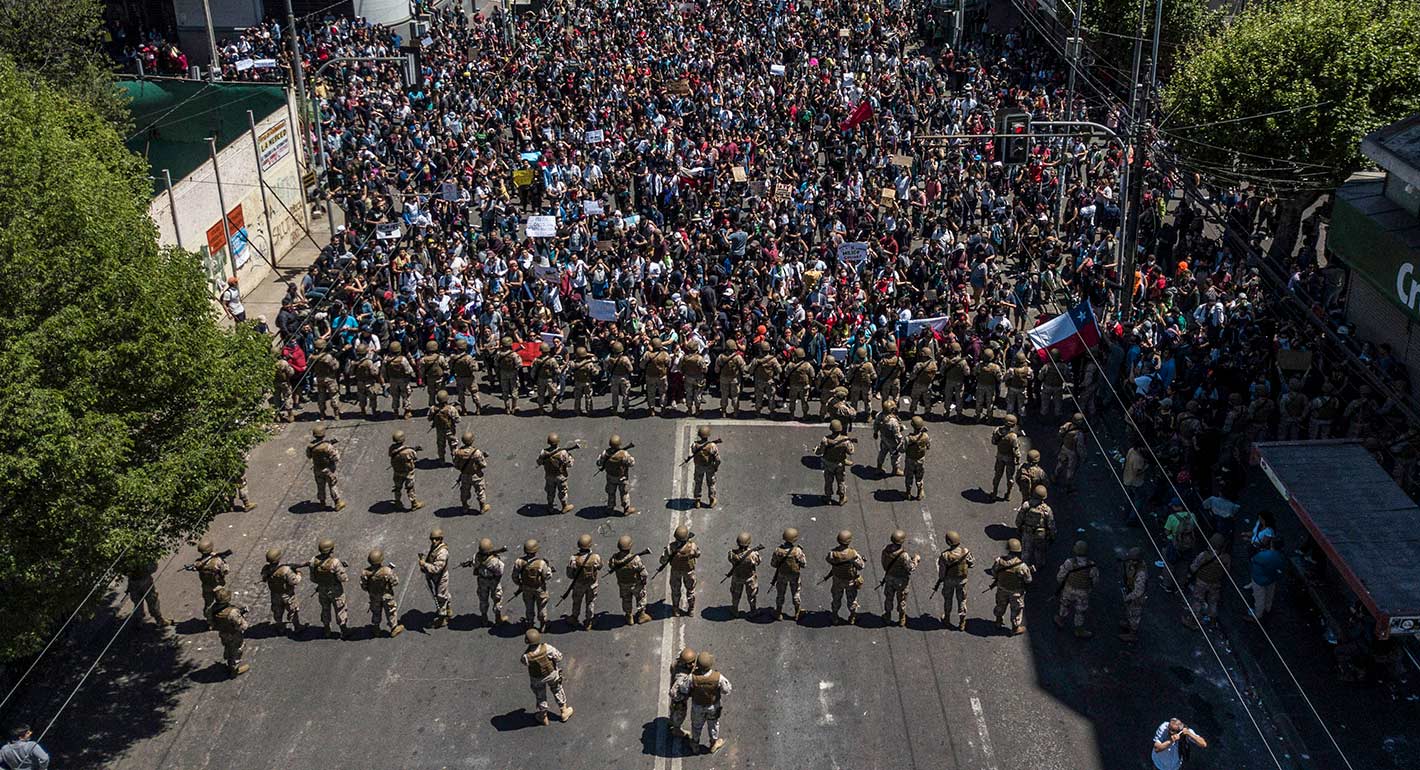
The protests now raging across much of Latin America originated from different sparks but are connected by a single common denominator: economic malaise.

Link Copied
By Moisés Naím and Brian Winter
Published on Oct 29, 2019
Program mobile hero image

Program

American Statecraft

The American Statecraft Program develops and advances ideas for a more disciplined U.S. foreign policy aligned with American values and cognizant of the limits of American power in a more competitive world.

Learn More

Source: Foreign Affairs

In a world aflame with protest, Latin America stands out as a raging ten-alarm fire. From Bolivia to Ecuador, Haiti to Honduras, the closing months of 2019 have seen enormous, sometimes violent demonstrations prompted by a truly dizzying array of grievances, including electoral fraud, corruption, and rising fuel and public transportation prices. Even Chile, the region’s ostensible oasis of calm and prosperity, erupted in protests and riots that left 20 dead and forced President Sebastián Piñera to declare a state of emergency. It is now an open question whether any country in the region can be considered truly stable.... 

Read Full text

This article was originally published in Foreign Affairs.

About the Authors

Moisés Naím

Distinguished Fellow

Moisés Naím is a distinguished fellow at the Carnegie Endowment for International Peace, a best-selling author, and an internationally syndicated columnist.

Brian Winter

Brian Winter is vice president for policy at the Americas Society/Council of the Americas.

Authors

Moisés Naím
Distinguished Fellow
Moisés Naím
Brian Winter

Brian Winter is vice president for policy at the Americas Society/Council of the Americas.

Political ReformNorth America

Carnegie does not take institutional positions on public policy issues; the views represented herein are those of the author(s) and do not necessarily reflect the views of Carnegie, its staff, or its trustees.

More Work from Carnegie Endowment for International Peace

  • Commentary
    Strategic Europe
    The EU Needs a Third Way in Iran

    European reactions to the war in Iran have lost sight of wider political dynamics. The EU must position itself for the next phase of the crisis without giving up on its principles.

      Richard Youngs

  • Commentary
    Carnegie Politika
    The Kremlin Is Destroying Its Own System of Coerced Voting

    The use of technology to mobilize Russians to vote—a system tied to the relative material well-being of the electorate, its high dependence on the state, and a far-reaching system of digital control—is breaking down.

      Andrey Pertsev

  • Commentary
    Carnegie Politika
    Notes From Kyiv: Is Ukraine Preparing for Elections?

    As discussions about settlement and elections move from speculation to preparation, Kyiv will have to manage not only the battlefield, but also the terms of political transition. The thaw will not resolve underlying tensions; it will only expose them more clearly.

      Balázs Jarábik

  • U.S. and Indian flags on display.
    Paper
    Indian Americans in a Time of Turbulence: 2026 Survey Results

    A new Carnegie survey of Indian Americans examines shifting vote preferences, growing political ambivalence, and rising concerns about discrimination amid U.S. policy changes and geopolitical uncertainty.

      • +1

      Milan Vaishnav, Sumitra Badrinathan, Devesh Kapur, …

  • Commentary
    Strategic Europe
    Can Europe Still Matter in Syria?

    Europe’s interests in Syria extend beyond migration management, yet the EU trails behind other players in the country’s post-Assad reconstruction. To boost its influence in Damascus, the union must upgrade its commitment to ensuring regional stability.

      Bianka Speidl, Hanga Horváth-Sántha

Get more news and analysis from
Carnegie Endowment for International Peace
Carnegie global logo, stacked
1779 Massachusetts Avenue NWWashington, DC, 20036-2103Phone: 202 483 7600Fax: 202 483 1840
  • Research
  • Emissary
  • About
  • Experts
  • Donate
  • Programs
  • Events
  • Blogs
  • Podcasts
  • Contact
  • Annual Reports
  • Careers
  • Privacy
  • For Media
  • Government Resources
Get more news and analysis from
Carnegie Endowment for International Peace
© 2026 Carnegie Endowment for International Peace. All rights reserved.