

Commentary
Thomas de Waal
{
  "authors": [
    "Thomas de Waal"
  ],
  "type": "legacyinthemedia",
  "centerAffiliationAll": "dc",
  "centers": [
    "Carnegie Endowment for International Peace",
    "Carnegie Europe"
  ],
  "collections": [
    "Europe’s Eastern Neighborhood"
  ],
  "englishNewsletterAll": "ctw",
  "nonEnglishNewsletterAll": "",
  "primaryCenter": "Carnegie Europe",
  "programAffiliation": "EP",
  "programs": [
    "Europe"
  ],
  "projects": [],
  "regions": [
    "Russia",
    "Europe",
    "Eastern Europe",
    "Caucasus",
    "Armenia",
    "Iran"
  ],
  "topics": [
    "Democracy"
  ]
}
Source: Getty
While several post-Soviet countries such as Georgia, Moldova, and Ukraine now routinely hold free and fair elections, another democratic pillar—rule of law—has proved much more difficult to achieve.
Source: World Politics Review
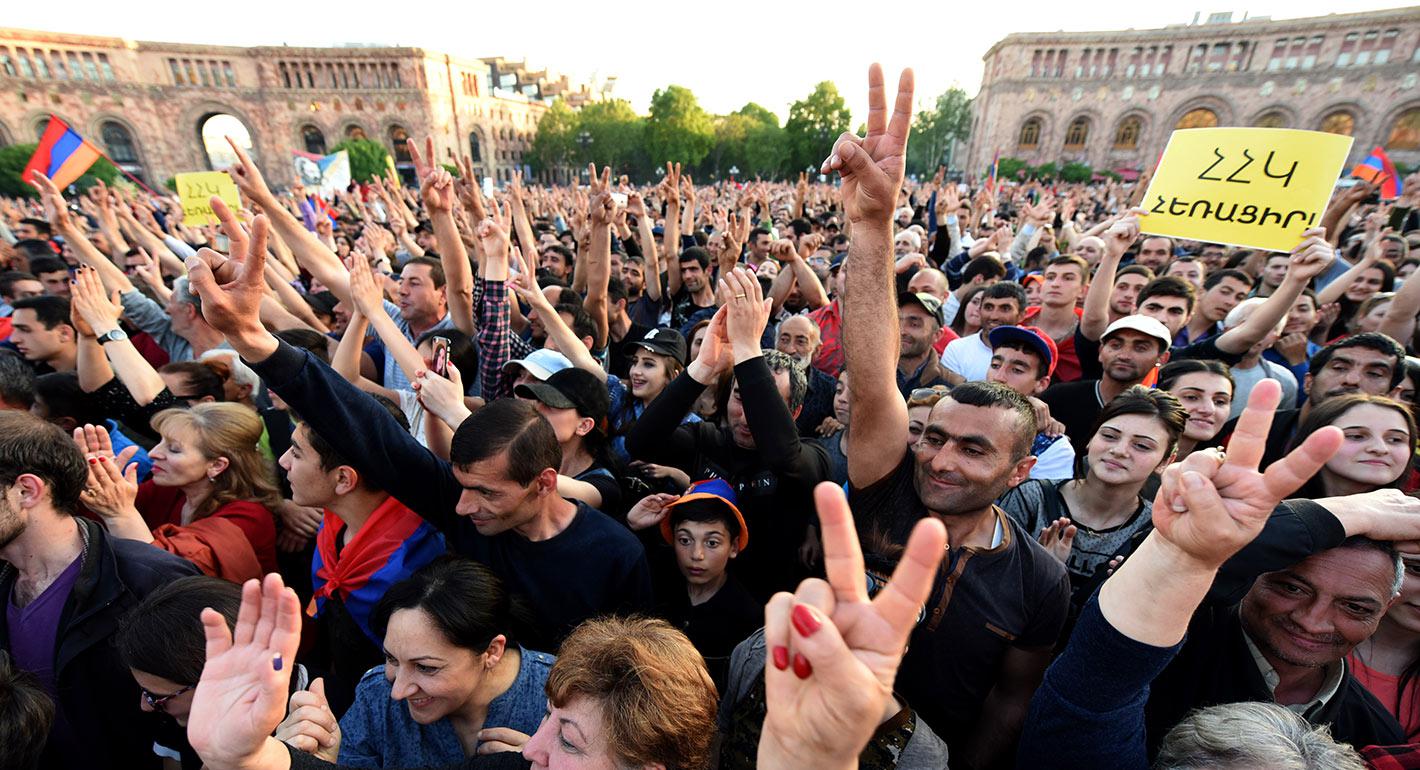
If you thought judicial appointments were an explosive issue in the United States, just look at Armenia, where over the past year, the government of Prime Minister Nikol Pashinyan has declared war on Armenia’s senior judges. Most recently, Pashinyan has called a popular referendum for April 5 to remove seven of the nine judges on the Constitutional Court, whom he accuses of blocking his reform agenda.The government sees this as a last-ditch measure to clean up a corrupt justice system that Pashinyan inherited from former President Serzh Sargsyan. For the judges, it is an assault by politicians on the rule of law. In an unusual statement last month, the president of the Venice Commission, the Council of Europe’s venerable advisory body on constitutional law, called on both sides “to exercise restraint and to de-escalate this worrying situation in order to ensure the normal operation of the constitution of Armenia.”
This article was originally published by World Politics Review.

Senior Fellow, Carnegie Europe
Thomas de Waal is a senior fellow at Carnegie Europe, specializing in Eastern Europe and the Caucasus.
Recent Work
Thomas de Waal
Thomas de Waal

Despite a new textbook, an influx of Russian teachers and managers, and an end to the teaching of Ukrainian, the Kremlin is unlikely to have “reprogrammed” locals.

Konstantin Skorkin

For every ruble allocated to social policy, health, and education in 2027, double that amount is earmarked for the army, the police, and the security services.

Alexandra Prokopenko
Fatima El Mansouri is the country’s first female prime minister. She’s also a privileged insider in a largely ceremonial position.

Sarah Yerkes

The acknowledgment has sparked fears of a new arms race with China and Russia.

Chris O’Meara

The European Commissioner for Trade is headed to China. But after President Xi’s bridge-building visit to Washington, can a more isolated EU overcome Beijing’s stranglehold on critical raw materials? Who will blink first?

Rym Momtaz, ed.