

Commentary
Andrei Kolesnikov
{
  "authors": [
    "Andrei Kolesnikov"
  ],
  "type": "legacyinthemedia",
  "centerAffiliationAll": "",
  "centers": [
    "Carnegie Endowment for International Peace",
    "Carnegie Russia Eurasia Center"
  ],
  "collections": [
    "Inside Russia"
  ],
  "englishNewsletterAll": "",
  "nonEnglishNewsletterAll": "",
  "primaryCenter": "Carnegie Endowment for International Peace",
  "programAffiliation": "",
  "programs": [],
  "projects": [],
  "regions": [
    "Russia"
  ],
  "topics": [
    "Political Reform"
  ]
}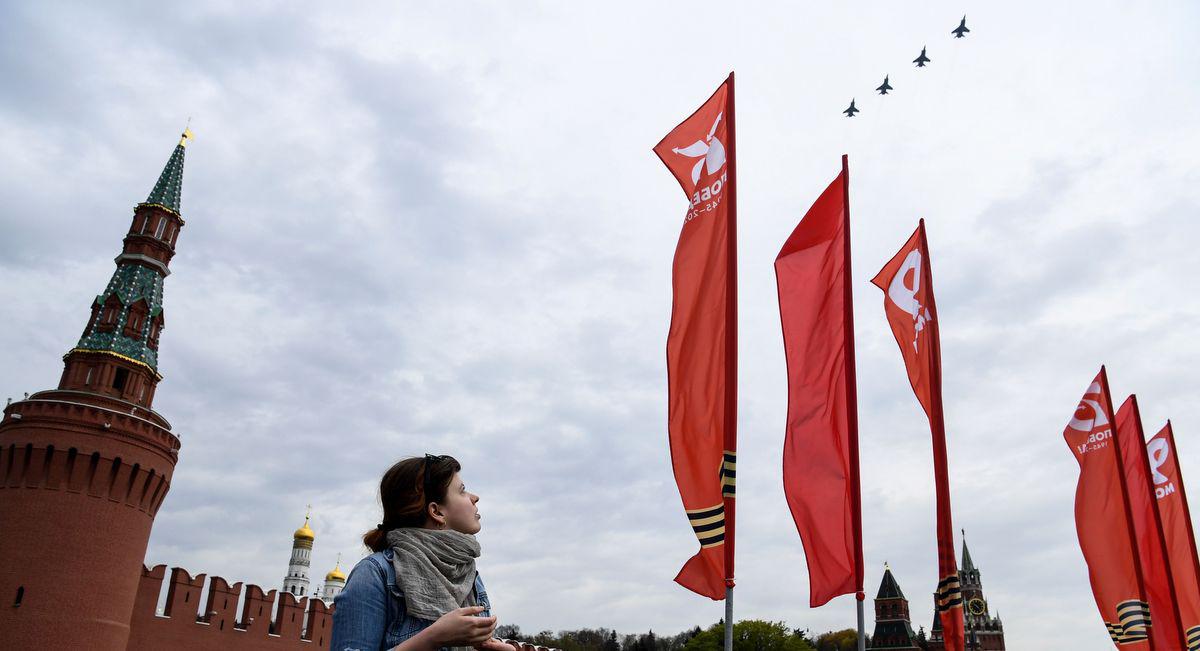
Source: Getty
The foundation of the current Kremlin ideology is a defensive narrative: that we have always been attacked and forced to defend ourselves. Another line of defense is history.
Source: Washington Post
Moscow intellectuals like to joke that our dark past is in fact our bright future. Russian President Vladimir Putin certainly seems to think so — and he’s not joking.
Every year on May 9, Russia celebrates the Soviet victory in World War II with a public holiday and an ostentatious military parade. This year, the covid-19 outbreak forced the Kremlin to postpone the parade. The festivities have ended up being limited to a military flyover and traditional fireworks display.
It turns out that the present isn’t quite as easy to control as the past. For years, Putin has been relying on the glories of history to try to galvanize the masses and distract them from current social problems — above all, the declining economy, sagging living standards and the paralysis of the political system. For the current regime, the victory over Nazism is a cornerstone of its national ideology and legitimacy. And as official policy becomes increasingly strident in its defense of the past, so, too, does its defense of the man most closely identified with the greatest triumphs of Soviet power: Joseph Stalin.
The creeping Stalinization of consciousness has been underway for years. According to the Levada Analytical Center, an independent pollster, the number of Russians expressing their “respect” for Stalin increased from 29 percent in 2018 to 41 percent in 2019. Stalin’s personal approval rating in his role in Russian history has also been growing steadily, reaching 70 percent last year. (Only 19 percent of those surveyed gave the dictator a negative assessment.) Forty-six percent of respondents in the same survey agreed that the successes achieved in the Soviet era justify the human sacrifices made during Stalinism. The opposite view was held by 45 percent — affirming that many Russians still hold starkly divergent views on the past.
Stalin — as an imaginary rather than actual historical figure, the embodiment of an idea of order and justice — is at the core of Russian perceptions of the glorious past. The Kremlin has done nothing to halt the creeping rehabilitation of Stalin; in fact, it is happy to encourage the cliches of Soviet success wherever it can.
Putin’s historical rhetoric increasingly echoes Stalin’s. When Stalin sent troops off to the front lines against the Nazi invaders on Nov. 7, 1941, he explicitly invoked Great Russian patriotism rather than Marxism-Leninism; Putin now uses the same language. The Kremlin has given new life to Soviet historical symbols. When listing the country’s accomplishments, the average Russian will remember only victory in World War II, Yuri Gagarin’s status as the first man in space, the country’s leading role in space exploration and, in a pinch, the “return” of Crimea to the Russian Federation. Small wonder that the average Russian is inclined to share Putin’s view of the Soviet collapse as “a major geopolitical disaster of the [twentieth] century.”
The state has not yet gone so far as to justify Stalin openly and officially. But the growing embrace of the Soviet dictator’s logic and actions has had a palpable effect on Russian policy. Official versions of historical events have changed in recent years to suit the Kremlin’s current agenda.
The secret protocol to the 1939 Molotov-Ribbentrop Pact, in which Germany and the Soviet Union agreed to carve up parts of eastern Europe into “areas of influence,” was officially condemned under Mikhail Gorbachev (after decades of denial that it ever existed). Now the same agreement is presented by senior Russian officials as a victory for Soviet diplomacy that made it possible to postpone Russia’s entry into the war (until 1941) and to create buffer zones in the Stalin-annexed territories of the Baltic states, western Ukraine, western Belarus and Bessarabia. It’s symptomatic that Russian propaganda resorted to the same rhetoric during the 2014 annexation of Crimea as was used during the “liberation” of Ukrainian and Belarusian lands: Both Stalin’s USSR and Putin’s Russia “came to help their brethren.”
The foundation of the current Kremlin ideology is a defensive narrative: that we have always been attacked and forced to defend ourselves. Another line of defense is history. The regime seeks to protect history from “falsifications,” a word often applied to professional analysis of an issue and the debunking of myths.
The Kremlin excels at issuing moral judgments and monopolizing historical discourse, and no one else has the right to discuss any World War II-related events. The Siege of Leningrad is the biggest taboo. When writer Yelena Chizhova, herself the daughter of survivors of the siege, argued that the siege and starvation of the city resulted from Stalin’s hatred for Leningraders, the regime unleashed a propaganda campaign against her. Members of parliament joined in, and prosecutors opened a criminal investigation into her comments.
A leader who can only offer the country its past as the future will unwittingly drive himself into a trap, taking all Russians with him. If Stalin is both our past and future, what development of the country can we hope for? In preventing the nation from having a serious conversation about its troubled past, the Kremlin makes it harder to find a way forward. And this is a more serious obstacle to Russia’s development than all of its current economic hardships.
This article was originally published in the Washington Post
Former Senior Fellow, Carnegie Russia Eurasia Center
Kolesnikov was a senior fellow at the Carnegie Russia Eurasia Center.
Recent Work
Andrei Kolesnikov
Andrei Kolesnikov
Carnegie does not take institutional positions on public policy issues; the views represented herein are those of the author(s) and do not necessarily reflect the views of Carnegie, its staff, or its trustees.

China’s political future will be shaped between now and next October. As the Communist Party enters its intense “campaign season” to prepare for a major political transition in 2027, reading Beijing's actions and responses may become more difficult as domestic politics weigh on its behavior more than usual.

Damien Ma

The EU can impose sanctions but struggles to enforce them without the United States. With Washington increasingly disinterested in backing European interests, the bloc must now fend for itself.


Nicu Popescu, Tiago Antunes

Japan’s long-term security policy is driven by concerns about China, and there is little appetite for (or interest in) pursuing a confrontation with Moscow.

James D.J. Brown

Russia is testing the waters of NATO’s mutual defense clause. What do strikes in Romanian territorial waters mean for the alliance’s posture toward Moscow?

Dimitar Bechev
The truth of the strategic situation is that Europe and Russia are extremely unlikely to be able to “turn the page” on their confrontation within the next two decades.
Arkady Moshes