• Research
  • Emissary
  • About
  • Experts
Carnegie Global logoCarnegie lettermark logo
DemocracyIran
  • Donate
{
  "authors": [
    "Thomas Carothers",
    "David Wong"
  ],
  "type": "commentary",
  "centerAffiliationAll": "dc",
  "centers": [
    "Carnegie Endowment for International Peace"
  ],
  "collections": [
    "Civic Activism",
    "Coronavirus"
  ],
  "englishNewsletterAll": "democracy",
  "nonEnglishNewsletterAll": "",
  "primaryCenter": "Carnegie Endowment for International Peace",
  "programAffiliation": "DCG",
  "programs": [
    "Democracy, Conflict, and Governance"
  ],
  "projects": [],
  "regions": [],
  "topics": [
    "Political Reform",
    "Democracy",
    "Civil Society"
  ]
}

Source: Getty

Commentary

The Coronavirus Pandemic Is Reshaping Global Protests

Many protest movements have adapted to coronavirus-related restrictions as they fold new public health and economic concerns into their lists of governance grievances.

Link Copied
By Thomas Carothers and David Wong
Published on May 4, 2020
Program mobile hero image

Program

Democracy, Conflict, and Governance

The Democracy, Conflict, and Governance Program is a leading source of independent policy research, writing, and outreach on global democracy, conflict, and governance. It analyzes and seeks to improve international efforts to reduce democratic backsliding, mitigate conflict and violence, overcome political polarization, promote gender equality, and advance pro-democratic uses of new technologies.

Learn More

The global wave of protests in recent years has run headlong into the unprecedented array of lockdowns governments have imposed on their citizens to combat the new coronavirus. Despite the predictions of some observers, however, thus far there has not been a uniform ebbing of protest activities. As a new update of the Global Protest Tracker helps illustrate, a more mixed picture is emerging.

Most major protests have indeed faltered or subsided. In France, there have been no news reports of yellow vest protests since mid-March, while unions in Colombia striking in opposition to President Iván Duque’s policies have had to cancel public marches. In New Delhi, authorities disbanded the women-led sit-in protest in the Shaheen Bagh neighborhood, which had become a central site of protests against the Citizenship Amendment Act that was passed into law last December.

Yet some protests have maintained their presence in public spaces. In Lebanon and Iraq, for example, protesters have continued to gather in the streets, though in lower numbers than in previous months. In Israel, several thousand citizens of diverse political affiliations assembled in Tel Aviv’s Rabin Square on April 19 to protest what they saw as the erosion of Israel’s democratic system under Prime Minister Benjamin Netanyahu.

Protesters in various countries have also changed their methods and focus to fit the new circumstances. In Chile, some citizens have created virtual murals to criticize government policies and projected images of recent demonstrations onto buildings and other public spaces. Some Hong Kong residents used the viral video game Animal Crossing to disseminate prodemocracy messages, resulting in the game’s removal from China’s most prominent e-commerce site. Meanwhile, in Algeria and Lebanon, protesters have delivered food to vulnerable populations, sanitized public areas, and distributed personal protective equipment—efforts that highlight the shortcomings of the countries’ healthcare and governance systems.

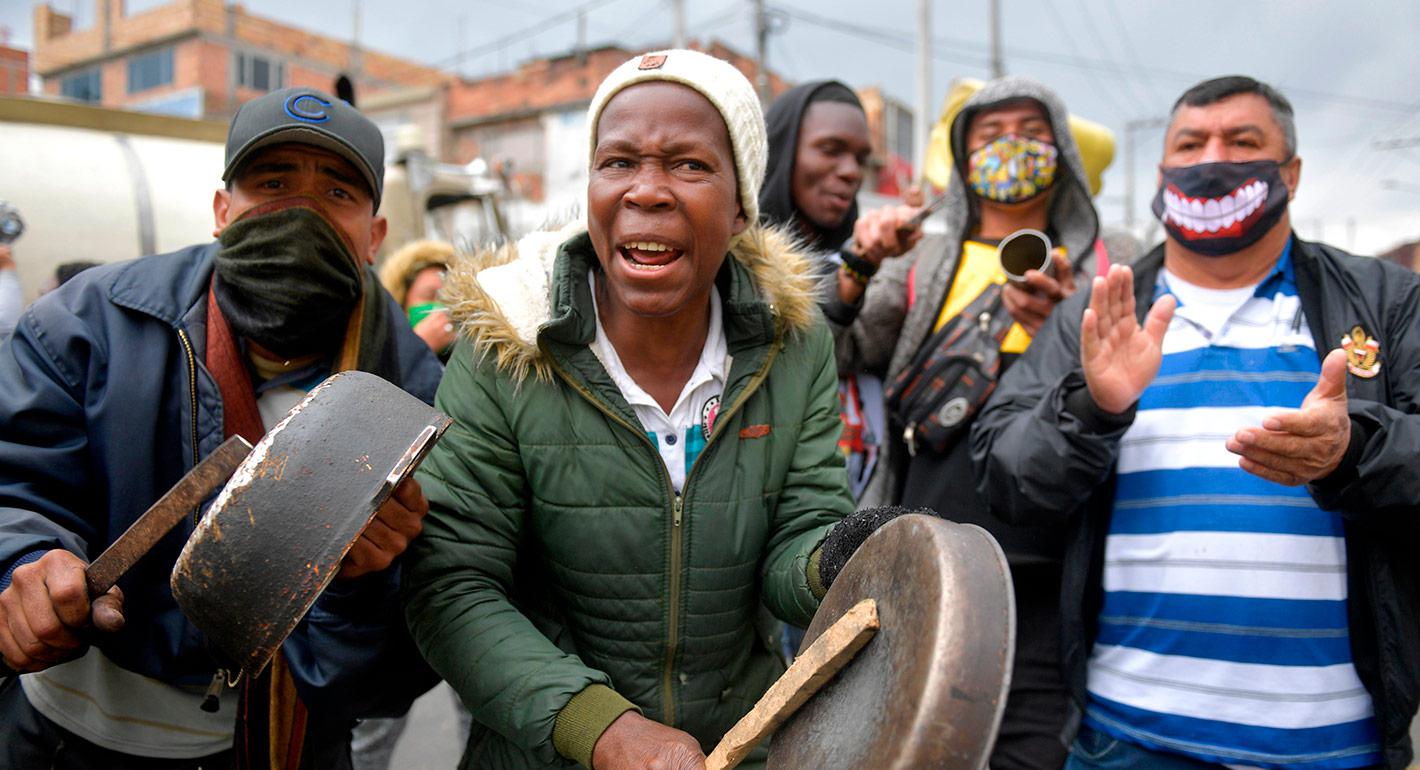
In addition, new protests directly related to the coronavirus have already emerged. In Brazil, Colombia, and other Latin American countries, citizens have banged pots and pans from their windows to express discontent with their governments’ responses. Elsewhere, economic concerns arising from the pandemic have driven citizens into the streets. Take India, where migrant workers stranded in major cities by the country’s lockdown have demonstrated to demand the payment of back wages and transport back to their local villages. In Malawi and in several U.S. states—including Michigan, Ohio, and Virginia—protests have burst out in favor of ending quarantines and lockdowns to accelerate the economic recovery. But not all such protests have economic roots: in late April, almost 1,000 protesters in Germany decried the government lockdown measures as infringements on basic freedoms of assembly and religion.

Fears over the spread of COVID-19, the disease caused by the coronavirus, have also fomented new forms of mobilization. In Abidjan, the financial hub of Côte d’Ivoire, residents worried about the possible transmission of the virus into their neighborhoods dismantled a local COVID-19 testing center. Concern over the possible spread of the disease in incarceration facilities has sparked demonstrations in prisons in Colombia, Italy, and Lebanon and outside detention facilities in U.S. states such as Arizona and California.

In short, while lockdowns and quarantines may appear to provide a timely respite to besieged governments, protesters are adapting and evolving. With the pandemic inflicting severe economic pain in countries around the world and brutally exposing governance failures, the numbers of unsettled and angry citizens are on track to rise rather than fall. In the months and years ahead, as countries emerging from the worst phase of the infection curve start to ease restrictions and reopen public life, more protests are likely.


About the Authors

Thomas Carothers

Harvey V. Fineberg Chair for Democracy Studies; Senior Fellow, Democracy, Conflict, and Governance Program

Thomas Carothers, a senior fellow in the Carnegie Endowment for International Peace’s Democracy, Conflict, and Governance Program, is a leading expert on comparative democratization and international support for democracy.

David Wong

Former James C. Gaither Junior Fellow, Democracy, Conflict, and Governance Program

David Wong was a James C. Gaither Junior Fellow with the Democracy, Conflict, and Governance Program.

Authors

Thomas Carothers
Harvey V. Fineberg Chair for Democracy Studies; Senior Fellow, Democracy, Conflict, and Governance Program
Thomas Carothers
David Wong
Former James C. Gaither Junior Fellow, Democracy, Conflict, and Governance Program
Political ReformDemocracyCivil Society

Carnegie does not take institutional positions on public policy issues; the views represented herein are those of the author(s) and do not necessarily reflect the views of Carnegie, its staff, or its trustees.

More Work from Carnegie Endowment for International Peace

  • Commentary
    The Spring and Autumn of Chinese Politics

    China’s political future will be shaped between now and next October. As the Communist Party enters its intense “campaign season” to prepare for a major political transition in 2027, reading Beijing's actions and responses may become more difficult as domestic politics weigh on its behavior more than usual.

      • Damien Ma

      Damien Ma

  • Commentary
    Carnegie Politika
    How the Latest Election Changed the Role of Russia’s Parliament

    Putin’s conservative staffing policies and search for ever greater control have cemented parliament’s transformation into a bureaucratic appendage of the executive branch.

      Andrey Pertsev

  • Two men wave and point to the sky against a dark background
    Commentary
    Emissary
    "Digger" May Be the Most Influential Climate Movie Yet

    Despite its flop at the box office, the film raises important questions for the climate community to answer.

      Leonardo Martinez-Diaz

  • Commentary
    Carnegie Politika
    Turkmenistan’s Ruling Duo Is Having a Family Feud. Will Their Regime Survive It?

    Ex-president Gurbanguly Berdimuhamedov remains interested in politics, but his son Serdar, Turkmenistan’s current president, is becoming increasingly independent and willing to break with his father’s legacy. If their covert rivalry goes too far, both risk losing power.

      Galiya Ibragimova

  • European Union EU democracy Parliament citizens assembly
    Article
    Europe’s Tide of Citizen Assemblies: Unsung Success or Anticlimax?

    A notable degree of participative democracy has firmly arrived in Europe. But to have more far-reaching impact, democratic deliberation needs to move into a radically new phase.

      Richard Youngs

Get more news and analysis from
Carnegie Endowment for International Peace
Carnegie global logo, stacked
1779 Massachusetts Avenue NWWashington, DC, 20036-2103Phone: 202 483 7600
  • Research
  • Emissary
  • About
  • Experts
  • Donate
  • Programs
  • Events
  • Blogs
  • Podcasts
  • Contact
  • Annual Reports
  • Careers
  • Privacy
  • For Media
  • Government Resources
Get more news and analysis from
Carnegie Endowment for International Peace
© 2026 Carnegie Endowment for International Peace. All rights reserved.