

Commentary
Shana Tabak, Alejandro Martin Rodriguez
{
  "authors": [
    "Shana Tabak"
  ],
  "type": "commentary",
  "blog": "Emissary",
  "centerAffiliationAll": "dc",
  "centers": [
    "Carnegie Endowment for International Peace"
  ],
  "englishNewsletterAll": "ctw",
  "nonEnglishNewsletterAll": "",
  "programAffiliation": "SCP",
  "programs": [
    "Sustainability, Climate, and Geopolitics"
  ],
  "topics": [
    "Climate Change",
    "Global Governance",
    "Civil Society"
  ]
}
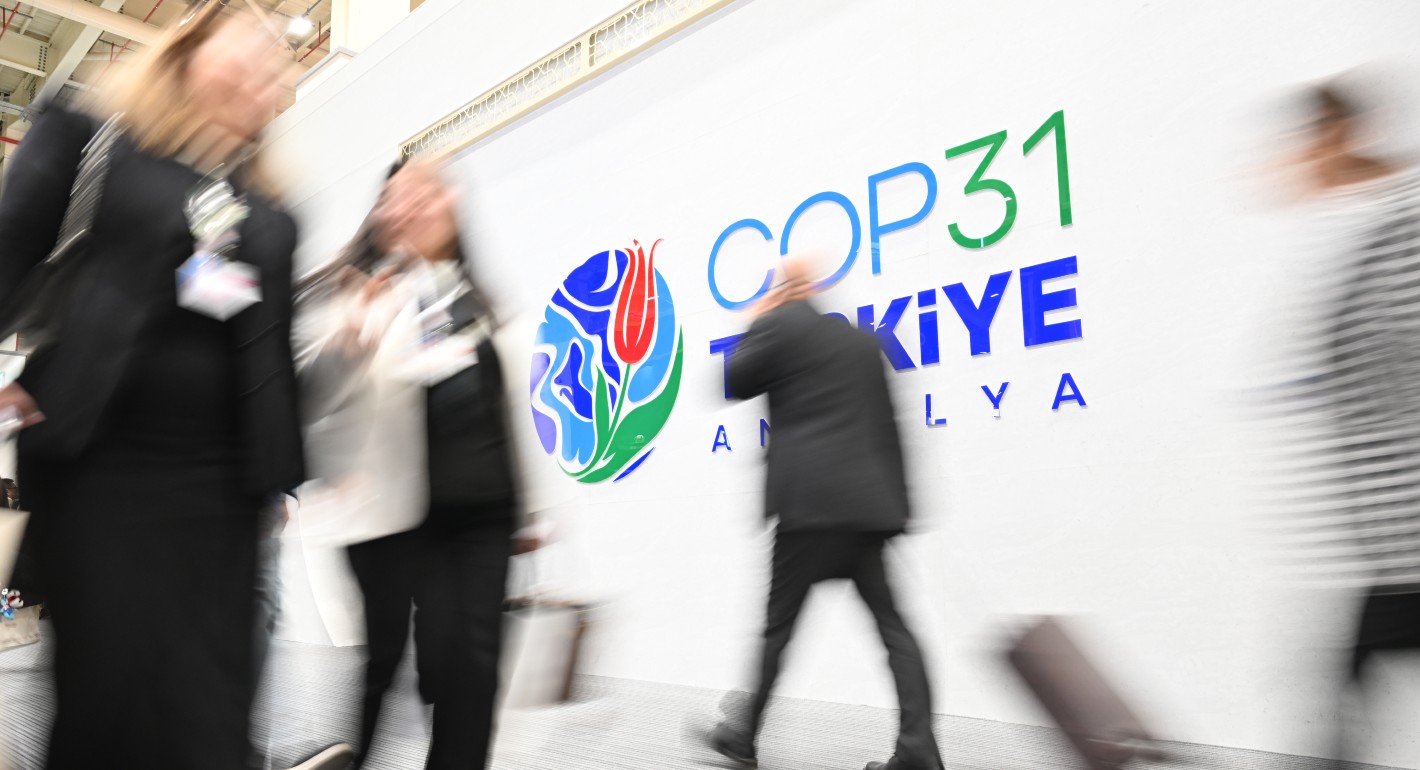
Participants attend events at COP31 on November 17, 2026. (Photo by Mehmet Ali Ozcan/Anadolu via Getty Images)
Conference delegates must decide whether their legacy will be stalled progress or a major step forward.
There’s a certain alchemy that happens at COP—somehow, half-baked ideas transform into concept notes, crowded trams lead to new friendships, or a comment at a panel sparks a new political platform. When it works, COP can be an engine for progress, but it does require luck, persistence, and faith. It’s been no different this year in Antalya, Türkiye, where COP31 is in its second week. Many are skeptical that formal negotiations will lead to any substantial breakthroughs, but those of us on the ground remain energized (though exhausted).
I’ve found it helpful to describe COP as two trains heading toward the same destination but operating on two different tracks. The first train is made up of state representatives negotiating the formal consensus decision, led by the COP presidency (or, as is the case this year, presidencies: Türkiye is leading the conference, while Australia is leading negotiations). The second train is much more diffuse and diverse: Activists, think tanks, philanthropies, civil society, city and local leaders, international organizations, and businesses gather to share ideas, highlight climate action successes, or show gaps that need to be better understood or financed. This second train is where we see evidence of minilateralism emerging—premised on the notion that change lies less in universal alignment and more in purposeful alignment. There, coalitions of the willing, pledges to act, and bold proposals—none of which would gain traction in the first train’s negotiation rooms—move the ball forward.
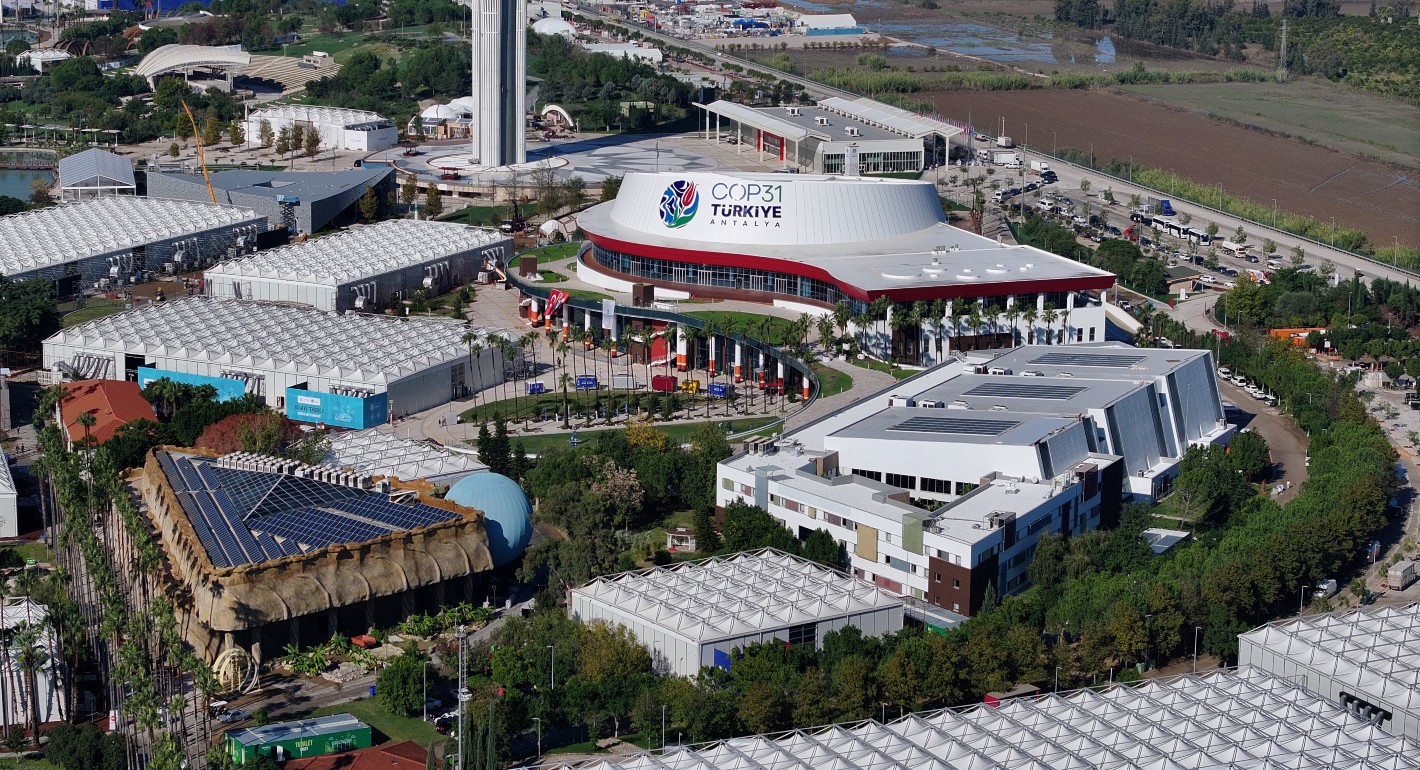
These two trains don’t often run in parallel, but they do inform each other of their progress. And on train two—where I spend most of my time with Carnegie—we see great energy. It’s a space for partnership, collaboration, and serendipitous run-ins. And there’s something very democratic about all being in the COP vortex together as we wake up too early, drink too much coffee, and walk far too many steps in one day. While sitting outside reviewing my notes, I see one delegate running to find a meeting amid the labyrinths of pavilions, a climate influencer making a video about her COP day while strolling in the picturesque outdoor central causeway, and a group of activists who biked to the venue with megaphones demanding an end to gas-guzzling COP shuttle buses. The audience is as large as the venue is sprawling.
Amid it all, COP31 has transitioned into its second week and will soon enter nail-biting negotiations to achieve its final result before it wraps on November 20. In the meantime, several key questions about the outcomes and future gatherings remain unanswered. Here’s what I’ll be watching:
How many countries will sign the 35-by-35 Global Electrification Pledge? This movement asks countries to commit to a nonbinding pledge to electrify 35 percent of their energy consumption by 2035. (The current global average is 23 percent, according to the International Energy Agency.) Notably, this commitment only requires electrification, not clean electricity. This pledge has also made it into the draft language of the final COP decision.
Will China host COP33? The next “global stocktake” COP—where countries assess their progress on global climate goals—will be held in 2028, and it is due to be hosted in Asia. (COP32 is already scheduled for Ethiopia.) Until this week, many had hoped that China might agree to host COP33 and take on the presidency. While China is shifting fast on clean energy, electrification, and electric cars, its leaders seem indifferent to engaging on climate on the global stage. Last week, it issued a statement saying it had ruled out hosting, but some are hopeful that it might change course.
Will the COP decision make a nod to local leadership or public-private partnerships? These topics, centering nonstate actors not traditionally involved in COP negotiations, are getting massive airtime in the side events at COP31. The presence of U.S. congressional, state, and local leaders demonstrates that much of the United States is committed to climate action, even without a formal delegation. Another key focus is how the insurance sector can support resilience and anticipatory action in communities impacted by climate events such as severe floods, cyclones, wildfires, heat waves, and droughts. Outside the formal negotiations at this COP, I’ve noticed increased interest in public-private partnerships, diversification of funding models, and a recognition from the business community that climate adaptation needs to be factored into planning.
Will the “F” word make it into the COP decision’s final text? The draft text released by Australia included the shoot-for-the-moon position calling for an immediate transition from fossil fuels. Whether that language survives negotiations is uncertain, since petrostates have limited previous COP texts from including such definitive language. (The first COP to even reference “fossil fuels” was in 2023.) But this is where minilateralism can shine: The Transitioning Away from Fossil Fuels (TAFF) Roadmap—a concrete push to end hydrocarbon use—is gaining traction. This plan was formally introduced by Brazil during its COP30 presidency and has continued to gather momentum. On Tuesday, four new European nations unveiled TAFF roadmaps at COP, leading to hope that scales may finally be tipping.
Will global legal actions on climate make it into the COP decision’s final text? In 2025, the International Court of Justice (ICJ) issued its ambitious advisory opinion on states’ obligations to address climate change. Earlier this year, the UN General Assembly formally backed the ICJ opinion, emphasizing states’ legal obligations to address climate change. Whether these actions get a nod in the COP text is up in the air. Over the weekend, they made it into the draft, thanks to the resolute leadership of several small island states, but it’s unclear if the ambitious decrees and their clear-eyed position reiterating the 1.5-degree limit to global warming will stick around.
Will COP31’s emphasis on the human impacts of climate change influence the conference’s outcome? I’d wager that this COP has hosted dozens, if not hundreds, of events uplifting locally led action on climate and centering the impacts that our changing climate has on human habitability and mobility. And these conversations are not limited to global majority nations: I participated in events on climate mobility with local leaders from the Philippines, Somalia, Kenya, Vanuatu, Brazil, Nepal, and Fiji, as well as the United States, France, the UK, and Spain. These conversations called for locally led action, diversified funding, and policies that operate with an eye toward inclusivity across levels and sectors of government. Much attention was paid to Europe’s “summer of truth,” characterized by wildfires, floods, and heat waves that cost the EU an estimated 180 billion euros. Nepal highlighted lessons learned from its tragic flash flood that killed more than 1,500 people, caused by a collapsing glacier. Discussions were centered around the need for better early warning systems, anticipatory action to mitigate climate as a driver of displacement, finance for loss and damage, and possibly planned relocation—all of which reiterate the need to unlock climate finance to build resilience. The human impacts of climate change are showing up in a big way here. We’ve certainly seen more conversation about climate impacts on human health, security, drought, displacement and migration, and food security than at any previous COP.
Climate nerds like to nickname COPs, with previous sessions being dubbed the adaptation COP (2022), the finance COP (2024), or the implementation COP (2025). Yet COP31 is the first to take place since a UN report documented that humanity will certainly surpass the 1.5-degree warming threshold that was the Paris Agreement goal for limiting the effects of climate change, leaving this COP at risk of being dubbed the overshoot COP.
The final COP decision would be wise to follow the guidance of departing UN Secretary-General António Guterres, who encouraged COP31 attendees to “Face the facts. Follow the science. Choose the future.” To do so, the COP decisionmakers must acknowledge the overshoot benchmark and mitigate climate change while adapting to its impacts. This would transform the overshoot COP into the both/and COP, with robust investment in mitigation as well as loss and damage, adaptation, and resilience finance. It would also ensure that COP’s two trains continue to travel in the same direction, instead of train two charging ahead while train one stops far short of the destination desired by a strong majority of people across the globe: dramatic and definitive human-centered action on climate.
Understand the world with the latest from our scholars around the world.

Senior Fellow and Director, Climate Mobility Project, Sustainability, Climate and Geopolitics Program
Shana Tabak is senior fellow and director of the Climate Mobility Project at the Carnegie Endowment for International Peace.
Recent Work

Shana Tabak, Alejandro Martin Rodriguez
Shana Tabak
Carnegie does not take institutional positions on public policy issues; the views represented herein are those of the author(s) and do not necessarily reflect the views of Carnegie, its staff, or its trustees.
Democrats now have the gavel and the purse, but the executive branch still pulls the levers on the U.S. role in the world.


James M. Acton, Dan Baer, Mark Baldassare, …
As the United States exits UN climate efforts, these smaller and less formal groupings will take on greater significance in global climate governance.
Theodore Zaritsky, Stewart Patrick

Despite its flop at the box office, the film raises important questions for the climate community to answer.

Leonardo Martinez-Diaz
They face an uphill climb, but they could draw on a strategy that other diplomats have used in the past.
Shana Tabak, Alejandro Martin Rodriguez

By focusing only on hard security, the Shield ignores the conditions that fuel cartel power.

Alejandro Martin Rodriguez, Kayly Ober