

Article
Paul Stronski
{
  "authors": [
    "Paul Stronski"
  ],
  "type": "legacyinthemedia",
  "centerAffiliationAll": "dc",
  "centers": [
    "Carnegie Endowment for International Peace"
  ],
  "collections": [
    "Coronavirus"
  ],
  "englishNewsletterAll": "ctw",
  "nonEnglishNewsletterAll": "",
  "primaryCenter": "Carnegie Endowment for International Peace",
  "programAffiliation": "russia",
  "programs": [
    "Russia and Eurasia"
  ],
  "projects": [
    "Changing Geopolitics of Eurasia"
  ],
  "regions": [
    "Central Asia",
    "Kazakhstan",
    "Caucasus",
    "Russia",
    "Armenia",
    "Georgia"
  ],
  "topics": [
    "Foreign Policy"
  ]
}
Source: Getty
One of the greatest achievements of U.S. foreign policy has been targeted by a vicious disinformation campaign.
Source: Foreign Policy
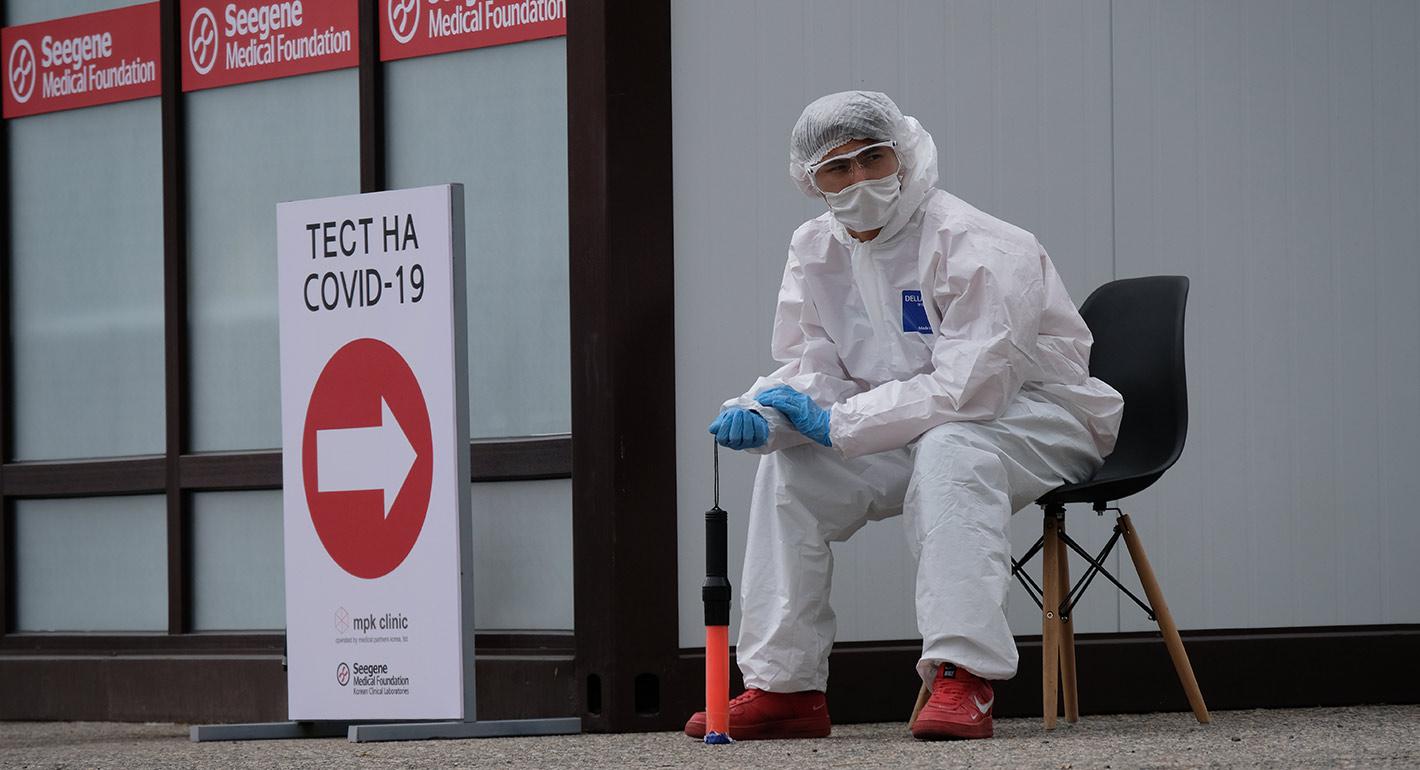
A network of Soviet-era laboratories once used to track plague outbreaks and develop bioweapons during the Cold War is at the front line of the fight against the coronavirus pandemic in Central Asia and the Caucasus. That hasn’t stopped Russia from instigating a propaganda and disinformation campaign against these labs, which were modernized and converted to civilian purposes long ago. That’s because these disease-control labs, located in former fiefs of the Soviet empire, are a legacy of one of the most successful and benevolent foreign-policy programs the United States has ever undertaken.
Back in an era of U.S. global leadership—before Washington turned its back on international cooperation—the Nunn-Lugar Cooperative Threat Reduction initiative in 1991 created a series of U.S. taxpayer-funded laboratories in former Soviet republics including Armenia, Azerbaijan, Georgia, Kazakhstan, and Uzbekistan. The purpose of these labs, most of which started out as Soviet-era facilities, was to help scientists in former Soviet republics secure and eliminate weapons of mass destruction, including nuclear weapons stocks and biowarfare capabilities.
Today, this artifact of U.S. multilateral benevolence is leading the way in enhanced disease monitoring, public health initiatives, and the training of biosecurity experts who are on the front lines of their nation’s coronavirus responses. That expertise has been crucial in a region that sits at the crossroads of China, Russia, and Iran—three of the world’s worst-hit countries. Georgia has contained the outbreak so far, boasting the lowest rate of COVID-19 fatalities in all of Europe and planning to reopen for tourism in July. Neighboring Armenia hasn’t been so lucky: It now has the region’s highest infection and death rates, with Armenian Prime Minister Nikol Pashinyan and his family catching the coronavirus but emerging unscathed. Kazakhstan is now experiencing a second wave of infections too; former Kazakh leader Nursultan Nazarbayev, who still wields considerable power, has tested positive for the coronavirus, his press secretary announced on June 18.
Most of the labs were part of the Soviet anti-plague system, created in the mid-20th century as a network of research institutes and field stations across the Soviet Union to study and prevent the spread of pathogens. Some of these facilities were pulled into the Soviet bioweapons program in the 1960s and 1970s. When the Soviet Union collapsed, all were left unsecured, underfunded, and in poor states of repair. It was feared they would no longer be able to monitor and control disease outbreaks—and that someone might get their hands on a stock of killer pathogens.
The Nunn-Lugar program, named after its authors in the U.S. Senate, Democratic Sen. Sam Nunn and Republican Sen. Richard Lugar, remedied that. It helped the newly independent states dismantle the legacies of Soviet bioweapons programs and to secure and ultimately destroy the dangerous pathogens left behind by the Soviet Union’s collapse. Some of the labs were merged, retrofitted, and enhanced with new capabilities to monitor disease outbreaks, turning several of them into state-of-the art public health facilities with U.S. support, spearheaded at the time by the Department of Defense. Today, they are operated by local experts under their countries’ civilian ministries and funded by their national budgets. They are proving well worth the investment in countries that have chosen to rely on the labs’ expertise to fight the pandemic.
In Georgia, the U.S.-sponsored lab—now called the Richard G. Lugar Center for Public Health—is part of Georgia’s National Center for Disease Control and Public Health. Having the lab proved fortuitous for Georgia, which activated its emergency response unit in January, well before the pandemic began spreading across Europe. By early February, the lab had developed its own testing capabilities, with results delivered within 24 hours. Prompt recognition of the threat enabled Georgian public health officials to identify, quarantine, and treat patients—and to implement contact-tracing—early on in the crisis.
Although Georgia was the first country in the region to identify a COVID-19 patient in late February, it has been able to keep infection and death rates low, particularly in comparison to its neighbors. The Lugar Center’s director, a Soviet-trained immunologist, has emerged as a major public face of Georgia’s pandemic response and has been blunt in his criticism of the Georgian Orthodox Church’s lax attitude toward social distancing. His science-based approach and ability to stay ahead of the pandemic’s curve has helped push the government to let medical professionals lead its pandemic response, which effectively depoliticized the crisis in a country with a history of deep polarization.
Kazakhstan’s lab from the U.S. program also facilitated a robust and timely response to the crisis. Although Kazakhstan did not identify its first COVID-19 patient until mid-March, the lab had already activated an emergency response team in January and tasked its scientists with monitoring the disease’s spread in Central Asia. By late March, Kazakhstan had coronavirus tests capable of giving results within five hours.
Public health successes and saved lives have not deterred Russian efforts to condemn the labs because of their connection with the United States. Senior Russian officials and propagandists have promoted conspiracy theories claiming that the labs are part of a secret U.S. bioweapons infrastructure designed to spread deadly pathogens and infectious diseases. This propaganda campaign has pointed to the labs as the alleged source of everything from the Zika virus and swine flu to invasive stink bugs infesting agricultural crops.
The Russian government has repeatedly asked for and received information about the laboratories, and Russian media have been given access to them. (That hasn’t prevented a diplomatic dispute from brewing between Russia and Armenia over the latter’s lab.) The labs also work with the World Health Organization, the World Organization for Animal Health, and other bodies—a clear indication they are open and have nothing to hide. They use the Electronic Integrated Disease Surveillance System to share real-time data among themselves and with other foreign counterparts.
None of this has stopped Russian disinformation about the labs’ alleged sinister activities. In 2019, a prominent Russian television talk-show host called on the Russian military to launch airstrikes on the Kazakhstan facility. In January, Russian television began insinuating that Georgia’s lab was somehow involved in the creation of the coronavirus, while Russian trolls have peddled similarly false stories on social media that the Kazakh lab also leaked the virus. In June, a Russian newspaper attacked the Uzbek Institute of Virology with wildly false claims that American and British researchers at the facility leaked brucellosis into the general population. Beijing has now joined the mix by pushing similar conspiracy theories about the U.S.-linked labs. These disinformation campaigns have prompted harsh rebukes from governments of the region.

Former Senior Fellow, Russia and Eurasia Program
Paul Stronski was a senior fellow in Carnegie’s Russia and Eurasia Program, where his research focuses on the relationship between Russia and neighboring countries in Central Asia and the South Caucasus.
Recent Work
Paul Stronski
Paul Stronski
Carnegie does not take institutional positions on public policy issues; the views represented herein are those of the author(s) and do not necessarily reflect the views of Carnegie, its staff, or its trustees.
Congress should ask tough questions about the agreement’s more unique features and whether they advance U.S. interests or compromise them.

Jane Darby Menton

While France and Australia are seeking to establish the legal obligations of messaging apps like Telegram, Russia wants total subordination.

Maria Kolomychenko

The ninety-three-year-old Biya’s absence and refusal to name a vice president threaten to upend domestic and regional stability.

Lesley Anne Warner

The recent uncovering of Dmitry Donskoy’s relics in the Cathedral of the Archangel is yet another attempt by the Russian Orthodox Church to help the state solve its problems. However, parroting the state’s version of Russian history leaves the Church with no message except “patriotism.”
Alexander Zanemonets

With the growth in points of friction between the great powers, organizations like the SCO will continue to play a role in the strategic adaptation of the smaller powers caught between them.

Temur Umarov