• Research
  • Emissary
  • About
  • Experts
Carnegie Global logoCarnegie lettermark logo
DemocracyIran
  • Donate
{
  "authors": [
    "Anouar Boukhars"
  ],
  "type": "other",
  "centerAffiliationAll": "dc",
  "centers": [
    "Carnegie Endowment for International Peace"
  ],
  "collections": [],
  "englishNewsletterAll": "menaTransitions",
  "nonEnglishNewsletterAll": "",
  "primaryCenter": "Carnegie Endowment for International Peace",
  "programAffiliation": "MEP",
  "programs": [
    "Middle East"
  ],
  "projects": [],
  "regions": [
    "North Africa",
    "Southern, Eastern, and Western Africa"
  ],
  "topics": [
    "Security"
  ]
}

Source: Getty

Other

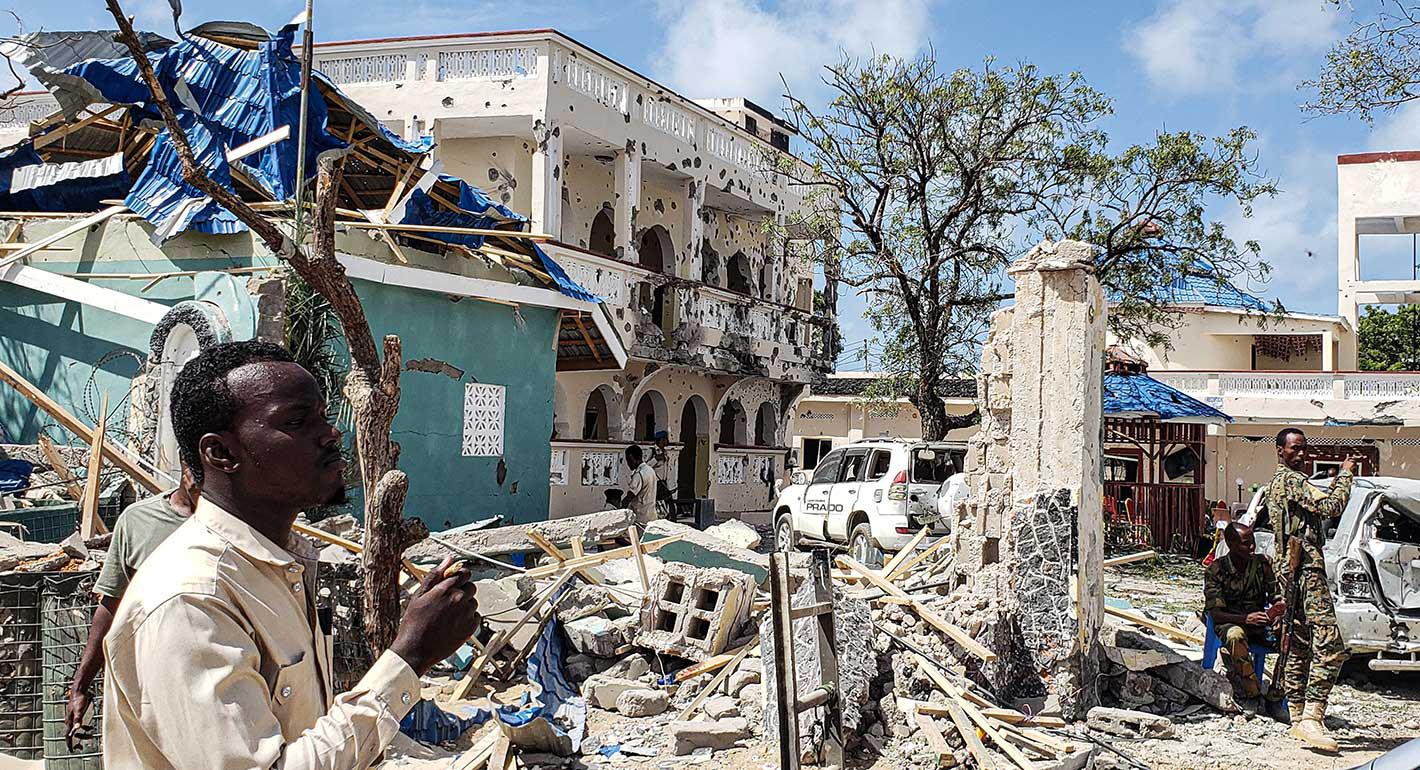
The Logic of Violence in Africa’s Extremist Insurgencies

Existing studies help explain how extremist insurgencies erupt and evolve, and why some countries are more affected than others. But there are still notable gaps in understanding the choices, tactics, and strategies of violent extremist groups.

Link Copied
By Anouar Boukhars
Published on Oct 30, 2020
Program mobile hero image

Program

Middle East

The Middle East Program in Washington combines in-depth regional knowledge with incisive comparative analysis to provide deeply informed recommendations. With expertise in the Gulf, North Africa, Iran, and Israel/Palestine, we examine crosscutting themes of political, economic, and social change in both English and Arabic.

Learn More

Source: Perspectives on Terrorism

Abstract

What factors explain the great variation in the target selection of VE groups in Africa? Some tend to focus their attacks mostly on official targets while others show a relative preference for civilians. Most, however, tend to typically change their target selection over time. This article demonstrates that the logic of violence in Africa’s fragile, conflict-prone states is driven by four factors: (1) The degree to which VE groups rely on local support to maintain the insurgency; (2) the dynamics of in-group/out-group differentiation and corresponding hostility; (3) inter-group rivalry and looming power shifts; and (4) the strategies of counterinsurgency employed by governments.

Read More

This article was originally published in Perspectives on Terrorism.

About the Author

Anouar Boukhars

Former Nonresident Fellow, Middle East Program

Boukhars was a nonresident fellow in Carnegie’s Middle East Program. He is a professor of countering violent extremism and counter-terrorism at the Africa Center for Strategic Studies, National Defense University.

    Recent Work

  • Article
    Islamic Authority and Arab States in a Time of Pandemic
      • +3

      Frederic Wehrey, Nathan J. Brown, Bader Al-Saif, …

  • Commentary
    A Different Type of Alliance

      Anouar Boukhars

Anouar Boukhars
Former Nonresident Fellow, Middle East Program
SecurityNorth AfricaSouthern, Eastern, and Western Africa

Carnegie does not take institutional positions on public policy issues; the views represented herein are those of the author(s) and do not necessarily reflect the views of Carnegie, its staff, or its trustees.

More Work from Carnegie Endowment for International Peace

  • Article
    Continental Asia and the Rise of Portfolio Politics

    “Central Asia” as an analytical category is itself part of the problem. The term is a Soviet administrative inheritance, drawn along lines that served the convenience of Moscow. The Central Asian states the Soviets named no longer see themselves through this category alone and are not aligning across political blocs but are instead building external partnerships sector by sector, assigning different partners to different functions.

      Jennifer B. Murtazashvili

  • Commentary
    Carnegie Politika
    In Russia, Private Companies Have Been Left to Pick Up the Tab for Ukrainian Drone Attacks

    The cost of air defense has become an unregistered tax on revenue for businesses. While military rents are consolidated in the federal budget, the costs of defense are being spread across the balance sheets of companies and regional governments.

      Alexandra Prokopenko

  • Tiananmen Gate with US and Chinese flags
    Commentary
    Emissary
    Trump and Xi Should Tackle a Previously Impossible AI Conversation

    Previous dialogues ended in failure. This time could be different.

      Scott Singer

  • A drone flies in front of an Iranian flag in southern Tehran, Iran
    Article
    The Unintended Consequences of Iran’s Asymmetric Strategy and America’s AI War

    The Iran war is unique in the scope and scale of asymmetric warfare and AI-enabled conflict. These will test the limits of protecting civilians.

      Steve Feldstein

  • A visitor looks at a simulator for "electronic warfare" at the booth of German Federal Armed Forces Bundeswehr during a tour of the Hannover industrial trade fair for mechanical and electrical engineering and digital industries, in Hannover, northern Germany on April 20, 2026.
    Article
    The Effect of Military AI on Contemporary Battlefields

    AI in warfare has numerous impacts, including how they shape human responses to target recommendations and how they increase the speed at which lawful targets can be recommended.

      Yahli Shereshevsky

Get more news and analysis from
Carnegie Endowment for International Peace
Carnegie global logo, stacked
1779 Massachusetts Avenue NWWashington, DC, 20036-2103Phone: 202 483 7600
  • Research
  • Emissary
  • About
  • Experts
  • Donate
  • Programs
  • Events
  • Blogs
  • Podcasts
  • Contact
  • Annual Reports
  • Careers
  • Privacy
  • For Media
  • Government Resources
Get more news and analysis from
Carnegie Endowment for International Peace
© 2026 Carnegie Endowment for International Peace. All rights reserved.