

Q&A
Dara Massicot, Aaron David Miller, Andrew S. Weiss
{
  "authors": [
    "Aaron David Miller"
  ],
  "type": "legacyinthemedia",
  "centerAffiliationAll": "",
  "centers": [
    "Carnegie Endowment for International Peace"
  ],
  "collections": [],
  "englishNewsletterAll": "",
  "nonEnglishNewsletterAll": "",
  "primaryCenter": "Carnegie Endowment for International Peace",
  "programAffiliation": "",
  "programs": [],
  "projects": [],
  "regions": [
    "North America",
    "United States"
  ],
  "topics": [
    "Political Reform"
  ]
}
Source: Getty
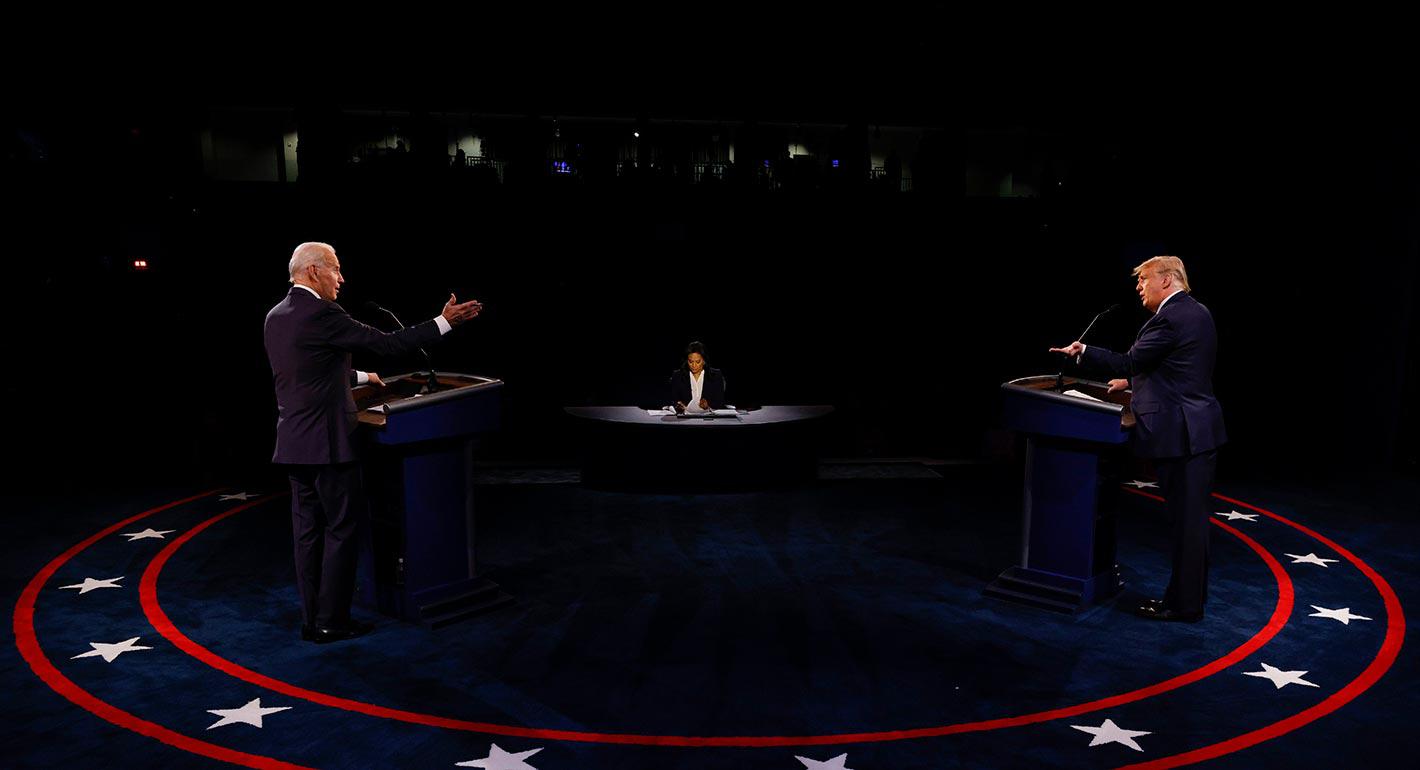
After four years, Donald Trump demonstrated he could control his temper. Joe Biden demonstrated he could be president.
Source: CNN
I tweeted before tonight's debate that the odds of a more moderate reasonable Donald Trump showing up was about as favorable as the chance of an Israeli-Palestinian peace accord. I was wrong. A much more controlled Trump did in fact show up. And indeed, tonight we actually did have something that resembled a real debate.
Biden won, in part, paradoxically, because in the absence of the yelling and interrupting during the first debate -- mostly on Trump's part -- we could actually listen to Trump's arguments and hear how untethered they were from reality. In contrast, on most issues, Biden simply made a lot more sense winning rounds on points, character and compassion.
Far from running out the clock, Biden was focused, strong, risk ready -- hammering and targeting Trump for his racism, abdication of leadership on Covid-19, immigrant children being separated from their parents and lack of a health care policy.
Trump's talking points were old and stale, targeting his base and not expanding it to reach out to independents who at this late stage might still be undecided.
Biden on several critical issues, especially race and Covid-19, squared himself to the camera and talked directly to the American public with empathy and compassion. Trump never did, partly because he lacks the capacity to do so.
Trump went to the gutter quickly -- launching charges based on unsubstantiated emails that Biden and family were enriching themselves from foreign countries and donors. Biden countered by hammering Trump on tax returns and his reported China bank account; but stayed out of the sewer by not making an issue of Trump's family.
After four years, Donald Trump demonstrated he could control his temper. Joe Biden demonstrated he could be President.

Senior Fellow, American Statecraft Program
Aaron David Miller is a senior fellow at the Carnegie Endowment for International Peace, focusing on U.S. foreign policy.
Recent Work


Dara Massicot, Aaron David Miller, Andrew S. Weiss



Sophia Besch, Eric Ciaramella, Steve Feldstein, …
Carnegie does not take institutional positions on public policy issues; the views represented herein are those of the author(s) and do not necessarily reflect the views of Carnegie, its staff, or its trustees.

Minsk clearly expected the dialogue with Washington to yield more results, in particular the lifting of EU sanctions and permission to export potash.

Artyom Shraibman

As the U.S. stumbles in its war with Iran, we are likely to see an acceleration of its disengagement from the region.

Michael Young
Why governance of rapidly evolving technology will be distributed and complex.


Stewart Patrick, Scott Singer

It should address the shortcomings of previous crisis communication efforts and adapt to the demands of frontier AI.

Lucy Luo

If the Russian-speaking community in Latvia cannot articulate their interests without being seen as disloyal, they could end up embracing a pro-Kremlin agenda.

Sergejs Potapkins