

Commentary
Artyom Shraibman
{
  "authors": [
    "Artyom Shraibman"
  ],
  "type": "commentary",
  "centerAffiliationAll": "",
  "centers": [
    "Carnegie Endowment for International Peace",
    "Carnegie Russia Eurasia Center"
  ],
  "collections": [],
  "englishNewsletterAll": "",
  "nonEnglishNewsletterAll": "",
  "primaryCenter": "Carnegie Endowment for International Peace",
  "programAffiliation": "",
  "programs": [],
  "projects": [],
  "regions": [
    "Eastern Europe",
    "Belarus"
  ],
  "topics": [
    "Economy"
  ]
}
Source: Getty
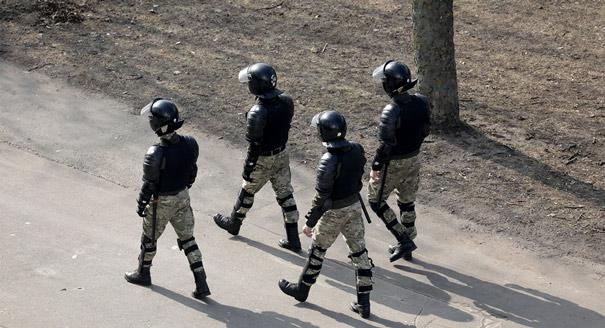
Russia is the only country that can truly influence the behavior of the Belarusian regime, so it’s only a matter of time before Western pressure is transferred from Minsk to Moscow.
When Minsk scrambled a fighter jet to force a Ryanair flight from Athens to Vilnius to land on Belarusian territory with the sole apparent aim of arresting the journalist and activist Roman Protasevich, the Belarusian political crisis stopped being a domestic issue and went definitively global.
Alexander Lukashenko’s international isolation has been growing for many months following the contested presidential election last summer and ensuing protests, but now it has reached a whole new level. With its own nationals and airplane having experienced how Minsk treats its opponents, the West is embarking on measures it has been reluctant to undertake for decades.
European airlines have already been banned by their governments from flying over Belarus, and Belarusian planes are prohibited from landing in European countries. New European economic sanctions are expected in the next few weeks that could impact not only on businesses close to the Belarusian regime, but also on the export of some Belarusian goods. U.S. President Joe Biden has announced that Washington will also introduce new sanctions against Minsk.
Minsk’s version is that an email was received from Hamas threatening to blow up the plane over Vilnius. And since Protasevich—who was wanted in his home country of Belarus—just happened to be on board the flight, the authorities seized the opportunity to arrest him and his girlfriend.
The damage to Minsk’s reputation is so severe that even Hamas has condemned Belarus and objected to being used as cover for stifling freedom of speech.
Many people have questioned whether it was really so important to arrest one activist: surely Lukashenko must have known it would cause an international scandal when he gave the order to send up a fighter jet to force a European plane to land?
In all likelihood, Minsk really didn’t foresee the scale of the inevitable fallout. The regime is in survival mode, which has worsened its tunnel vision. All of its energy is focused on one thing: neutralizing its enemies. Reputational damage is a side effect that has no place in the decisionmaking process. No one in the system would dare to oppose an initiative to punish enemies of the regime—even such a risky initiative—and to be fair, it’s not clear at what point Lukashenko became aware of the security services’ plan to force the plane carrying Protasevich to land.
The ensuing boycott of Belarusian airspace by most European airlines makes the country far more toxic than ever before, and excludes Minsk from any kind of meaningful international cooperation. Transit passengers used to be a main source of revenue for Minsk airport and the state airline Belavia. Now the carrier will likely have to be subsidized, with major job losses. If any Western investors and business travelers were still interested in going to Belarus, they now face logistical problems as well as reputational risks. Sports teams are also refusing to fly to Belarus for tournaments.
Too little is known so far about the impending economic sanctions to be able to assess the potential damage from them. It’s unlikely that the EU will impose a full trade embargo or ban overland transit through Belarusian territory, but the outrage is far stronger this time around than ever before. This is reflected in the distinct absence right now of two arguments traditionally heard against imposing tough sanctions: that they will only push Minsk even closer to Moscow, and that they will cause harm to ordinary Belarusians.
The flights boycott, for example, will backfire against opponents of the regime who would like to flee abroad. And there are no serious economic sanctions that will not impact ordinary people and force Minsk to search for alternative markets, trade routes, and simply support in Russia.
But for the EU and the United States, the priority right now is not to help Belarusians solve their problems with their government. It’s to avoid setting a precedent of failing to punish actions that are being described as state terrorism or piracy.
The relationship between Lukashenko and the West can never be repaired now. Latvian Foreign Minister Edgars Rinkēvičs—once pragmatic in his dealings with Minsk—and Mārtiņš Staķis, the mayor of Riga, demonstratively lowered the Belarusian state flag from a flagpole celebrating the Ice Hockey World Championship in the Latvian capital, and replaced it with the white-and-red flag favored by the Belarusian opposition. The entire Latvian embassy has been expelled from Minsk, but Riga is not bothered: it has given up on Lukashenko.
Minsk is not afraid to take steps that are bound to incense the West because it feels protected by Moscow. In fact, such provocative actions are even an asset that Lukashenko can use in conversation with Russia. The message to Putin is that there will never be a more anti-Western leader of Belarus, so he should cherish this one.
The extent to which Moscow is prepared to prop up Lukashenko—including financially—is unclear. The more costly the union becomes, and the more that Russia is accused of involvement in Minsk’s actions, the louder the voices critical of Lukashenko heard within the Russian elite.
The context of the upcoming meeting between the U.S. and Russian presidents is also important. For many months, the Belarusian opposition was unable to secure a discussion of their cause at the highest level, but now Lukashenko himself has given them a helping hand. The White House has already confirmed that the issue of Belarus will be on the agenda.
There is much speculation that Moscow and Washington will strike some kind of deal on broad de-escalation, involving exchanging concessions on various regions and issues. This would appear to be an oversimplified view of international politics. Such a deal would require a lot more trust, and not every dispute can be solved by going over the heads of those who would be directly affected by such an exchange.
Still, it might be possible to establish some kind of mutual understanding, and then Moscow would have to consider where it is prepared to give ground in order to preserve the atmosphere of de-escalation that has shakily formed in relations with Washington in the last month. Making concessions on domestic policy would be humiliating for the Kremlin, while to do so on Ukraine would be dangerous. Moscow genuinely fears that Kyiv will resolve the issue of the Donbas by military force if Russia relaxes its presence there. A compromise on Belarus, meanwhile, would not be so complicated or risky.
This scenario looks far from inevitable, or even particularly likely: the United States and Russia first need to agree on de-escalation, which they aren’t always able to do. Ultimately, the more toxic Lukashenko becomes internationally, the more important it becomes for the West to show that its pressure on the Belarusian regime is having tangible consequences. Russia is the only country that can truly influence the behavior of the Belarusian authorities, so it’s only a matter of time before that pressure is transferred from Minsk to Moscow.

Nonresident Scholar, Carnegie Russia Eurasia Center
Artyom Shraibman is a nonresident scholar at the Carnegie Russia Eurasia Center.
Recent Work
Artyom Shraibman
Artyom Shraibman
Carnegie does not take institutional positions on public policy issues; the views represented herein are those of the author(s) and do not necessarily reflect the views of Carnegie, its staff, or its trustees.

China’s banking crisis in the 2000s was resolved by transferring the costs to households through financial repression—a decision that recapitalized the banks while exacerbating the structural imbalances that continue to shape the Chinese economy today.

Michael Pettis
Lee’s tour shows how Seoul is reorganizing its diplomacy away from Pyongyang and toward industrial networks and the geography of the compute economy.

Darcie Draudt-Véjares
Most migrants may have left Ceuta, but the effects may linger.


Alejandro Martin Rodriguez, Sarah Yerkes
Saied’s main accomplishment has been to destroy a decade’s worth of democratic progress.
Sarah Yerkes
The targeting of Damietta Port appears to be more than a mere security message.

Amr Hamzawy