• Research
  • Emissary
  • About
  • Experts
Carnegie Global logoCarnegie lettermark logo
Democracy
  • Donate
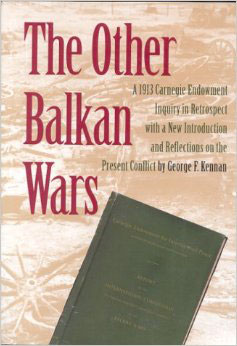
Other Balkan Wars: A 1913 Carnegie Endowment Inquiry in Retrospect
Book

Other Balkan Wars: A 1913 Carnegie Endowment Inquiry in Retrospect

In 1993, against the background of the atrocities of the new Balkan wars, the Endowment reissued its original 1913 report with a new introduction by George Kennan.

Link Copied
By George Frost Kennan
Published on Jan 1, 1993

Additional Links

Paperback - $16.95

Source: Washington

In 1913, the young Carnegie Endowment for International Peace established a seven-member commission to investigate the 1912 and 1913 wars in the Balkans. The horrifying and gruesome information collected, and the pessimistic conclusions reached, were originally published by the Endowment in the early summer of 1914—and were quickly overshadowed by the beginning of the first World War. In 1993, against the background of the tragedies and atrocities of the new Balkan wars, the Endowment reissued the report with a new introduction by George Kennan.

George Frost Kennan
Security

Carnegie does not take institutional positions on public policy issues; the views represented herein are those of the author(s) and do not necessarily reflect the views of Carnegie, its staff, or its trustees.
More Work from Carnegie Endowment for International Peace

  • Kushner and Putin shaking hands, with Witkoff standing next to them
    Commentary
    Emissary
    What If Trump Gets His Russia-Ukraine Deal?

    It’s dangerous to dismiss Washington’s shambolic diplomacy out of hand.

      Eric Ciaramella

  • Commentary
    Strategic Europe
    To Survive, the EU Must Split

    Leaning into a multispeed Europe that includes the UK is the way Europeans don’t get relegated to suffering what they must, while the mighty United States and China do what they want.

      • Rym Momtaz

      Rym Momtaz

  • Commentary
    Carnegie Politika
    Russia’s Unspoken Condition for Ending the War Is Zelensky’s Resignation

    Insisting on Zelensky’s resignation is not just a personal vendetta, but a clear signal that the Kremlin would like to send to all its neighbors: even if you manage to put up some resistance, you will ultimately pay the price—including on a personal level.

      Vladislav Gorin

  • Commentary
    Carnegie Politika
    For Putin, Increasing Russia’s Nuclear Threat Matters More Than the Triad’s Modernization

    For Putin, upgrading Russia’s nuclear forces was a secondary goal. The main aim was to gain an advantage over the West, including by strengthening the nuclear threat on all fronts. That made growth in missile arsenals and a new arms race inevitable.

      Maxim Starchak

  • Commentary
    Carnegie Politika
    Japan’s “Militarist Turn” and What It Means for Russia

    For a real example of political forces engaged in the militarization of society, the Russian leadership might consider looking closer to home.

      James D.J. Brown

Get more news and analysis from
Carnegie Endowment for International Peace
Carnegie global logo, stacked
1779 Massachusetts Avenue NWWashington, DC, 20036-2103Phone: 202 483 7600Fax: 202 483 1840
  • Research
  • Emissary
  • About
  • Experts
  • Donate
  • Programs
  • Events
  • Blogs
  • Podcasts
  • Contact
  • Annual Reports
  • Careers
  • Privacy
  • For Media
  • Government Resources
Get more news and analysis from
Carnegie Endowment for International Peace
© 2026 Carnegie Endowment for International Peace. All rights reserved.