

Q&A
Andrew Leber, Lesley Anne Warner
{
  "authors": [
    "Andrew Leber"
  ],
  "type": "commentary",
  "blog": "Emissary",
  "centerAffiliationAll": "dc",
  "centers": [
    "Carnegie Endowment for International Peace"
  ],
  "collections": [
    "The Iran War’s Global Reach"
  ],
  "englishNewsletterAll": "menaTransitions",
  "nonEnglishNewsletterAll": "",
  "primaryCenter": "Carnegie Endowment for International Peace",
  "programAffiliation": "MEP",
  "programs": [
    "Middle East"
  ],
  "regions": [
    "Middle East",
    "Iran",
    "Saudi Arabia",
    "Oman",
    "Qatar",
    "United Arab Emirates",
    "United States",
    "Kuwait",
    "Bahrain"
  ],
  "topics": [
    "Security",
    "Economy",
    "Energy"
  ]
}
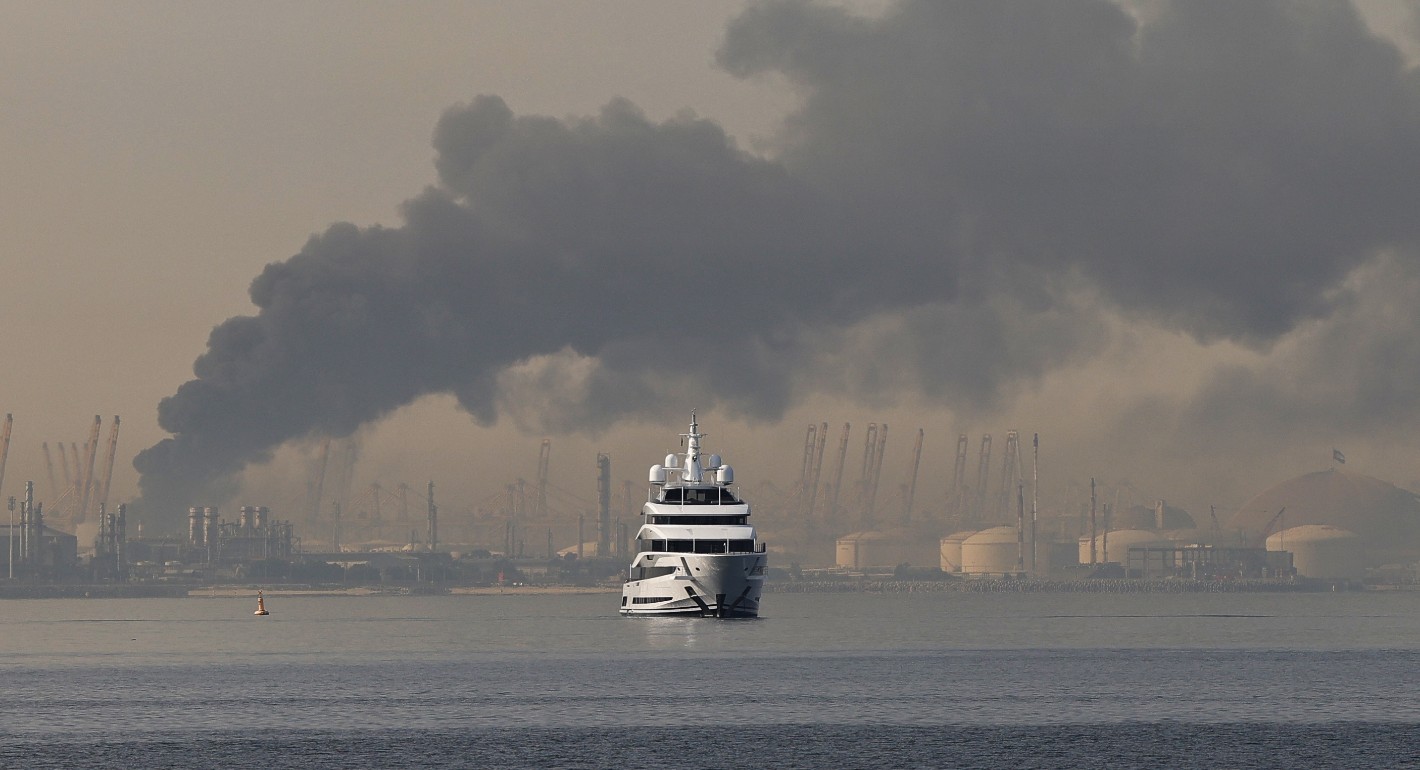
A yacht sails past a plume of smoke following a reported Iranian strike in Dubai on March 1, 2026. (Photo by Fadel Senna/AFP via Getty Images)
Only collective security can protect fragile economic models.
Amid the open-ended war that the United States and Israel kicked off this weekend, each of the Gulf Cooperation Council (GCC) states has been targeted—and in some cases hit—by Iranian drone and missile strikes. The strikes sparked fires near luxury hotels in Dubai, caused panic at Kuwait’s international airport, and put Saudi Arabia’s largest oil refinery out of commission. In an interview with CNN, President Donald Trump called the attacks on the Gulf “probably the biggest surprise” of the war so far.
It shouldn’t have been surprising. During the Trump administration’s “maximum pressure” campaign against Iran in the president’s first term, the Islamic Republic backed attacks on oil tankers near the Persian Gulf as well as Saudi oil infrastructure, each of which dampened GCC support for overt confrontation of Iran.
Since then, and especially since a 2023 rapprochement between Saudi Arabia and Iran, the GCC states broadly prioritized diplomacy and dialogue in their dealings with Tehran. Although all of the Gulf states host U.S. military personnel in one way or another, each tried to publicly distance itself from U.S. and Israeli military action in the runup to the current hostilities (despite suggestions of private rhetoric to the contrary).
Gulf state diplomats typically communicate via rote statements and not-for-attribution nuance. In recent days, however, a number of officials have tried to clearly distance their countries from a push for war and warn of consequences for any Iranian attacks—all to little avail, even for monarchies ostensibly at the forefront of diplomatic outreach to Iran.
Qatar, which helped mediate an Israel-U.S.-Iran ceasefire last summer, shut down its liquid natural gas (LNG) exports—20 percent of the global LNG market—after Iranian drones targeted key facilities. Oman, whose diplomats were mediating U.S.-Iran nuclear talks and whose foreign minister made a last-minute appeal for diplomacy on U.S. television, suffered successive Iranian drone attacks targeting its Duqm port complex.
The economic fallout for the Gulf monarchies will be considerable. For years, the GCC states presented themselves as havens of stability and opportunity for mobile talent and capital, contrasted with a regional backdrop of political conflict and economic stagnation. However self-serving, this narrative will be harder to sustain amid scenes of burning hotels and panic over closed airports, no matter how much interior ministries warn against sharing “rumors or unknown videos” of damage.
In the short term, the Gulf monarchies will be under pressure to maintain the narrative of calm at home. On Monday, top Emirati officials toured a shopping mall to convey a literal sense of “business as usual,” while a host of Dubai-based influencers conveniently converged on the same theme. The UAE and Qatar both vehemently denounced reporting that suggested their interceptor stockpiles were running low. Even if these statements and actions allay some fears, the conflict still risks opening up longstanding divides inside these countries. In Bahrain, protests are beginning to break out among the country’s Shia population after years of stern political repression.
A longer-term concern is that the Gulf states—and especially the UAE and Saudi Arabia—have banked heavily on “connectivity” as a bridge to a post-oil economic future. But attracting tourists, building and operating data centers, and sustaining complex logistical hubs is difficult in the middle of an active war zone. Shooting down most of the drones and missiles targeting the GCC is good in the short term, but it is likely not good enough when it comes to global firms deciding where to invest and expand. Citizens are also likely to wonder why they should bear the risk of hosting U.S. forces when the United States is unable or unwilling to protect the Gulf from Iranian attacks.
The latest from Carnegie scholars on the world’s most pressing challenges, delivered to your inbox.
Iran is well aware of the impact of these dynamics. Drone strikes on UAE-based Amazon data centers speak directly to U.S. concerns about placing critical AI infrastructure in the Gulf. Iran’s surviving leadership is counting on these reputation costs—and the threat of worse—to force Gulf rulers to lobby Trump for a ceasefire or risk an even more ruinous open military confrontation.
Houthi-controlled Yemen already offers an indication of how difficult it is to dislodge an ideologically motivated, politically organized authoritarian regime along a strategic waterway. Iran’s population is six times larger and spread out across fourteen times as much territory.
At the same time, the Gulf’s rulers are confronting the limits of their ability to spend their way to influence at the White House. Although Trump is clearly willing to sell whatever Gulf states want to buy, that has not translated into any leader’s ability to reshape the president’s increasingly war-forward outlook—especially when that outlook aligns with Israeli priorities.
As Kuwaiti political scientist Bader Al Saif noted last fall, only collective action among the GCC states is likely to get them out of this dilemma. It is easier for Iran to cajole, and the United States to dismiss, individual Gulf states, so Gulf leaders should capitalize on this crisis by pushing their countries closer together. Security coordination across the bloc can pool interceptor stockpiles to defend against Iranian attacks, even as diplomatic coordination seeks to provide negotiated off-ramps. The pressure to join U.S. attacks will increase, but doing so is unlikely to accomplish much other than subjecting the Gulf states to yet more Iranian reprisals.
Domestic audiences matter as well—and not just as subjects to be kept calm and in line. Repression and censorship will not paper over Gulf citizens’ sense that their leaders have struggled to navigate this moment, particularly if air defenses should fail and the destruction worsen. Much as Gulf rulers have sought to avoid political inclusivity at all costs, greater representation in decisionmaking would help insulate the Arab Gulf governments from the pressures of their security situation and strengthen rulers’ hands in charting a more independent foreign policy.
The Gulf countries are facing an unprecedented—if unsurprising—crisis. But they have a way out: domestic inclusivity and collective security can help ensure GCC security amid the current conflict and in the long term. The alternative is to remain trapped between a desperate Iranian leadership willing to impose significant costs and a U.S. president heedless of them.

Nonresident Scholar, Middle East Program
Andrew Leber is a nonresident scholar in the Carnegie Middle East Program.
Recent Work

Andrew Leber, Lesley Anne Warner
Andrew Leber
Carnegie does not take institutional positions on public policy issues; the views represented herein are those of the author(s) and do not necessarily reflect the views of Carnegie, its staff, or its trustees.
It signals a new era of tech diffusion and warfare.

Steve Feldstein

The conflict has sent economic and political shock waves through a country with no representation at the negotiating table—and Kenya is not alone.
Georgia Schaefer-Brown, Jane Munga
The targeting of Damietta Port appears to be more than a mere security message.

Amr Hamzawy
Despite the agreement’s uncertainty, it’s still a significant development in regional and nuclear policy.

Andrew Leber, Jane Darby Menton
By burying disagreements in imprecision, the new deal risks same fate as its predecessors.

James M. Acton