• Research
  • Emissary
  • About
  • Experts
Carnegie Global logoCarnegie lettermark logo
DemocracyIran
  • Donate
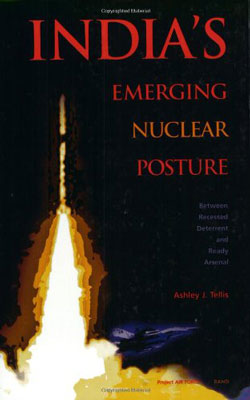
India's Emerging Nuclear Posture: Between Recessed Deterrent and Ready Arsenal
Book

India's Emerging Nuclear Posture: Between Recessed Deterrent and Ready Arsenal

This book examines the forces—political, strategic, technological, and ideational—that led to India's dramatic nuclear policy shift and describes how New Delhi's force-in-being will be fashioned, particularly in light of the threat India faces from its two most salient adversaries, China, and Pakistan.

Link Copied
By Ashley J. Tellis
Published on Oct 13, 2001

Additional Links

RAND Corporation
Program mobile hero image

Program

Nuclear Policy

The Nuclear Policy Program aims to reduce the risk of nuclear war. Our experts diagnose acute risks stemming from technical and geopolitical developments, generate pragmatic solutions, and use our global network to advance risk-reduction policies. Our work covers deterrence, disarmament, arms control, nonproliferation, and nuclear energy.

Learn More
Program mobile hero image

Program

South Asia

The South Asia Program informs policy debates relating to the region’s security, economy, and political development. From strategic competition in the Indo-Pacific to India’s internal dynamics and U.S. engagement with the region, the program offers in-depth, rigorous research and analysis on South Asia’s most critical challenges.

Learn More

RAND Corporation

On May 11, 1998, after a hiatus of more than two decades, India conducted a series of nuclear tests that signaled a critical shift in its strategic thinking. Once content to embrace a nuclear posture consisting largely of "maintaining the option"—i.e., neither creating a nuclear arsenal nor renouncing its right to do so—India is now on the threshold of adopting a posture that, while stopping short of creating a ready arsenal, will take as its goal the establishment of a "minimum but credible deterrent," known as a "force-in-being." India's Emerging Nuclear Posture: Between Recessed Deterrent and Ready Arsenal examines the forces—political, strategic, technological, and ideational—that led to this dramatic policy shift and describes how New Delhi's force-in-being will be fashioned, particularly in light of the threat India faces from its two most salient adversaries, China, and Pakistan.

About the Author

Ashley J. Tellis

Former Senior Fellow

Ashley J. Tellis was a senior fellow at the Carnegie Endowment for International Peace.

    Recent Work

  • Paper
    Multipolar Dreams, Bipolar Realities: India’s Great Power Future

      Ashley J. Tellis

  • Commentary
    India Sees Opportunity in Trump’s Global Turbulence. That Could Backfire.

      Ashley J. Tellis

Ashley J. Tellis
Former Senior Fellow
South AsiaIndiaPakistanNuclear Policy

Carnegie does not take institutional positions on public policy issues; the views represented herein are those of the author(s) and do not necessarily reflect the views of Carnegie, its staff, or its trustees.

More Work from Carnegie Endowment for International Peace

  • Photo of Balen Shah taking a selfie with a group of Nepali adults and children.
    Article
    A New Generation Takes Power in Nepal

    The incoming government has swept Nepal’s election. The real work begins now.

      Amish Raj Mulmi

  • India and a Changing Global Order: Foreign Policy in the Trump 2.0 Era
    Research
    India and a Changing Global Order: Foreign Policy in the Trump 2.0 Era

    Trump 2.0 has unsettled India’s external environment—but has not overturned its foreign policy strategy, which continues to rely on diversification, hedging, and calibrated partnerships across a fractured order.

      • Sameer Lalwani
      • +6

      Milan Vaishnav, ed., Sameer Lalwani, Tanvi Madan, …

  • Gen Z United activists hold a demonstration in Kathmandu, Nepal, on September 8 and 9, 2025, under the banner ''Don't Forget the Blood of Martyrs,'' honoring protest martyrs and demanding justice and accountability for those killed during past movements.
    Article
    Gen Z Protests Across Asia Offer a Delicate but Renewed Democratic Order

    A disconnect between Gen Z citizenry and older rulers has fueled massive demonstrations. What are the key issues and how is protest energy translating into electoral change?

      • Usama Khilji

      Usama Khilji

  • Article
    What Could a Reciprocal Defense Procurement Agreement Do for U.S.-India Ties?

    India and the United States are close to concluding a Reciprocal Defense Procurement Agreement (RDPA) that will allow firms from the two countries to sell to each other’s defense establishments more easily. While this may not remedy the specific grievances both sides may have regarding larger bilateral issues, an RDPA could restore some momentum, following the trade deal announcement.

      Konark Bhandari

  • Japanese Prime Minister Sanae Takaichi delivers a speech during the graduation ceremony at the National Defense Academy of Japan on March 14, 2026 in Yokosuka, Kanagawa Prefecture, Japan.
    Article
    Revisiting Japan’s Non-Nuclear Principles: Between a Nuclear Allergy and Umbrella

    Japan’s prime minister, Takaichi Sanae, may kickstart a discussion on Japan’s non-nuclear principles.

      Shizuka Kuramitsu

Get more news and analysis from
Carnegie Endowment for International Peace
Carnegie global logo, stacked
1779 Massachusetts Avenue NWWashington, DC, 20036-2103Phone: 202 483 7600Fax: 202 483 1840
  • Research
  • Emissary
  • About
  • Experts
  • Donate
  • Programs
  • Events
  • Blogs
  • Podcasts
  • Contact
  • Annual Reports
  • Careers
  • Privacy
  • For Media
  • Government Resources
Get more news and analysis from
Carnegie Endowment for International Peace
© 2026 Carnegie Endowment for International Peace. All rights reserved.