

Article
Thomas Carothers
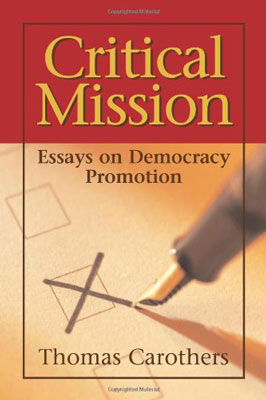
Demand for practical knowledge and lessons about how the United States and other countries can more effectively promote democracy around the world has never been higher. This timely book by Thomas Carothers, one of the foremost authorities worldwide on democracy-building, helps meet that need.
Source: Washington

Critical Mission draws together a wide-ranging set of Carothers’s many seminal, widely cited essays, organized around four vital themes: (1) the role of democracy promotion in U.S. foreign policy; (2) the core elements of democracy aid; (3) the state of democracy in the world; and (4) the new U.S. push to promote democracy in the Middle East. From puncturing myths about civil society promotion to sizing up the prospects for democracy in the Arab world, Carothers is consistently penetrating, incisive, and challenging to policy makers, democracy activists, and scholars alike.
Critical Mission also includes the only up-to-date, comprehensive bibliography on democracy promotion
About the Author
Thomas Carothers is director of the Democracy and Rule of Law Project at the Carnegie Endowment for International Peace. His other books include Aiding Democracy Abroad: The Learning Curve , Funding Virtue: Civil Society Aid and Democracy Promotion, edited with Marina S. Ottaway, and Assessing Democracy Assistance: The Case of Romania.
"Thomas Carothers is the world’s leading authority on democracy promotion. Though a passionate believer in the virtues of democracy, Carothers is no romantic. His analysis is as rigorous as it is compelling. This brilliant collection of essays reveals his unique sensibility: both hardheaded and humane. For anyone interested in the promise and pitfalls of promoting democracy around the world, Carothers's book is a gold mine."
—Robert Kagan, Author of Of Paradise and Power
"The promotion of democracy has never had a more thoughtful advocate or a tougher critic than Thomas Carothers. Balanced, incisive, steeped in local knowledge and yet focused on the big picture, this remarkable collection of trenchant essays is full of good judgments and sharp insights. Essential reading for both democracy’s critics and its advocates."
—Michael W. Doyle, Columbia University, author of Ways of War and Peace
This valuable collection of essays by Thomas Carothers provides penetrating analyses of the work of the rapidly growing global network of organizations dedicated to helping build an international community of democracies. Over the years we have gained an understanding of the difficulty and the necessity of establishing democratic institutions and practices; but there is no single recipe for this task. Carothers’s examinations have helped us think harder and more critically about our work and we are better at what we do because of his insights.
—Kenneth Wollack, President, National Democratic Institute

Harvey V. Fineberg Chair for Democracy Studies; Senior Fellow, Democracy, Conflict, and Governance Program
Thomas Carothers, a senior fellow in the Carnegie Endowment for International Peace’s Democracy, Conflict, and Governance Program, is a leading expert on comparative democratization and international support for democracy.
Recent Work
Thomas Carothers
Thomas Carothers
Carnegie does not take institutional positions on public policy issues; the views represented herein are those of the author(s) and do not necessarily reflect the views of Carnegie, its staff, or its trustees.

Despite its flop at the box office, the film raises important questions for the climate community to answer.

Leonardo Martinez-Diaz

In an interview, Rozina Ali discusses her new book on the rise and manifestations of Islamophobia in the United States.

Michael Young

While the EU and European governments are embracing the much-lauded middle-power moment, this entails three difficult conundrums.

Richard Youngs

Ex-president Gurbanguly Berdimuhamedov remains interested in politics, but his son Serdar, Turkmenistan’s current president, is becoming increasingly independent and willing to break with his father’s legacy. If their covert rivalry goes too far, both risk losing power.

Galiya Ibragimova

Europe is facing rising populism internally as well as external pressures from Russia, China, Turkey, and the United States.

Dimitar Bechev