

Commentary
Nathan J. Brown
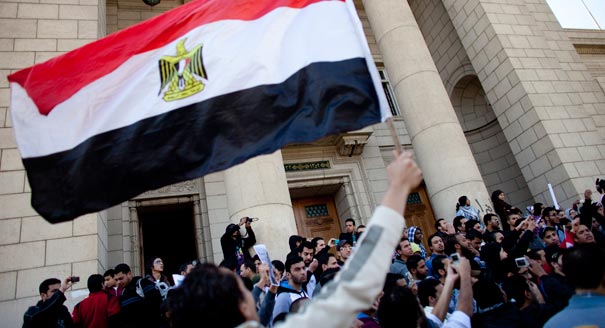
Source: Getty
Part mosque, part university, part center of religious research and knowledge, al-Azhar is perhaps the central—and certainly the most prestigious—element in the state–religion complex in Egypt.
All political forces in Egypt seem to agree: The country’s premier religious institution, al-Azhar, must be made more independent from the regime. But that agreement is deeply misleading; it masks a struggle within al-Azhar and among leading political forces over its role in Egyptian society. Part mosque, part university, part center of religious research and knowledge, al-Azhar is perhaps the central—and certainly the most prestigious—element in the state–religion complex in Egypt.
Egypt has a very substantial bureaucratic apparatus intertwining religion and state. Nobody in Egypt is arguing for a separation of religion and state; the dispute is over the terms and ways in which they will interact. All within al-Azhar want it to become more authoritative, respected, and autonomous, but there are sharp differences on how to accomplish that and how much it should control. A similar debate is taking place outside al-Azhar, where the call to make the institution more autonomous is broadly voiced but for very different reasons.
The most likely outcome of this post-revolutionary struggle is a religiously influenced state, but not an Iranian-style theocracy. Contrasting visions of what that means are leading to a political battle, fought not on the plane of abstract philosophical argument but on the very prosaic ground of legal drafting. That process has already begun, and it will be placed forcefully on the agenda of the new parliament.

Nonresident Senior Fellow, Middle East Program
Nathan J. Brown, a professor of political science and international affairs at George Washington University, is a distinguished scholar and author of nine books on Arab politics and governance, as well as editor of five books.
Recent Work
Nathan J. Brown
Nathan J. Brown
Carnegie does not take institutional positions on public policy issues; the views represented herein are those of the author(s) and do not necessarily reflect the views of Carnegie, its staff, or its trustees.

Sergei Kiriyenko used Russia’s parliamentary vote to further hone his strategy of corporate mobilization that is designed to maximize votes for United Russia.

Andrey Pertsev

Before the next wave of EU enlargement takes place, the union needs to grapple with thorny questions of how power is distributed among its members.


Emil Sondaj Hansen, Ditte Brasso Sørensen

The European far right might fail to steer EU policy in the direction Russia wants, but they will create enough chaos inside Europe to benefit the Kremlin.

Dimitar Bechev

In Egypt’s dense cities, the disappearance of foliage has health implications and punishes daily commuters.

Angie Omar

If the Russian-speaking community in Latvia cannot articulate their interests without being seen as disloyal, they could end up embracing a pro-Kremlin agenda.

Sergejs Potapkins