

Commentary
It should address the shortcomings of previous crisis communication efforts and adapt to the demands of frontier AI.
Lucy Luo
Source: Getty
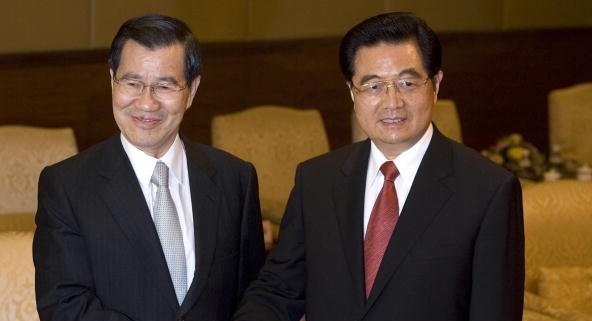
Stability in cross-Strait relations is based on policies in Taipei, Beijing, and Washington, but with all three countries looking toward potential changes in leadership, the framework for peace remains fragile.
Taiwan is in the heat of a presidential campaign, and its cross-Strait policy is the most headline-grabbing issue in the whole region. President Ying-jeou Ma’s mainland policy has achieved three years’ worth of stability for the Asian-Pacific region, and if he wins reelection in January, that stability can probably endure even longer.
But the region is facing a great deal of change, and the possibility for chaos is a real one. There will be at least seven major countries with general elections and leadership changes in 2012, including Taiwan, South Korea, Russia, the United States, and the Chinese Mainland. Ma’s victory will be critical for the region.
The structural factors that contribute to the stability of the China-Taiwan relationship stem from three different policy lines coming out of Taiwan, China, and the United States.
For Taipei, when Mr. Ma won his 2008 campaign, he didn’t hesitate to construct a policy of “maintaining cross-Strait stability” according to his party platform. That platform was based on the 1992 Consensus, in which Beijing and Taipei agreed that there is one China, but that each side has its own interpretation of what that means. That policy line helped eliminate the instability caused by the “one country on each side” principle that was raised by Ma’s predecessors from the Democratic Progressive Party (DPP). It implied that China and Taiwan were separate countries, not just two political spheres within one country.
In Beijing, almost immediately after Ma won the presidency, there was a great debate over China’s Taiwan policy. Policymakers wondered whether Beijing should push Taiwan toward unification or maintain the current stage of cross-Strait peaceful development. Chinese President Hu Jintao prudently concluded that the character of current cross-Strait relations should be fixed on anti-independence rather than a push for unification, suggesting that the policy of “cross-Strait peaceful development” should remain intact.
Last but not least was Washington’s policy. The United States, as the most important player in the region, has been trying to maintain the status quo.
So, a stable framework was constructed through a vague saddle point to keep the current cross-Strait situation from descending into chaos: Taipei acted to maintain cross-Strait stability; Beijing promoted cross-Strait peaceful development; and Washington sought to maintain the status quo. The stability is no longer abstract but has a distinct structure, though that framework is still fragile and each side still has to learn how to trust the others.
Almost all the subsequent policies that can help bring about greater stabilization are based on this fragile structure. There is the potential for a diplomatic truce, Taiwan’s participation in the World Health Organization, and, most importantly, Taipei’s involvement in the Economic Cooperation Framework Agreement (ECFA), a trade agreement between China and Taiwan that came into effect in September 2010.
The effects of ECFA have been greatly distorted. Those who criticize the agreement believe that it will only make Taiwan more dependent on the Chinese Mainland. They argue that Beijing also sees the agreement as a way to increase Taiwan’s dependence on China, but that the Chinese use a different phrase: “deepening the interaction of the two sides.”
But for Taipei, the ECFA represents something different. First, it tells Beijing that Taiwan did not shut down all the possibilities of a common future, and this will definitely make Beijing consider similar future policies more reasonably and rationally.
Second, the ECFA is a gateway for Taiwan’s economy. For the first decade of the twenty-first century, there were approximately 60 meaningful free trade agreements around the pan-Pacific region. Two countries were excluded from those agreements: North Korea and Taiwan. The result is that Taiwan has been gradually marginalized. The previous Taiwanese administration tried to push Beijing on this matter. But under the leadership of Chen Shui-bian, Taiwan failed to sign any trade or investment agreements with its neighbors.
Through the ECFA, Taipei has gotten closer to Southeast Asia, America, Europe, and Japan. This helps create a favorable environment for the cross-Strait peaceful development and peaceful competition, with benefits for both sides of Taiwan Strait. This group constitutes a collective force resisting the economic magnet that is the Chinese Mainland. And this creates a strategic balance across the Straits.
Simultaneously, more relaxed cross-Strait relations allow Taiwan to move closer to the West in the areas of ideology and security.
Nonetheless, 2012 will bring a crisis of sorts to cross-Strait stability. Both Taipei’s and Beijing’s policy stances may be altered. If that is the case, only time will tell whether, at best, a new saddle point of stability develops, or whether the uncertainty of the previous administration will return to Taiwan-China relations. The latter could indeed happen.
Two variables will impact regional stability, and they are both related to election campaigns. In Taiwan, the DPP presidential candidate Tsai Ying-wen’s Mainland policy could create instability. Her Mainland policy has been criticized as being without substance, suggesting that it might be regarded by Beijing as a great leap backward from the current situation.
And the problem of China is even more complicated. Vice President Xi Jinping is expected to take the presidency at the Eighteenth Party Congress in the autumn of 2012. But little is known about Xi and his staff, especially when it comes to his policy toward Taiwan. This definitely adds uncertainty.
And the transition time for Xi and his staff will be long. It is expected that at the administrative level his government will not be in position until the late spring of 2013, which means it will not be until late fall 2013 that Xi and his staff will start to work substantially. It is difficult to imagine what the situation will be like two years from now. This suggests that there will be no real cross-Strait or regional stability policy of Xi’s own until the winter of 2013. And if the Chinese economy and domestic situation are taken into consideration, things will be even more complicated.
But Taipei cannot wait that long. Taiwan will enter another presidential campaign cycle beginning in early 2015. There will be very little time to breathe between now and then.
Given all of this, if Ma wins reelection, Taiwan can keep its own policy stable. The Taiwan factor in the equation will remain unchanged. And when Xi comes into power, it will be much easier for him to manage cross-Strait relations. That will mean maintaining current cross-Strait stability will be much easier and more likely.
But the situation could be entirely different—and much more difficult—if Tsai wins the presidency. In that situation, the lack of a defined cross-Strait policy that will bring balance to relations is the issue. This will put cross-Strait relations in a shadow of uncertainty. Instability could be the result.
Certainly, before Xi completes his governmental organization, the line from China will not be clear either. And before Xi and his staff determine a guiding principle and press ahead with a clear policy, Beijing may adopt an even tougher policy toward Taipei. During the transition, a “rather left than right” policy—that is, a more radical rather than too conservative policy—is safer. And Xi may even take a high-profile posture toward Taiwan in the face of Ma’s future reelection, let alone Tsai’s victory. This suggests there will either be double uncertainty from both Taipei and Beijing—or an even worse scenario.
Yang-ming Sun is the vice president of the Prospect Foundation.
Yang-ming Sun
Prospect Foundation
Carnegie does not take institutional positions on public policy issues; the views represented herein are those of the author(s) and do not necessarily reflect the views of Carnegie, its staff, or its trustees.
It should address the shortcomings of previous crisis communication efforts and adapt to the demands of frontier AI.

Lucy Luo

If the Russian-speaking community in Latvia cannot articulate their interests without being seen as disloyal, they could end up embracing a pro-Kremlin agenda.

Sergejs Potapkins
Washington’s decision to support some UN functions while letting others wither is pulling the organization apart at the seams.

Stewart Patrick, Theodore Zaritsky

Are Germany’s economic, industrial, and political struggles becoming a liability for the EU’s ability to rise to the geopolitical moment?

Rym Momtaz, ed.

Russia’s ruling party would have benefited from Putin appearing as its distant patron, but as an active frontman imposing his views on the public, he has done nothing but harm both the party’s election campaign and the ruling system overall.

Andrey Pertsev