• Research
  • Emissary
  • About
  • Experts
Carnegie Global logoCarnegie lettermark logo
Democracy
  • Donate
A 21st Century Myth—Authoritarian Modernization in Russia and China
Report
Carnegie Russia Eurasia Center

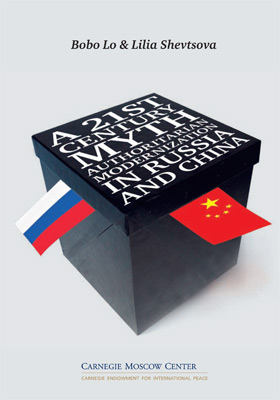
A 21st Century Myth—Authoritarian Modernization in Russia and China

The idea of authoritarian modernization, or state capitalism, has become fashionable in the wake of the global financial crisis, but the examples of China and Russia demonstrate that it is ultimately a self-serving illusion.

Link Copied
By Bobo Lo and Lilia Shevtsova
Published on Jul 1, 2012

Additional Links

Full Text
Project hero Image

Project

Eurasia in Transition

Learn More

Source: Carnegie Moscow Center Report

In recent years, China has emerged as the poster child for a new economic “model,” commonly known as authoritarian modernization or state capitalism. The idea that economic development is best managed top-down by a wise, paternalist state has become especially fashionable in the wake of the global financial crisis.

To many observers, this crisis has not only exposed the weaknesses of the advanced Western economies, but also called into question the value of democratic liberalism itself. Set against the failures of the West, the continued economic success of China and, to a lesser extent, Russia appears to suggest a more promising path of development.

Bobo Lo and Lilia Shevtsova rebut such assumptions. They argue that the notion of authoritarian modernization is in fact a self-serving illusion. In Russia, there has been a significant increase in authoritarianism, but very little modernization. Meanwhile, China has experienced a remarkable transformation, yet one driven largely by economic liberalization and bottom-up reform.

The authors conclude that the real threat to democratic liberalism comes not from competing value-systems such as a putative “China model,” but from within. Political and economic stagnation, moral complacency, and a selective approach to values have led to the current crisis of Western liberalism, and helped build up the myth of authoritarian modernization.

Authors

Bobo Lo
Lilia Shevtsova
Former Senior Associate, Russian Domestic Politics and Political Institutions Program, Moscow Center
Lilia Shevtsova

Carnegie does not take institutional positions on public policy issues; the views represented herein are those of the author(s) and do not necessarily reflect the views of Carnegie, its staff, or its trustees.

More Work from Carnegie Endowment for International Peace

  • Kushner and Putin shaking hands, with Witkoff standing next to them
    Commentary
    Emissary
    What If Trump Gets His Russia-Ukraine Deal?

    It’s dangerous to dismiss Washington’s shambolic diplomacy out of hand.

      Eric Ciaramella

  • Abstract of global AI
    Article
    South-South AI Collaboration: Advancing Practical Pathways

    The India AI Impact Summit offers a timely opportunity to experiment with and formalize new models of cooperation.

      Lakshmee Sharma, Jane Munga

  • Commentary
    Strategic Europe
    Taking the Pulse: Can the EU Attract Foreign Investment and Reduce Dependencies?

    EU member states clash over how to boost the union’s competitiveness: Some want to favor European industries in public procurement, while others worry this could deter foreign investment. So, can the EU simultaneously attract global capital and reduce dependencies?

      • Rym Momtaz

      Rym Momtaz, ed.

  • Article
    What Can the EU Do About Trump 2.0?

    Europe’s policy of subservience to the Trump administration has failed. For Washington to take the EU seriously, its leaders now need to combine engagement with robust pushback.

      Stefan Lehne

  • Commentary
    Strategic Europe
    To Survive, the EU Must Split

    Leaning into a multispeed Europe that includes the UK is the way Europeans don’t get relegated to suffering what they must, while the mighty United States and China do what they want.

      • Rym Momtaz

      Rym Momtaz

Get more news and analysis from
Carnegie Endowment for International Peace
Carnegie global logo, stacked
1779 Massachusetts Avenue NWWashington, DC, 20036-2103Phone: 202 483 7600Fax: 202 483 1840
  • Research
  • Emissary
  • About
  • Experts
  • Donate
  • Programs
  • Events
  • Blogs
  • Podcasts
  • Contact
  • Annual Reports
  • Careers
  • Privacy
  • For Media
  • Government Resources
Get more news and analysis from
Carnegie Endowment for International Peace
© 2026 Carnegie Endowment for International Peace. All rights reserved.