

Commentary
Congress should ask tough questions about the agreement’s more unique features and whether they advance U.S. interests or compromise them.
Jane Darby Menton
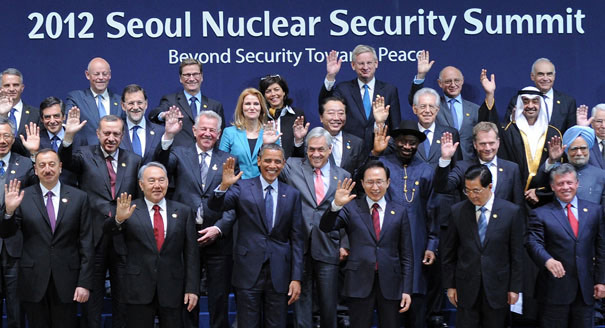
Source: Getty
So far, the promotion of nuclear security has been conducted mostly through a top-down approach, but it is best achieved through a bottom-up approach by creating nuclear security champions.
Conventional wisdom holds that technical fixes can close loopholes in the emerging nuclear security regime. According to this approach, a large budget and enough capacity building resources will allow most issues to be addressed quickly and effectively.
Accordingly, many experts argue that the Nuclear Security Summit process, which began with an April 2010 meeting hosted by U.S. President Barack Obama in Washington and continued with a second summit that took place in Seoul this past spring, urgently needs to set higher expectations and pursue more ambitious goals. For instance, Joan Rohlfing, president of the Nuclear Threat Initiative, argues that “we need to develop a comprehensive, universal, and ultimately enforceable [nuclear] materials control system.”1
Kenneth Luongo, president of the Partnership for Global Security and co-chair of the Fissile Materials Working Group, calls for a framework agreement to unite currently disparate and loosely-defined nuclear security conventions, rules, and standards.2 Akin to the United Nations Framework Convention on Climate Change, such an agreement would be universal, but it would permit a comprehensive system to be developed over time. It would promote recognition of nuclear security as a priority and require its parties to take specific steps to gradually achieve its objectives.
While much has been achieved through the Nuclear Security Summit process, the reality is that states set their own goals. Most of these goals require minimal action, and not all states have made commitments. More importantly, no agreement has been reached on a rigorous methodology to assess progress. There is, therefore, little chance that a more ambitious, overarching nuclear security regime like the one envisioned by Rohlfing or Luongo will see the light of day any time soon.
There are many reasons why progress toward a comprehensive regime has been limited. Experts usually point to practical hurdles such as a lack of funding, limited human resources, and technological deficiencies, particularly in developing states. However, the most fundamental problems are political.
The key question for policymakers should not be “How much capacity do I need?” but “How best can I make use of the capacity I have?” But states will ask this question only after they have made the political decision to recognize nuclear security as a priority. Many developing states have not prioritized nuclear security, because they have more important concerns, such as trade, development, and poverty alleviation.
Moreover, many developing states, notably the members of the Non-Aligned Movement, are reluctant to accept the expansion of the nuclear security agenda on ideological grounds. It is an unfortunate reality that many Non-Aligned states view the United States’ championing of this agenda as hypocritical or illegitimate given its large nuclear arsenal. Ultimately, nuclear security is not just a technical problem that requires technical fixes. Many the same divisions and political issues that exist in the nonproliferation realm are at play.
So far, the Obama administration’s efforts to address this legitimacy deficit (through more active disarmament diplomacy) have had limited success in changing perceptions. And the perception of illegitimacy has been carefully exploited by Iran’s divisive diplomacy; Tehran has worked steadily to keep developed and developing states apart, notably in meetings of the International Atomic Energy Agency (IAEA).
Against this background, an overly ambitious push for an international nuclear security regime is not only unlikely to succeed, but it could actually prove counterproductive by inflaming divisions between developed and developing states and bringing any progress to a standstill. Pursuit of the best—rapid development of an international nuclear security regime—can work against the good—gradual development in all states of a strong nuclear security culture.
To develop a nuclear security culture at the national level—that is to have nuclear security accepted as a legitimate goal and guaranteed to receive the attention it deserves—national citizens who will champion nuclear security at home are needed. These “nuclear security champions” will have an extensive knowledge of the topic. They will appreciate its political, legal, economic, social, and technological ins and outs.
Nuclear security champions will also have excellent interpersonal and intercultural skills. They will be well-connected to and highly respected by the expert community, both nationally and internationally. They will know how to navigate government agencies. The champions will also know how to reach out both to national leadership and to nuclear security implementers and facilitate communication and coordination among them.
Most importantly, nuclear security champions will be charismatic top-notch problem-solvers with outstanding negotiation skills. They will think laterally to come up with practical, tailored solutions to the specific problems that their country faces. They will know how to generate broad-based consensus for their ideas and how to “sell” them to decision-makers. And they will export these ideas at the regional level through engagement with relevant organizations.
Of course, people that combine all these qualities are rare. But it is possible to identify rising stars, train them, and empower them. Negotiation and problem-solving skills, as well as topic knowledge, can be learnt. That is why the IAEA has increasingly given a high priority to providing training and advice to member states on establishing educational programs in nuclear security. For instance, it has helped create the International Nuclear Security Education Network, which aims to develop, share, and promote excellence in nuclear security education.3
Independent of IAEA efforts, other similar programs are being developed by states and international organizations such as the European Union. Charitable foundations, also, are investing in nuclear security education. The John D. and Catherine T. MacArthur Foundation, for instance, is supporting interdisciplinary training in nuclear security at the graduate and post-doctoral levels.4
These nascent efforts should be continued, enhanced, and targeted particularly to the developing world. So far, the promotion of nuclear security has been conducted mostly through a top-down approach. It is time we realized that it is best achieved through a bottom-up approach and that we focus our efforts on creating nuclear security champions.
The first step is to identify likely candidates. In most countries, it is unclear which the main actors responsible for nuclear security are and how each government operates to deal with it. States should, therefore, provide clarity on the portfolios of all relevant officers, both at the policy and at the implementation level. They should also develop a comprehensive organizational chart for nuclear security, not only to identify where the gaps are, but also to pin-point who the movers and shakers could be. Training efforts to give these individuals the tools to effectively champion nuclear security could then be more effectively targeted.
Granted, this approach demands a long, drawn out endeavor—and nuclear security is an urgent task. But given the political realities, it is the one most likely to pay off.
David Santoro is the Senior Fellow for Nonproliferation and Disarmament at the Pacific Forum CSIS. He can be contacted at david@pacforum.org.
1. “A Next Step in Nuclear Arms Control: Securing Fissile Materials,” Panel Discussion at the Brookings Institution, Washington, DC, June 28, 2012, transcript available at https://www.nti.org/media/pdfs/Transcript_-_Brookings_Event_-_6-28-12.pdf?_=1342805779.
2. Kenneth N. Luongo, “The Nuclear Security Summit and Global Nuclear Security Governance for the 21st Century,” Testimony before the Senate Committee on Homeland Security and Governmental Affairs Subcommittee on Oversight of Government Management, the Federal Workforce, and the District of Columbia, March 14, 2012.
3. For more information, visit http://www-ns.iaea.org/security/workshops/insen-wshop.asp.
4. For more information, visit http://www.macfound.org/info-grantseekers/grantmaking-guidelines/ips-grant-guidelines/.
David Santoro
Carnegie does not take institutional positions on public policy issues; the views represented herein are those of the author(s) and do not necessarily reflect the views of Carnegie, its staff, or its trustees.
Congress should ask tough questions about the agreement’s more unique features and whether they advance U.S. interests or compromise them.

Jane Darby Menton

Nuclear and maritime communities face a long and challenging journey to deploy commercial nuclear applications at sea.


Jamie Kwong, Toby Dalton

A look at how public opinion influences the credibility of coercive nuclear threats,and how it enables and constrains strategies of nuclear coercion.

Lauren Sukin, Samuel Seitz
Despite the agreement’s uncertainty, it’s still a significant development in regional and nuclear policy.

Andrew Leber, Jane Darby Menton
The nuclear weapons threshold is increasingly important for proliferation strategy and policy. Policymakers should better understand the implications of the threshold phenomenon in the current international security environment and plausible strategies to deal with the growing challenge that it presents.

Ariel (Eli) Levite, Toby Dalton