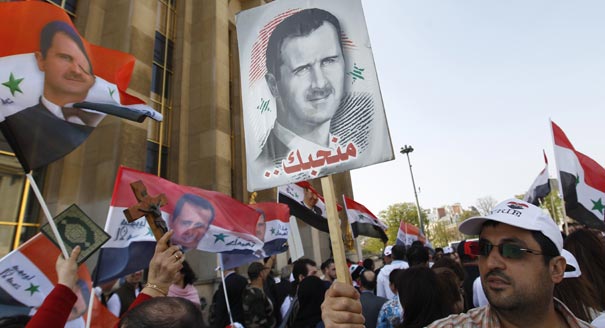
Syrian President Bashar al-Assad argued in an interview aired on the state al-Ikhbariya television station last week that his country faces a choice between submitting to “a new colonization” by the West or to the “dark”
forces of extremist Islamism. Europe and the United States will pay the price for weakening the Syrian state, he warned, as al-Qaeda will transform Syria into a safe haven for jihadists from other Muslim countries. “There is no choice before us but victory,” Assad concluded, “failure to achieve it would mean the end of Syria.”
This was familiar stuff. So were the responses of the Syrian opposition, which described Assad as “detached from reality” and “delusional,” and the reactions of Western media, which noted his position was “hardening.” But the real takeaway is that Assad expects to survive until the presidential election scheduled for May 2014 and plans to use this as leverage in negotiations with the principal external actors currently arrayed against him.
Assad’s expectation reflects his growing confidence that regime forces have held their own against the opposition’s armed rebels and can go on doing so for the foreseeable future. Indeed, recent military gains in various parts of the country are encouraging regime loyalists to envisage reversing the tide. The more hawkish among them see no reason to have a dialogue with the Syrian opposition at all.
It was always doubtful that a meaningful dialogue could be launched on the basis of the
plan Assad laid out in a speech at the Damascus Opera House on January 6. But in any case, Assad effectively abandoned calling for dialogue in a series of interviews he gave to British, Turkish, and Syrian media starting in March. Instead, he has repeatedly questioned, at length, the opposition’s cohesion and representative character, asking rhetorically, “Who will be invited to the national dialogue conference, and on what basis? . . . Is the representation connected to the number of members of a specific party? How?”
Dismissing the opposition is not new. But in emphasizing that it does not merit serious attention, Assad’s latest interviews make it clear that his sights are set firmly on influencing external actors.
The Syrian president’s April 2
interview with the Turkish Ulusal television channel and Aydınlık newspaper was clearly intended to feed public unease over the Syria policy of Turkey’s prime minister, Recep Tayyip Erdogan. Assad dealt deftly with the contentious Kurdish question, endorsing Kurdish ethnic rights while opposing separatism, and sought to tempt his audience by reviving the vision of joint economic, energy, and infrastructure networks connecting the two countries and their neighbors.
Assad used the carefully staged Ikhbariya television interview on April 17 to deliver a thinly veiled warning to Jordan, which he accused of allowing “thousands” of rebels to cross the common border “with their armaments and equipment.” “Jordan is as susceptible to these events as Syria,” he argued, alluding to the armed rebellion by the Syrian Muslim Brotherhood in 1976–1982. He urged the Jordanian authorities to “learn what the Iraqi officials have learned, because they . . . are very aware that the fire in Syria will inevitably spread to neighboring countries.” With Jordan already bracing for a massive surge of refugees as combat intensifies around Damascus and in Deraa Province, Assad’s warning is not hollow.
The foreign audience was not the only focus. The interview contained clear domestic messages as well. On one hand, Assad presented the regime’s religious credentials, stating that it had built “18,000 mosques, 220 sharia schools and tens of institutes for training religious preachers” since 1970. On the other, he reasserted its defense against sectarianism, a recurrent theme since his Opera House speech in January. Assad deliberately associated sectarian discourse with the Muslim Brotherhood, implicitly reminding his audience once again of the Islamist group’s disastrous military adventure nearly four decades ago. He boasted “I can say, without exaggeration, that the situation in Syria now is better than it was at the beginning of the crisis.” After extolling the “real national unity” demonstrated by Syria’s Christians and Muslims, he concluded, “I’m absolutely not worried [about sectarianism].”
The Ikhbariya interview was also undoubtedly intended to check the worsening of relations with Syria’s Kurds following clashes between the army and the militia of the Kurdish Democratic Union Party (PYD) in Aleppo and the northeastern city of Qamishli. “The Kurds in Syria are a natural and essential part of the fabric of our society,” Assad asserted. He listed measures undertaken by the government to improve their status, such as the naturalization of 110,000 Syrian Kurds in 2011 and the addition of Kurdish language and literature courses at Syrian universities. Most importantly, Assad sought to dispel speculation that the start of peace talks between the Turkish government and the Kurdistan Workers’ Party (PKK), with which the PYD has close ties, heralded a rupture with the PYD. He pointedly insisted that “our relationship with the Kurds is good, including the Kurdish parties that have been fighting for their rights in Turkey.”
Most of these messages are about crisis management and buying time. But Assad’s maneuvering is not aimless, nor is his timeline indefinite. And apparently he does not expect to fight to the bitter end. Rather, his insistence that “ultimately, only the people can decide whether a President remains in office or not” hints strongly that he intends to use the May 2014 presidential election for political advantage. Assad feels he is in a position to negotiate and expects that others will be compelled to deal with him.
This might not be delusional. On April 20,
U.S. Secretary of State John Kerry reiterated the commitment of the pro-opposition Friends of Syria group to a “mutually-consented-to transitional government that then frames the process for an elected transition for the new leadership of Syria.” Although this clearly assumes that Assad will not run for president in an agreed-upon election, it just as obviously accepts that he will remain in office until then, bypassing a crucial stumbling block that has so far obstructed agreement with Russia. Only a day later, Assad reportedly told a visiting
delegation of Lebanese politicians that “the Americans have been pragmatic from the outset, they don’t go all the way, and ultimately go with the victor.”
Is a deal in the offing? Not likely. The Syrian conflict will worsen considerably before the principal parties are ready to negotiate in earnest. At that point, the presidential election is likely to be the linchpin of an agreed exit. This is not to say that Assad might eventually allow a genuine challenge by opposition candidates—or a presidential election to be held at all—but it speaks to the importance of May 2014.