

Commentary
Ahead of a tough winter for Ukraine, Donald Trump’s swing back toward Russia bodes ill. But instead of panicking, Kyiv’s European allies are focusing on action.
Rym Momtaz
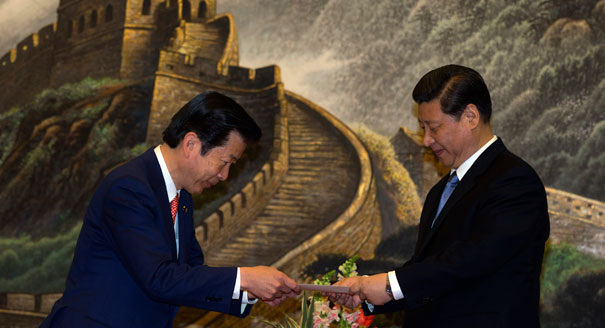
Source: Getty
China’s president and Japan’s prime minister may not meet at the G20 summit, but with tensions escalating in the East China Sea, they need to talk soon.
At the G20 summit in St. Petersburg that begins on September 5, Chinese President Xi Jinping and Japanese Prime Minister Shinzo Abe will be in the same room. Yet it seems a sideline meeting that could be critical to moving toward rapprochement in Sino-Japanese relations is not likely to take place. With tensions escalating in the East China Sea, the stakes are too high for this impasse to continue.
Since September 2012, when Japan nationalized some of the disputed East China Sea islands known in China as the Diaoyu and in Japan as the Senkaku, the two countries’ leaders have not met. Both Japanese Foreign Minister Fumio Kishida and Chinese Foreign Minister Wang Yi attended the ASEAN summit in Brunei this summer, but they did not speak to one another. The July 2013 visit to Beijing of Japan’s Vice Foreign Minister Akitaka Saiki was the first meeting at that level between Chinese and Japanese officials since last October. Yet, no great strides were made. Shortly after Saiki departed, Xi reaffirmed China’s absolute unwillingness to compromise on “national core interests” in both the East and the South China Seas.China then purportedly refused to engage in high-level talks with Japan until Abe decided whether to visit the highly controversial Yasukuni Shrine on the August 15 anniversary of Japan’s World War II defeat. The shrine honors Japanese war dead, including war criminals, and official visits have long stirred up tensions with Japan’s neighbors. Yet even now that this sensitive anniversary has passed—and Abe refrained from visiting the shrine in person—obstacles to rapprochement remain.
China has demanded that Japan agree to establish a no-entry zone around the islands as a precondition to a high-level summit. This would entail implicit recognition that the facts surrounding sovereignty of these islands are in dispute, which Japan denies, and it would contradict Japan’s administrative control of the islands. For Japan, the government’s purchase of the islands last fall was intended as a de-escalatory measure to avoid a worse outcome—the conservative governor of Tokyo, Shintaro Ishihara, would have bought the islands from their Japanese owner and developed them.
In light of the Japanese government’s perceived restraint, conceding that a dispute exists would be difficult for Abe, especially without some sort of reciprocal move by China. So despite calling for talks and expressing openness to dialogue, Abe has criticized China for demanding these initial concessions and appears unwilling to give way.
Yet, the longer the stalemate persists, the more incendiary the conflict becomes. The situation in the East China Sea is highly volatile. China’s newly consolidated and armed coast guard maintains near-constant patrols around the Diaoyu/Senkaku Islands and has consistently ventured into the islands’ territorial waters. After Japanese lawmakers visited the Yasukuni Shrine in August, China conducted what the military called “routine” live-fire exercises in the East China Sea. Recently, Japanese and Chinese nationalists alike have set sail for the disputed islands, and some confrontation between these activists and coast guard vessels is almost inevitable. There is a real danger that a miscalculation at sea could provoke a crisis that cannot be contained. An accident could easily spark escalation, fueled by resurgent nationalism in public opinion.
To manage tensions and prevent them from ratcheting up further, China and Japan must repair relations. And that can only happen if the two heads of state lead by example. Xi and Abe must be bold in overcoming their respective reservations and domestic political pressures. Although in the short term, nationalist grandstanding may be more politically palatable than making painful concessions, China’s and Japan’s true interests are best served through a cooperative approach to this dispute.The costs of continued conflict are high. Mounting tensions in the East China Sea have seriously impacted trade between China and Japan. Following Japan’s September 2012 nationalization, there was a sharp, consistent drop in Chinese demand for Japanese products. In 2012, Japan’s exports to China fell 10.4 percent to $144.8 billion. And Japan’s total trade with China dropped 3.3 percent to $333.7 billion, the first such decrease since 2009. Although there were few clear indicators of official measures to reduce trade, significantly reduced demand and a Chinese consumer boycott of Japanese goods particularly affected the auto and tourism sectors.
China and Japan have powerful incentives to preserve cooperative relations. Beyond the five uninhabited islands and three barren rocks at the heart of this conflict, Beijing and Tokyo share many interests of great consequence that are currently being shirked as a result of failed diplomacy in the territorial dispute. China and Japan alike stand to benefit from stabilizing the status quo in the East China Sea, and economic interdependence has proved to be a deterrent to escalation and a stabilizing force. Approximately 60 to 70 percent of Japan’s exports to China are machinery and parts necessary for the production of China’s own exports.
Xi and Abe have made economic growth and reform top priorities of their domestic agendas. Particularly at a time when China faces a slowing of its economy and diminished demand in the West for its exports, Beijing cannot afford to jeopardize trade ties with Tokyo. So too, Japan’s own economic revitalization through Abenomics may depend in part on China. In this regard, the continuation of trilateral free trade negotiations between China, Japan, and South Korea, with the first round completed in March, is potentially a positive sign. The continued flow of Japanese direct investment into China is another.
Prolonged diplomatic tension and dueling maritime patrols preclude China from maintaining the stability it seeks in its environment. This situation will also likely lead Japan to continue cultivating deeper relations and cooperation with its Asia-Pacific neighbors and contemplating a more active military presence in the region—developments that run counter to China’s interests.
While visiting Washington in August to meet with U.S. Secretary of Defense Chuck Hagel, Chinese Minister of National Defense General Chang Wanquan emphasized that disputes in the Asia-Pacific should be solved using “dialogue and negotiation.” Making constructive progress on these issues can only begin in earnest with a conversation at the highest level, at the very least to signal to domestic audiences that the broader bilateral relationship might be more important than those eight little rocks and islets.
Although Xi and Abe may not meet at the G20 summit, these heads of state should do so soon. They are supposed to be leaders after all.

Former Maurice R. Greenberg Director’s Chair, Carnegie China
Paul Haenle held the Maurice R. Greenberg Director’s Chair at the Carnegie Endowment for International Peace and is a visiting senior research fellow at the East Asian Institute, National University of Singapore. He served as the White House China director on the National Security Council staffs of former presidents George W. Bush and Barack Obama.

Former Senior Fellow, Asia Program
James L. Schoff was a senior fellow in the Carnegie Asia Program. His research focuses on U.S.-Japan relations and regional engagement, Japanese technology innovation, and regional trade and security dynamics.
Carnegie does not take institutional positions on public policy issues; the views represented herein are those of the author(s) and do not necessarily reflect the views of Carnegie, its staff, or its trustees.

Ahead of a tough winter for Ukraine, Donald Trump’s swing back toward Russia bodes ill. But instead of panicking, Kyiv’s European allies are focusing on action.

Rym Momtaz

Funding Ukraine remains a priority for European leaders. As Russia’s war of aggression heads into another winter, two feasible options to mobilize support for Kyiv should be fast-tracked.


Vladyslav Rashkovan, Gregory P. Wilson

Russian strikes are weakening the economy sustaining Ukraine’s war effort. Closing the growing funding gap will require more European support and politically contentious reforms in Kyiv.

Balázs Jarábik

While the EU and European governments are embracing the much-lauded middle-power moment, this entails three difficult conundrums.

Richard Youngs

The middle power moment will not be defined by sovereign states alone, and California stands out for its potential contributions to international cooperation.


Ian Klaus, Stewart Patrick