• Research
  • Emissary
  • About
  • Experts
Carnegie Global logoCarnegie lettermark logo
DemocracyIran
  • Donate
Governing Cyberspace: A Road Map for Transatlantic Leadership
Report
Carnegie Europe

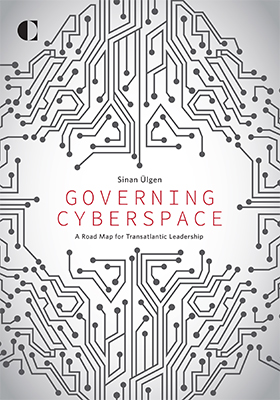
Governing Cyberspace: A Road Map for Transatlantic Leadership

Cybertechnologies are rapidly changing the international landscape, but weak international governance of cyberspace stands in stark contrast to the accelerating pace of challenges.

Link Copied
By Sinan Ülgen
Published on Jan 18, 2016

Additional Links

Full TextBrief
Program mobile hero image

Program

Europe

The Europe Program in Washington explores the political and security developments within Europe, transatlantic relations, and Europe’s global role. Working in coordination with Carnegie Europe in Brussels, the program brings together U.S. and European policymakers and experts on strategic issues facing Europe.

Learn More
Program mobile hero image

Program

Technology and International Affairs

The Technology and International Affairs Program develops insights to address the governance challenges and large-scale risks of new technologies. Our experts identify actionable best practices and incentives for industry and government leaders on artificial intelligence, cyber threats, cloud security, countering influence operations, reducing the risk of biotechnologies, and ensuring global digital inclusion.

Learn More

Cybertechnologies are rapidly changing the international landscape, but leaders in government, business, and elsewhere are just beginning to understand the ramifications, both good and bad, of an interconnected digital world. Weak international governance of cyberspace stands in stark contrast to the accelerating pace of challenges. To shape the regimes that govern cyberspace to the advantage of generations to come, the United States and the European Union should forge a joint policy vision.

The Role of the Transatlantic Partners

  • Given their economic and technological edge, the United States and Europe have a natural interest in playing a more influential role in the cybernorms debate.
     
  • Washington and Brussels have started to engage third countries on cyberpolicy issues to develop multilateral norms. The impact of these disparate attempts can be greatly enhanced by a transatlantic effort to identify and jointly shape a more ambitious global agenda.
     
  • The feasibility of any joint initiative will depend on the potential for convergence between Washington and Brussels on key policy areas related to cyberspace, such as online privacy, Internet freedoms and governance, cybersecurity, and cyberwarfare.
     
  • There is a significant degree of real and potential convergence between the transatlantic partners, and these areas should provide the basis for a new approach to creating a global policy framework for cyberspace.

How to Capitalize on Areas of Convergence

Develop norms regulating government-industry collaboration on mass data collection and retrieval. To enhance trust in the Internet, the transatlantic partners should develop a joint code of conduct for regulating interactions between government agencies, large Internet companies, and data handlers regarding access to online data.

Create a new multilateral instrument to prevent cybercrime. The transatlantic partners should develop more robust ways to detect and analyze cyberattacks so that culprits can be more easily identified and future attacks better deterred.

Propose amendments to international trade law to introduce penalties for economic cyberespionage. Changing World Trade Organization rules will require a joint action led by the transatlantic partners.

Lead efforts to codify norms governing the export of surveillance technologies. The transatlantic partners should guide this effort that would help to constrain the capacity of illiberal regimes to restrict Internet freedoms.

Agree on a mandate for NATO to develop a more robust approach to cyberdeterrence. The North Atlantic Treaty Organization has developed a strategy focused on enhancing the resilience of the alliance against cyberattacks. But NATO also needs a more offensive posture to improve its overall deterrence.

Read Full Text

About the Author

Sinan Ülgen

Senior Fellow, Carnegie Europe

Sinan Ülgen is a senior fellow at Carnegie Europe in Brussels, where his research focuses on Turkish foreign policy, transatlantic relations, international trade, economic security, and digital policy.

    Recent Work

  • Q&A
    Can the EU Achieve Its Tech Ambitions?

      Raluca Csernatoni, Sinan Ülgen

  • Q&A
    Can the EU Overcome Divisions on Defense?

      Catherine Hoeffler, Sinan Ülgen

Sinan Ülgen
Senior Fellow, Carnegie Europe
Sinan Ülgen
EuropeNorth AmericaUnited StatesWestern EuropeIranSecurityTechnologyGlobal Governance

Carnegie does not take institutional positions on public policy issues; the views represented herein are those of the author(s) and do not necessarily reflect the views of Carnegie, its staff, or its trustees.

More Work from Carnegie Endowment for International Peace

  • One man tossing a sack to another to stack on a truck
    Commentary
    Emissary
    The Other Global Crisis Stemming From the Strait of Hormuz’s Blockage

    Even if the Iran war stops, restarting production and transport for fertilizers and their components could take weeks—at a crucial moment for planting.

      • Noah  Gordon ​​​​

      Noah Gordon, Lucy Corthell

  • Commentary
    Diwan
    Shockwaves Across the Gulf

    The countries in the region are managing the fallout from Iranian strikes in a paradoxical way.

      • Angie Omar

      Angie Omar

  • Commentary
    Strategic Europe
    Taking the Pulse: Is France’s New Nuclear Doctrine Ambitious Enough?

    French President Emmanuel Macron has unveiled his country’s new nuclear doctrine. Are the changes he has made enough to reassure France’s European partners in the current geopolitical context?

      • Rym Momtaz

      Rym Momtaz, ed.

  • Commentary
    The Iran War’s Dangerous Fallout for Europe

    The drone strike on the British air base in Akrotiri brings Europe’s proximity to the conflict in Iran into sharp relief. In the fog of war, old tensions in the Eastern Mediterranean risk being reignited, and regional stakeholders must avoid escalation.

      Marc Pierini

  • Commentary
    Diwan
    The U.S. Risks Much, but Gains Little, with Iran

    In an interview, Hassan Mneimneh discusses the ongoing conflict and the myriad miscalculations characterizing it.

      Michael Young

Get more news and analysis from
Carnegie Endowment for International Peace
Carnegie global logo, stacked
1779 Massachusetts Avenue NWWashington, DC, 20036-2103Phone: 202 483 7600Fax: 202 483 1840
  • Research
  • Emissary
  • About
  • Experts
  • Donate
  • Programs
  • Events
  • Blogs
  • Podcasts
  • Contact
  • Annual Reports
  • Careers
  • Privacy
  • For Media
  • Government Resources
Get more news and analysis from
Carnegie Endowment for International Peace
© 2026 Carnegie Endowment for International Peace. All rights reserved.