• Research
  • Emissary
  • About
  • Experts
Carnegie Global logoCarnegie lettermark logo
DemocracyIran
  • Donate
Violence and Development Along the India-Pakistan Border in Jammu and Kashmir
Book

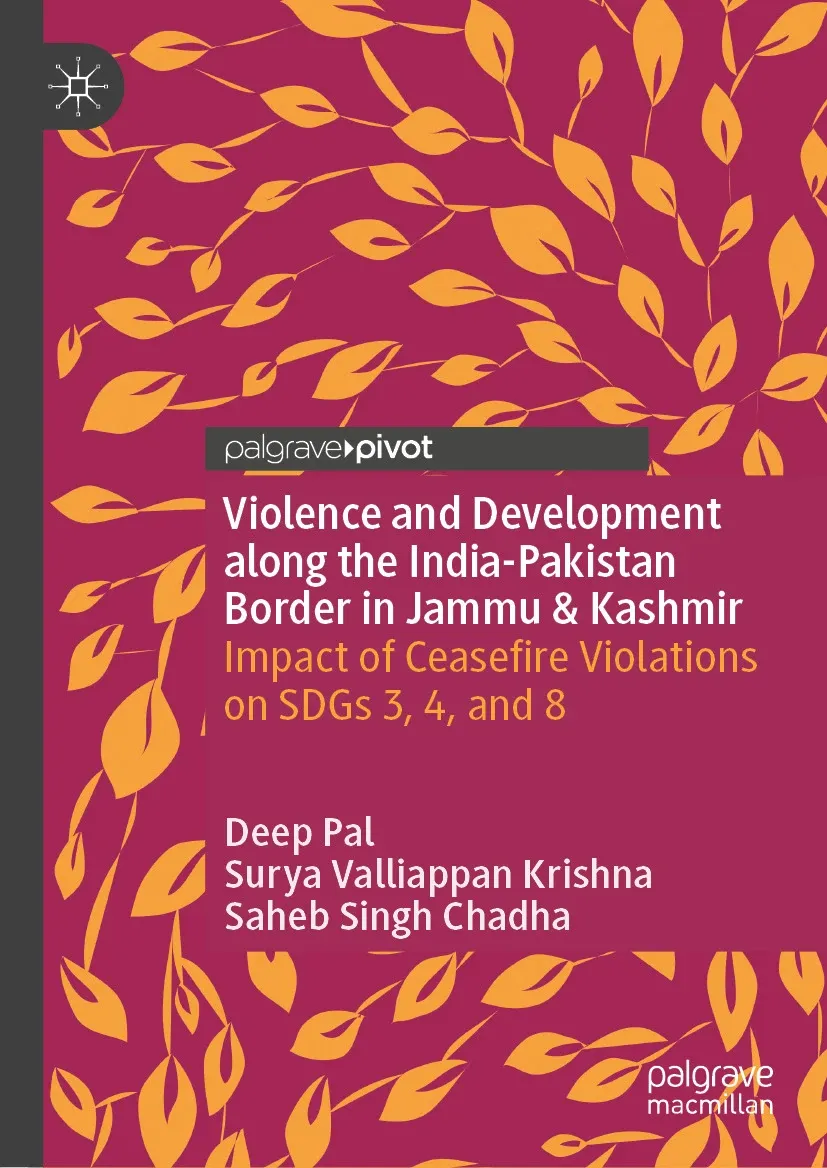
Violence and Development Along the India-Pakistan Border in Jammu and Kashmir

This book examines the impact of cross-border violence on communities living along the Line of Control and the International Border in Jammu and Kashmir, India.
Link Copied
By Deep Pal, Surya Valliappan Krishna, Saheb Singh Chadha
Published on May 20, 2025
Project hero Image

Project

Security Studies

India’s evolving role in regional and global security is shaped by complex dynamics. Experts in the Security Studies Program examine India’s position in this world order through informed analyses of its foreign and security policies, focusing on the relationship with China, the securitization of borders, and the geopolitics of the Indo-Pacific. 

Learn More
Explore the Book

About the Authors

Deep Pal

Former Visiting Scholar, Asia Program

Deep Pal was a visiting scholar in the Asia program at Carnegie Endowment for International Peace.

Surya Valliappan Krishna

Former Deputy Director, Projects and Operations

Surya Valliappan Krishna was the deputy director of projects and operations at Carnegie India.

Saheb Singh Chadha

Former Senior Research Analyst, Security Studies Program

Saheb Singh Chadha was a senior research analyst in the Security Studies Program at Carnegie India. His research focuses on China’s foreign and security policies, India-China relations, and India’s military modernization.

Authors

Deep Pal
Former Visiting Scholar, Asia Program
Deep Pal
Surya Valliappan Krishna
Former Deputy Director, Projects and Operations
Surya Valliappan Krishna
Saheb Singh Chadha
Former Senior Research Analyst, Security Studies Program
Saheb Singh Chadha
IndiaPakistanSecurity

Carnegie does not take institutional positions on public policy issues; the views represented herein are those of the author(s) and do not necessarily reflect the views of Carnegie, its staff, or its trustees.

More Work from Carnegie Endowment for International Peace

  • Research
    The Unintended Consequences of German Deterrence

    Germany's sometimes ambiguous nuclear policy advocates nuclear weapons for deterrence purposes but at the same time adheres to non-proliferation. This dichotomy can turn into a formidable dilemma and increase proliferation pressures in Berlin once no nuclear protector is around anymore, a scenario that has become more realistic in recent years.

      Ulrich Kühn

  • Commentary
    Carnegie Politika
    Why Are China and Russia Not Rushing to Help Iran?

    Most of Moscow’s military resources are tied up in Ukraine, while Beijing’s foreign policy prioritizes economic ties and avoids direct conflict.   

      • Alexander Gabuev

      Alexander Gabuev, Temur Umarov

  • A missile tail embedded in the ground in an open field with green ground cover and a blue sky.
    Commentary
    Emissary
    Turkey Has Two Key Interests in the Iran Conflict

    But to achieve either, it needs to retain Washington’s ear.

      Alper Coşkun

  • people watching smoke rising at sunrise from rooftops
    Commentary
    Emissary
    Bombing Campaigns Do Not Bring About Democracy. Nor Does Regime Change Without a Plan.

    Just look at Iraq in 1991.

      Marwan Muasher

  • Satellite of a damaged oil refinery
    Commentary
    Emissary
    Iran Is Pushing Its Neighbors Toward the United States

    Tehran’s attacks are reshaping the security situation in the Middle East—and forcing the region’s clock to tick backward once again.

      Amr Hamzawy

Get more news and analysis from
Carnegie Endowment for International Peace
Carnegie global logo, stacked
1779 Massachusetts Avenue NWWashington, DC, 20036-2103Phone: 202 483 7600Fax: 202 483 1840
  • Research
  • Emissary
  • About
  • Experts
  • Donate
  • Programs
  • Events
  • Blogs
  • Podcasts
  • Contact
  • Annual Reports
  • Careers
  • Privacy
  • For Media
  • Government Resources
Get more news and analysis from
Carnegie Endowment for International Peace
© 2026 Carnegie Endowment for International Peace. All rights reserved.