• Research
  • Emissary
  • About
  • Experts
Carnegie Global logoCarnegie lettermark logo
DemocracyIran
  • Donate
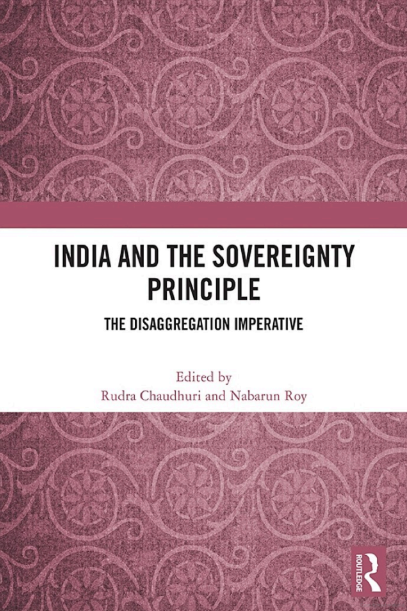
India and the Sovereignty Principle: The Disaggregation Imperative
Book
Carnegie India

India and the Sovereignty Principle: The Disaggregation Imperative

This book offers a comprehensive analysis of India's evolving relationship with sovereignty in a complex global order. Moving beyond conventional narratives, it examines how the sovereignty principle shapes India's behavior across four critical domains—from traditional military power to contemporary data governance.

Link Copied
By Rudra Chaudhuri and Nabarun Roy
Published on Sep 26, 2025
IndiaSecurity

Carnegie does not take institutional positions on public policy issues; the views represented herein are those of the author(s) and do not necessarily reflect the views of Carnegie, its staff, or its trustees.

More Work from Carnegie Endowment for International Peace

  • Pedestrians passing through mist
    Commentary
    Emissary
    India’s Heatwave Is a Warning for the Future

    As “unprecedented” temperatures become routine, the country is failing its energy transition stress test.

      • Kayly Ober

      Kayly Ober

  • Commentary
    Carnegie Politika
    Is Belarus Really Set to Return to the Ukraine War?

    By reminding the world that Lukashenko is a threat to NATO and Ukraine, Kyiv is trying to return the focus to why the Belarusian regime needs to be contained rather than rewarded.

      Artyom Shraibman

  • Commentary
    India’s Semiconductor Ecosystem Is Maturing—and ASML Is Taking Notice

    The ASML MoU with Tata Electronics is an indicator of how far the Indian semiconductor ecosystem has come. This ecosystem has been years in the making and represents real commercial logic.

      Konark Bhandari

  • Paper
    A Review of India's 2023 Space Policy and Entrepreneurship Ecosystem

    This paper examines the relationship between India’s evolving space policy and the corresponding growth in private space ventures. It analyzes both the enabling factors created by recent regulatory changes and the persistent challenges facing entrepreneurs in this capital-intensive, highly regulated industry.

      Harshan Vazhakunnam

  • Recruit polices vow as they join in the police at Beijing Public Security Bureau on February 18, 2011 in Beijing, China. (
    Paper
    China’s Police and Security Cooperation Agreements

    China’s Ministry of Public Security is often portrayed as a domestic law enforcement agency, but it is also a global security actor. This paper explores how MPS has used international law enforcement and security cooperation agreements—over 200 since 2006—to advance China’s vision of security in a changing global environment.  

      • Sheena Chestnut Greitens

      Sophie Zhuang, Sheena Chestnut Greitens, Cameron Waltz

Get more news and analysis from
Carnegie Endowment for International Peace
Carnegie global logo, stacked
1779 Massachusetts Avenue NWWashington, DC, 20036-2103Phone: 202 483 7600
  • Research
  • Emissary
  • About
  • Experts
  • Donate
  • Programs
  • Events
  • Blogs
  • Podcasts
  • Contact
  • Annual Reports
  • Careers
  • Privacy
  • For Media
  • Government Resources
Get more news and analysis from
Carnegie Endowment for International Peace
© 2026 Carnegie Endowment for International Peace. All rights reserved.