

Commentary
Alejandro Martin Rodriguez, Kayly Ober
{
  "authors": [
    "Kayly Ober"
  ],
  "type": "commentary",
  "blog": "Emissary",
  "centerAffiliationAll": "dc",
  "centers": [
    "Carnegie Endowment for International Peace"
  ],
  "englishNewsletterAll": "ctw",
  "nonEnglishNewsletterAll": "",
  "programAffiliation": "SCP",
  "programs": [
    "Sustainability, Climate, and Geopolitics"
  ],
  "regions": [
    "India"
  ],
  "topics": [
    "Climate Change",
    "Energy"
  ]
}
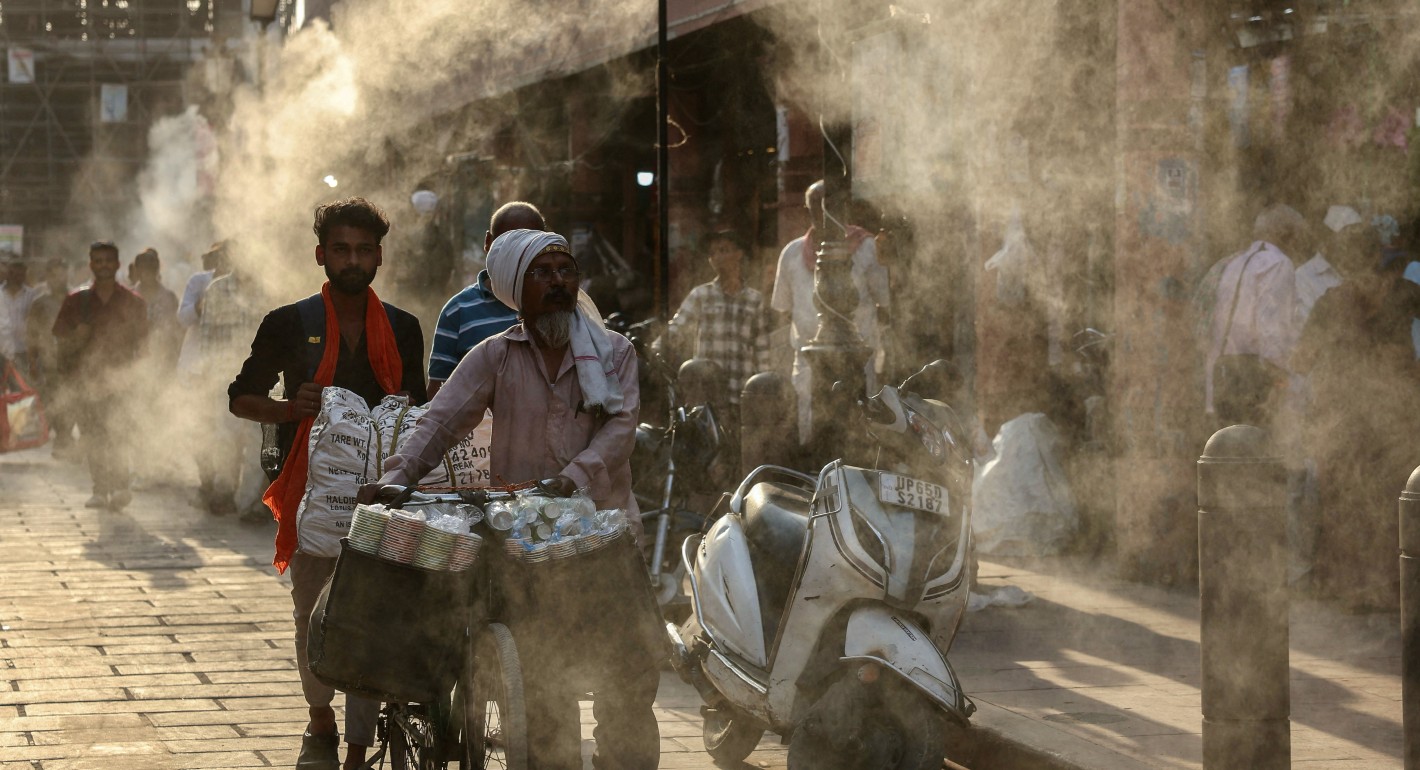
People walk under sprinklers in Varanasi, India, on April 27, 2026. (Photo by Niharika Kulkarni/AFP via Getty Images)
As “unprecedented” temperatures become routine, the country is failing its energy transition stress test.
On a single day in late April, India captured an unwanted record: all fifty of the world’s hottest cities were within its borders. By May, that figure had climbed to ninety-seven out of the top 100, with Balangir in Odisha registering a staggering 48 degrees Celsius. Census workers have died on duty. Voters collapsed at polling stations during West Bengal’s elections. A man boarding a bus to attend a wedding was dead before he arrived. Across the northern and eastern belt, temperatures between 45 degrees and 48 degrees Celsius have become, in the span of a few weeks, routine.
The word appearing in official statements and media coverage is invariably “unprecedented.” But India’s 2022 heatwave was called unprecedented, as was 2024’s and 2025’s. According to the Indian Meteorological Department, heatwave frequency across India’s core heat zone has increased by 0.1 days per decade since 1961, and total heatwave duration by 0.44 days per decade. Average nighttime temperatures are rising at roughly 0.21 degrees Celsius per decade. Thirty-five of thirty-six Indian states and union territories are getting hotter at night.
What is happening in 2026 is not unprecedented—but it is a warning for others.
Heatwaves strike segments of society very differently, especially in India. Those who can move through the crisis in air-conditioned cocoons—homes, cars, offices, malls—can escape some of the worst effects. Roughly three-quarters of India’s workforce—about 380 million people—labors in heat-exposed sectors, agriculture and construction above all. Up to 90 percent of the labor force works informally, without contracts guaranteeing basic protections, mandatory rest breaks, or employer liability. And only 8 percent of Indian households have air conditioning.
Early onset heatwaves are particularly dangerous because the body has not yet acclimatized. The most vulnerable—the elderly, infants, outdoor workers, pregnant women—face acute risk from the rapidity of the temperature shift as much as from its absolute level.
The 2026 heatwave is also being shaped by an alarming humidity surge. High humidity prevents the body from cooling through sweat evaporation—the last line of physiological defense—meaning that conditions that once carried manageable risk are now deadly. India’s average relative humidity rose from 67.1 percent between 2015 and 2019 to 71.2 percent between 2020 and 2024, with Delhi seeing the sharpest single-state increase of 8 percentage points. Researchers have established that a wet-bulb temperature—the combined measure of heat and humidity—of 35 degrees Celsius is the threshold beyond which even a healthy, resting adult with ample water and shade will experience a fatal rise in core temperature within hours. Air conditioning is able to remove both heat and moisture to mitigate impacts of high wet-bulb temperatures, but the cooling methods available to most Indian households—such as fans and open windows—are not. And for workers laboring outdoors in the heat, physical exertion drives temperatures to cross dangerous thresholds well before the official heat index would indicate.
Driven in part by the oppressive heat, India’s electricity demand has hit an all-time high. It crossed 270 gigawatts for the first time on May 21—the fourth consecutive day of a new national record, up sharply from the 243 GW peak recorded in June 2025. Parts of Chennai, one of India’s major manufacturing and technology hubs, are experiencing nightly power outages. These power failures add to the underlying risk: With nights no longer providing relief from the heat, the body cannot fully recover from daytime heat stress, and compound day-night heatwaves drive substantially higher mortality than daytime heat alone.
To fill the electricity gap, India has ramped up coal use, which is now providing upward of 75 percent of power during peak load periods. This increase comes at a moment when India has pledged to source 50 percent of its energy from renewables by 2030 and achieve net zero by 2070.
This energy crisis is further inflamed by the U.S.-Israeli conflict with Iran. As the world’s third-largest oil importer, India has been acutely exposed to supply disruptions. The Strait of Hormuz blockage has triggered a 40 percent decline in India’s liquefied petroleum imports, reduced liquefied natural gas supplies, and spurred a near 15 percent fall in overall oil imports in March. India’s response has been to pivot sharply toward Russian crude—imports jumped 90 percent in March compared to February—and to burn more coal. This sets up a perilous feedback loop: More heat drives more cooling demand, more cooling demand drives more coal combustion, and more coal combustion drives more warming.
To be fair, India has made genuine progress on renewable energy. Nonfossil fuel sources now account for more than half of total installed electricity capacity. On the day of the record demand peak, solar alone supplied nearly a quarter of the load. But solar generation peaks in the afternoon and collapses after sunset—precisely when accumulated heat drives a second wave of air conditioning use. The gap between solar’s output and evening demand must be filled by something—and without adequate battery storage, that something remains coal and gas.
The heatwave is, in this sense, a stress test that India’s energy transition has not yet passed.
India’s city-level Heat Action Plans are also being tested to their limits. These frameworks deploy early warning systems, cooling centers, water distribution, and mandatory rest breaks to try to mitigate the heat’s dangers. But, as researchers have noted, the plans are structurally calibrated to reach people already inside formal systems: those with registered employers, those connected to municipal services, and those reachable by public health messaging. Informal workers and daily-wagers—the most exposed—fall largely outside the protections such plans are built around, and enforcement of even those provisions that nominally apply is rarely tracked or evaluated.
Some consequences are yet to be fully felt. For example, India is one of the world’s largest wheat exporters, and this year’s heatwave struck in the midst of the wheat harvest season. Research shows each 1 degree Celsius increase in temperature causes a national average wheat yield loss of approximately 8 percent. In recent heatwave-affected years, India has lost somewhere between 15 percent and 25 percent of yields in the worst-hit areas. In 2022, heatwaves compelled India to outright ban the export of wheat. The UN has warned that the combined effect of heat stress on farmers, livestock, and crops is pushing food supply “to the brink.”
The long-term economic toll is already compounding. A 2024 Lancet report found that almost one-third of the heatwave days India experienced that year were directly driven by climate change. The study estimated that heat exposure resulted in the loss of 247 billion potential labor hours—mostly in agriculture and construction—amounting to an economic loss of approximately $194 billion. With 2026’s temperatures running hotter and the season arriving earlier, this year’s figures will undoubtedly be worse.
Economists now warn that extreme summers are no longer episodic shocks to India’s economy. They are becoming a structural drag on GDP growth, resulting in productivity losses of up to 4.5 percent by 2030.
As unprecedented heatwaves become routine not just in India but around the globe, governments would be wise to work toward mitigation and adaptation efforts. The stress tests are no longer hypotheticals of the future—they’re here, and they’re becoming more severe.

Visiting Scholar, Sustainability, Climate, and Geopolitics Program
Kayly Ober is a visiting scholar with the Sustainability, Climate, and Geopolitics Program at the Carnegie Endowment for International Peace.
Recent Work

Alejandro Martin Rodriguez, Kayly Ober

Liliana Gamboa, Kayly Ober
Carnegie does not take institutional positions on public policy issues; the views represented herein are those of the author(s) and do not necessarily reflect the views of Carnegie, its staff, or its trustees.
They face an uphill climb, but they could draw on a strategy that other diplomats have used in the past.

Shana Tabak, Alejandro Martin Rodriguez

By focusing only on hard security, the Shield ignores the conditions that fuel cartel power.
Alejandro Martin Rodriguez, Kayly Ober
That statistic about a bottle of water may not live up to scrutiny.


Jon Bateman, Andy Masley
The groundbreaking legislation faces an uphill battle, but it creates a framework for others to follow—especially as the effects of climate change intensify.
Liliana Gamboa, Kayly Ober
Natural disasters are no longer local incidents but sources of systemic risk that threaten vital infrastructure and the economy—and public support for international engagement.

Leonardo Martinez-Diaz