

Research
- +5
Herbert Crowther, Darcie Draudt-Véjares, Walter James, …
Source: Getty
Batteries are essential technologies for twenty-first-century growth, security, and energy—and they cut to the core of geopolitical ambitions for high-tech strategic autonomy.
Batteries are essential technologies for twenty-first-century growth, security, and energy—and they cut to the core of geopolitical ambitions for high-tech strategic autonomy. Lithium-ion batteries are now endemic to the transition to electrified mobility, firming of renewable power, data center loads, a suite of consumer electronics, and the frontiers of warfare. Today, the battle for battery technology and supply chains is overwhelmingly dominated by China. In the years to come, this dynamic is likely to accelerate, with Chinese firms racing ahead to corner the next generation of products. This persistent theme in contemporary industrial policy—the scale of Chinese production, upstream integration, and advancements—has prompted some to suggest that the developed world should accept defeat and let Chinese industry corner this technology of the future. Doing so would be economically efficient, perhaps easing a rapid low-carbon transition. Conversely, others argue that the risks are too high to allow such geographic concentration of this technology in a country willing to wield export restrictions on key battery metals and production machinery. Giving up would risk economic security, defense industrial bases, and the durability of the long-term energy transition, given the lack of value-added capacity.
Undoubtedly, the developed world faces an industrial challenge: Continue to fight an expensive and technologically complex uphill battle to incubate an essential industry, or accept defeat (and with it, the penalties of latent strategic foresight and fragmented policy). Yet there is a nuanced path forward, one that recognizes the severe asymmetry of industrial power while identifying opportunities for countries and industries to cooperate toward a more balanced outlook in battery geopolitics. This paper presents that path, based on a holistic analysis of technology and the market, covering manufacturing capacity, trade, and investment, as well as a comparative look at emerging battery technologies by their patents and commercialization, how existing factories could be repurposed for them, and how they could affect mineral demand. Based on the analysis, it also offers recommendations for optimal cooperation and supply chain coordination between partner countries to develop some de-risking pathways. The following is part one of a series of papers produced in conjunction with the New Energy Industrial Strategy Center; the second paper will provide jurisdiction-level analyses on the battery strategies of China, the United States, Europe, South Korea, Japan, India, and Canada.
Partners in the Organisation of Economic Co-operation and Development (OECD)—namely the United States, Europe (including the European Union and its member states, the United Kingdom, and Norway), South Korea, and Japan—should balance near- and long-term strategies that leverage each other’s strengths (for example, market access, legacy industries, and innovation ecosystems) to ensure that China’s dominance does not eclipse external competition and that some companies from other countries remain in the market. This will be a major challenge in a fractured global operating environment and will come with costs, but the approach is strategically sound. This does not mean cooperation with Chinese firms should be shunned; to the contrary, smart and tactful joint ventures in key technology verticals are a necessary part of this strategy under the right conditions.
The modern rise of battery technologies tracked with the explosion of Japanese camcorders, but their development dates back to the energy crisis of the 1970s. Lithium-ion batteries have long been sought to commercially store energy through “intercalation”—the electro-chemical process of exchanging positively charged ions through an electrolyte between a positively charged cathode and negatively charged anode (known collectively as an electrode).1 In the 1960s and 1970s, important prototypes were tested by NASA and American oil and auto majors.2 Some of these first iterations included sodium-based cathodes and lithium-metal anodes—breakthrough chemistries making their way to market today and part of this paper’s analysis.3 By the early 1980s, the lithium-ion chemistry met its match when researchers stabilized the intercalation process by adding a graphite anode and, later, a lithium-cobalt-based cathode.4 Once proven, a Japanese conglomerate acquired this technology to power camcorders, an expensive product that could absorb the high battery cost to democratize filming the surrounding world.5
Starting in the 1990s and into the new millennia, lithium-ion batteries began to permeate across new products, including laptop computers and cell phones.6 It was not until 2010, however, that the first commercial-scale electric vehicle (EV) was rolled onto automobile assembly lines where lithium-ion batteries proved capable of fully replacing the internal combustion engine of the modern car.7 By 2017, the world’s first large-scale battery storage system—a 150-megawatt facility in South Australia—was deployed on the grid.8 Put into context, the use of lithium-ion technology in commercial-scale power and transport applications is still incredibly nascent; nuclear power plants, by comparison, have been operational on the power grid for nearly seventy-five years.9 As these applications matured in the late 2010s, the primacy of South Korean and Japanese firms gave way to Chinese producers, which dominated cell production by the end of the decade.10 The scale of growth during this time was nothing short of remarkable: In 2010, about 14 gigawatts per hour (GWh) of production capacity existed solely in Asia, jumping to a staggering 734 GWh globally in 2020.11
Today’s lithium-ion batteries are discretely powering revolutionary shifts in mobility, power, aviation, and defense markets. In 2025, about one quarter of global car sales were fully electric or plug-in hybrid—up from less than 1 percent a decade prior—with new models being sold to deliver benefits from five-minute charge times to over 500-mile-drive ranges.12 On the grid, batteries are finally making renewable power reliable, as recently observed when deployed in conjunction with solar technologies to provide the first 24/7 renewable projects in the Gulf, collectively integrated as virtual power plants for backup power projects in California, or deployed with the grid-balancing ability to simulate the stabilizing properties of thermal power plants, as seen in Australia.13 Lithium-ion systems are also the backbone of the emerging trend to electrify maritime vessels and some short-range air travel vehicles, including EV vertical takeoff and landing aircraft (eVOTLs).14 Lastly, they are core to high-tech warfare, whether used in drones or in soldiers’ wearable radios and GPS.15 And of course, batteries remain increasingly omnipresent in the tech sector, including, for example, in everyday consumer electronics or to support the back-end stabilization of high-tech data centers.16
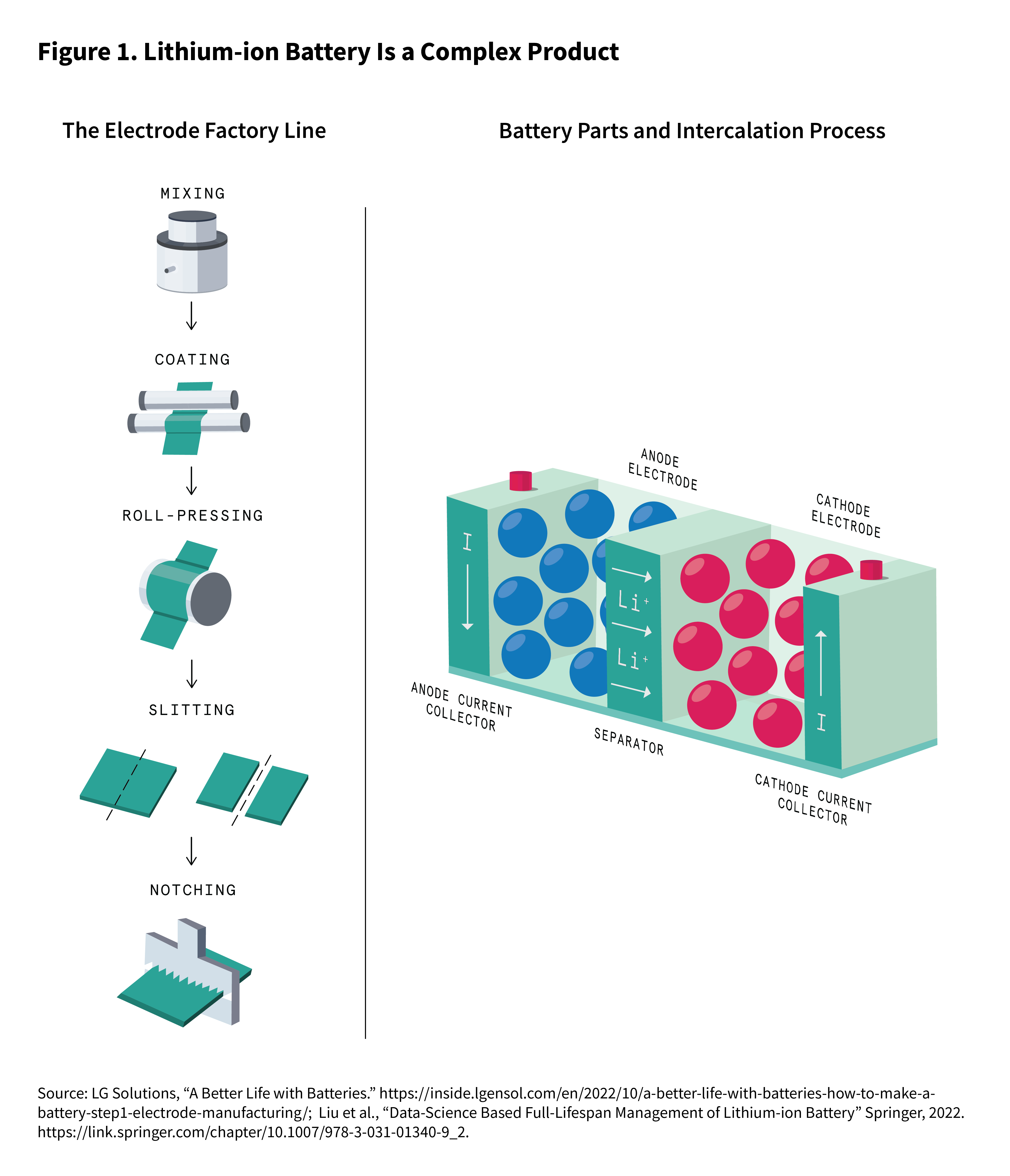
The lithium-ion battery is a complex product with various inputs and stages of assembly. The core part of making a battery is the electrode—the engine of the battery cell—which is manufactured in a multi-step industrial process (see figure 1). The electrode’s fabrication is technically demanding and requires specialized machinery to mix, coat, dry, and compress active materials into a precise and stable form onto copper and aluminum current collectors. Once the electrode is produced, it must be cut and assembled with other materials for the cell to function.17 Four key inputs are required to enable these processes: both cathode and anode active materials, which are the core demand-driving components for critical minerals like lithium and graphite; the separator, a plastic film that prevents the cathode and anode from touching; and the electrolyte, a specialized liquid gel (though it can be, or include, a solid substance) that facilitates the movement of ions between the cathode and anode.18
The primary story in battery technology geopolitics is China’s unrivaled production capacity and corporate leadership. China’s supply-side prowess applies more acutely to upstream inputs—especially graphite and anode active materials—but its lead in downstream cell production is also an important signifier of its dominance in the sector writ large.19 Over the next five years, most forecasts expect the supply chain to remain largely the same, with marginal progress in diversification, particularly in cathode active materials and lithium, which present more of a relative balance between ex-China corporations and country production.20 Therefore, throughout this paper, battery cell factories are used as a proxy for battery-related industrial development because they are the most economically important value-added part of the supply chain, and their presence can dictate the emergence of geographic battery hubs.21 In sum, the cell facilities being developed today will likely define the primary battery ecosystems for decades to come, and their location is an essential metric for visualizing the physical emergence of the global battery market.
Although Chinese corporations lead across battery technology and supply chains, there is an importance nuance: Legacy producers, especially those from South Korea, still have an edge (see figure 2). In 2025, two Chinese firms dominated just over half of the global battery market, but three Korean firms and one Japanese conglomerate still sit in the top ten. Similarly, Korean firms still have a notable edge in the global production of nickel-cobalt-manganese (NMC) CAM, an incumbent cathode product. Not listed in the graphic are additional conglomerates like European chemical giants and Japanese metal houses, both of which are also capable of producing and recycling these materials at scale.22 These are notable details often omitted in headlines that rightfully waive the alarm bells of single-country dominance. But in the coming years, this diversified market is at risk of fading.
By 2030, China’s cell production will dominate in a likely oversupplied market (see figure 3). Based on data provided by the Global Clean Investment Monitor, Chinese cell capacity could triple that of the OECD’s members combined, hitting at least 5,862 GWh based on current projects under construction, with an upper-bound potential of 6,720 GWh. These levels of Chinese industrial capacity could potentially surpass an upper-bound global cell demand at 5,100 GWh. By comparison, all OECD factories will hold a capacity of about 1,881 GWh, with an upper-bound potential of only 2,422 GWh. The United States will claim about half of that capacity, and Europe will claim around 690 GWh while the rest will be split between Canada, South Korea, and Japan, in that order. Despite calls for attracting value-added industry from emerging markets (EMs) and developing markets (DMs), they will constitute the smallest fraction of cell production at about 217 GWh, split mostly between India and Indonesia.
These trends of Chinese overcapacity (or “involution”) are endemic to China’s political economy, and they are already affecting trade flows of battery products, especially to Europe (see figure 4).23 By 2025, monthly Chinese battery exports totaled over $6 billion, nearly half of which was destined for the European market. Also notable, Asian imports tallied about $2 billion per month, driven mostly by India, Australia, and Japan, with decreasing—yet still significant—growth from South Korea. Lastly, North American imports were about $1 billion per month, driven almost entirely by the United States. Of the jurisdictions observed in this analysis, only the United States and India have clearly started tariffs or duties on Chinese batteries, as well as varying forms of subsidies that target domestic production and that might work to pull away demand from cheaper alternatives.24 While the EU is deliberating its own local-content measures, the bloc’s recently adopted battery transparency rules are imposing specific transparency regulations that may, tangentially, incentivize more local measures.25
These trade dynamics are not just dictated by capacity but also cost; China’s batteries are, in varying degrees, cheaper than those of OECD competitors. Using the European single market as a proxy where tariffs on Chinese batteries do not exist, European battery cells face varying cost differentials with Chinese imports into the EU: nickel-manganese-cobalt (NMC) cells see a smaller cost difference (10 to 27 percent), but lithium-iron-phosphate (LFP) cells see a significant cost gap (24 to 50 percent) (see figure 5). This can primarily be attributed to access to cheaper materials, manufacturing equipment, and, most importantly, more efficient production, especially during ramp-up when factories produce high quantities of scrap.26 Production support in the form of ramp-up subsidies and trade barriers could help mitigate these challenges as producers scale.27 For LFP, closing the cost difference would require at least a 30-percent tariff rate or a U.S.-style $30 per kilowatt-hour (kWh) production tax credit (PTC), or perhaps some combination of the two. Imported electro-active materials from China yield small cost reductions, strengthening the security rationale for onshoring or nearshoring these components. It should be noted that these figures are not static and can be altered, whether by further Chinese innovation, depressed prices from dumping, or macroeconomic conditions outside the bounds of this research like currency manipulation.
Cost-competitive Western batteries are critical to creating a more balanced playing field for global production. While the previously mentioned tools of statecraft may help incubate the sector, they are only part of the solution to develop competitive industries—this will require deep technical know-how to maximize factory output and resource efficiency. As with all unit economics, much of the cost of battery cells is dictated by factory throughput—the rate at which gigafactories can deliver cells relative to their theoretical maximum output. For newcomers to the market, this is a notable challenge, as observed with roughly 40 to 90 percent scrap rates from new battery cell operations and, accordingly, lower yields of functioning battery products.28 Policy could support engaging Asian expertise during ramp-up to advise on best practices and help incubate this knowledge at the local company and lab levels.
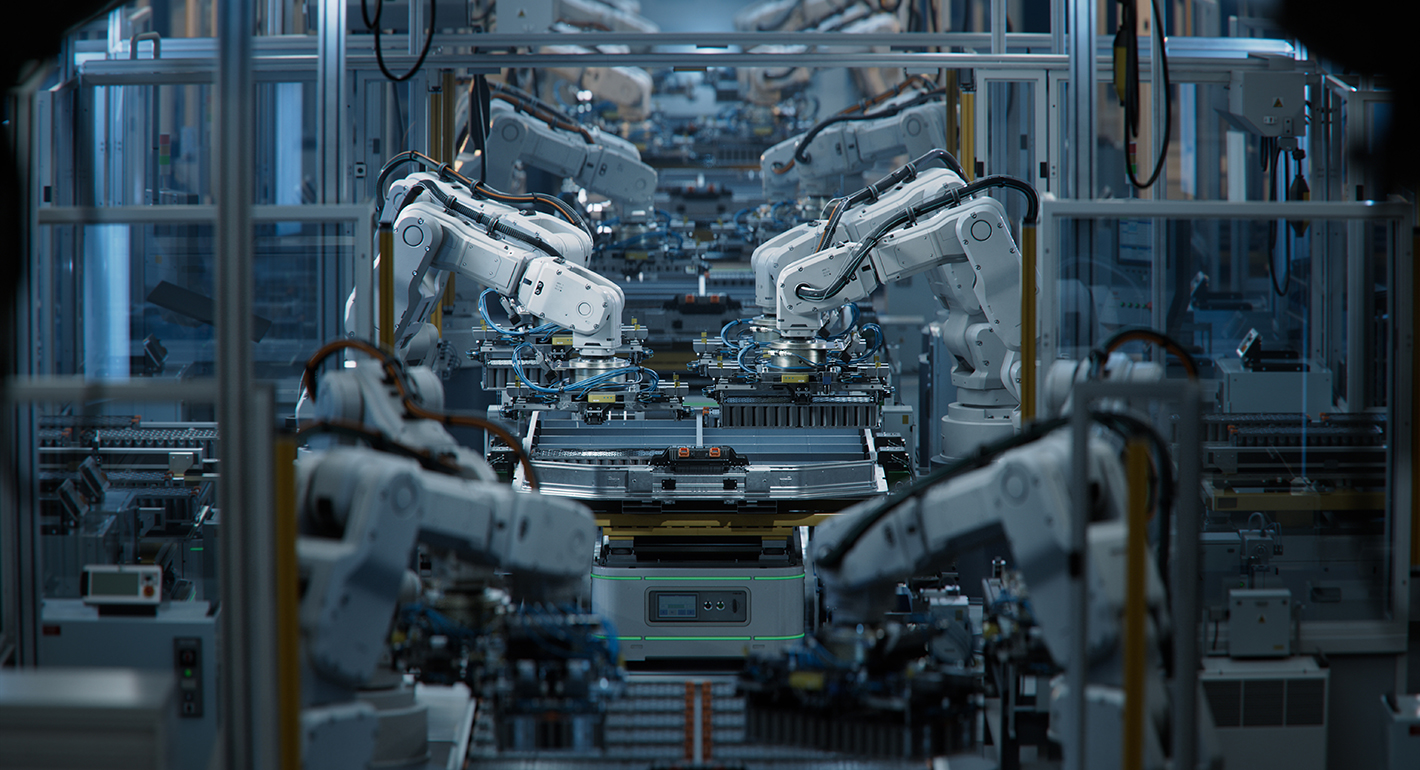
Critical political economy questions remain about enhancing battery cell production with automation. Bolstering factory efficiency and automation might become one of the most important levers countries can use to improve domestic battery competitiveness; evidence from China indicates that AI-powered process controls and digital twins can reduce scrap and improve yields.29 Yet doing so might detract from the social and political case for batteries as a labor transition from internal-combustion-engine parts production, even though it is likely to still require more jobs.30 As China moves toward a “dark factory” model, wherein automated robotics are increasingly present throughout assembly lines, Western competitors will be inclined to reduce costs and improve quality through automation as well.31 This is sound policy, but it entails important considerations for honest political narratives: battery production has immense strategic value and it will create jobs, but it may not drive the scale of labor renaissance in the long term.
As China moves toward a “dark factory” model, wherein automated robotics are increasingly present throughout assembly lines, Western competitors will be inclined to reduce costs and improve quality through automation as well.
Other long-term factory-process innovations may reduce production costs, including more efficient materials processing and breakthroughs in fabrication. The most notable example is “dry coating,” which replaces the energy- and chemical-intensive process of binding active materials by rolling or spraying dry powders directly onto metal foil. This approach would cut three of the seven major steps in production and could substantially lower manufacturing costs by up to 30 percent.32 These processes are coming to market in the United States, with America’s EV giant claiming commercial validation, while an array of other firms in the United States, South Korea, Europe, and China are also pursuing production.33 However, the outlook is inherently long term: these processes are unlikely to replace the majority of electrode assembly lines already being built with incumbent wet-coating systems, and they may prove especially beneficial to niche next-generation architectures like solid state, where such processes and cost reductions would be game-changing.34
Battery chemistries are rapidly evolving. This analysis takes stock of six key battery chemistries: NMC, LFP, sodium-ion (Na-ion), silicon-anode (Si-anode), lithium metal battery (LMB), and lithium sulfur (Li-S). NMC and LFP are the primary sibling chemistries of the incumbent lithium-ion battery, while Na-ion might be described as its cousin: very similar in function and design but with some different materials.35 Throughout this analysis, Si-anode refers to high or majority blends of silicon in the graphite anode, not fully silicon-based designs which remain challenging. Lithium metal batteries replace the conventional graphite anode with pure lithium metal foil while lithium sulfur replaces the incumbent cathode with sulfur-based cathode active materials (CAM).36 As illustrated in later chapters, these chemistries are all either commercial or nearing commercial scale, receiving prominent investment and corporate backing. It should be noted that the selected chemistries are not perfect analogs to each other: some are complimentary, such as Si-anodes being deployed with nickel-based cathodes like NMC; others are prone to variants like LFP’s inclusion of manganese (LMFP); and some are being used in different types of cell architectures like LMB in both solid state and so-called liquid-solid state.37 Additional chemistries are being researched, such as aluminum-ion or lithium-air, but these six chemistries are the most important lithium-ion variants coming to market.
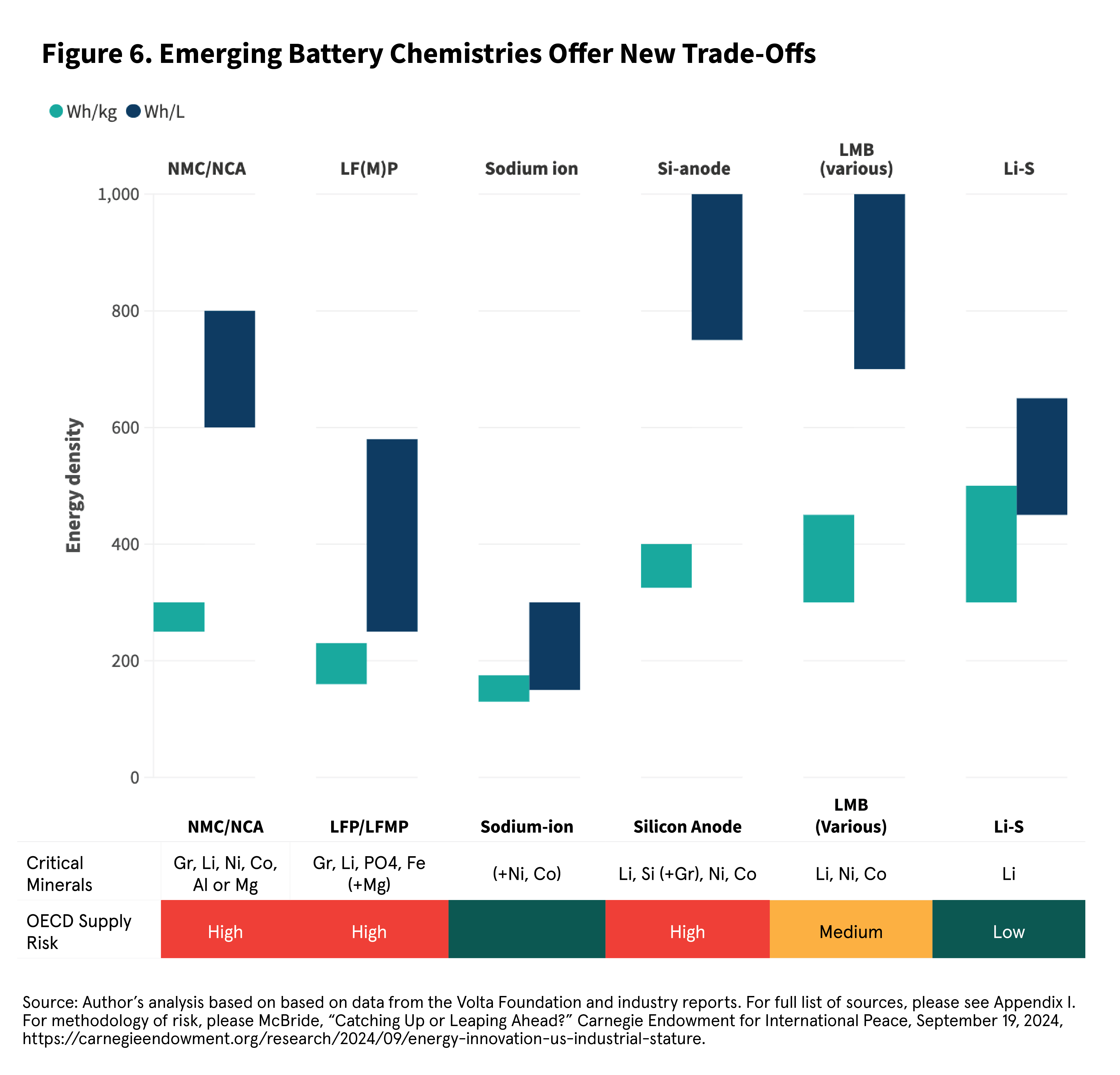
Battery chemistries come with trade-offs in performance and material requirements (see figure 6). Chemistries have varying energy densities—electrical output based on size (watt hour per kilogram, or Wh/kg) and weight (watt hour per liter, or Wh/L)—as well as different critical raw material (CRM) requirements. This analysis takes the view of OECD countries who face similar CRM risks, most notable for graphite, nickel, and cobalt products dominated by China and less so for geographically and commercially diverse lithium.38 Of the incumbent technologies, LFP yields a lower energy density than NMC (though this gap is closing thanks to new LFP designs) but is less expensive because it does not require high-cost CRMs like cobalt and nickel.39 Sodium-ion can require fewer, if any, CRMs, but yields a lower energy density, a notable trade-off for some mobility applications.40 The high-end battery family that enhances the anode, including silicon anode, lithium metal, and lithium sulfur, also boasts vastly higher energy densities with varying impact on CRMs. Although lithium metal batteries swap graphite anodes for lithium, they are observed to use high-nickel cathodes. While lithium sulfur yields a lower volumetric energy density (implying that the battery is larger) than lithium metal, it solely requires lithium for the anode and no CRMs in the cathode. Not listed in figure 6 are additional indicators related to lifespan and safety.
The most pressing question today for battery diversification is how to navigate Chinese advantage in LFP. The tech was originally pioneered in North America, before being sold off to Chinese firms who began using the lower energy density solution in electric buses.41 Although initially written off as suboptimal to NMC batteries for their relatively low energy density, Chinese battery firms innovated this then niche and alternative chemistry, and by the early 2020s, LFP experienced an astronomical rise in production and market share due to cost reductions and increased energy densities now suitable for more applications, especially in the mobility sector.42 Today, LFP accounts for about half of the global lithium-ion market and most of Chinese production.43 China dominates its geographic concentration at around 98 percent of global production capacity—a staggering market share that triumphs over other strategic advanced industrial products like rare earth magnets, lithography equipment, humanoid robots, or AI chips (see figure 7).
An alternative, ex-China LFP supply chain is emerging. Starting in 2021, the battery investment boom in the United States and Europe was driven almost entirely by NMC technology. The result was twofold: NMC was viewed as the best way to deliver the longer driving ranges Western automobile consumers demanded, and it was the primary product offered by South Korean and Japanese heavyweights that became key industrial partners to American and European battery belts.44 Today, the United States is rapidly course-correcting, with South Korean producers and American automakers racing to switch assembly to LFP to serve the burgeoning battery energy stationary storage (BESS) market and correlated subsidy support that survived policy shifts.45 Similar trends are emerging in Europe, where Chinese and South Korean manufacturers are seeking to build domestic LFP capacity, likely in anticipation of Brussels’ increasing focus on supply chain resilience and localization.
Europe leads North America and ex-China Asia LFP manufacturing capacity, but all of these regions are severely lacking specific cathode materials for truly domestic production (see figure 8). Based on an analysis of all projects in the pipeline, the United States boasts about 100 GWh of LFP cell capacity potential (primarily concentrated in Michigan). Europe’s LFP potential is at about 170 GWh (spread between Spain, Hungary, Serbia, Italy, and Poland). Additionally, LFP CAM facilities are underway in both Morocco and Germany, which are strategically placed for access to the European market. In Asia, South Korea is building its first LFP factories but at a relatively low scale (for example, 1 GWh compared to a Chinese LFP factory at about 50 GWh). Meanwhile, Indonesia has a 50 GWh facility, and India intends to build a 40 GWh facility. Alongside LFP cathode factories underway in Canada and Finland, some companies in South Korea and Canada are pioneering novel techniques to more efficiently produce CAM.46
Critical questions remain about the efficacy of onshoring Chinese LFP production. Some argue that, given China’s immense lead in LFP, the most logical pathway to indigenize this technology is to grant Chinese manufacturers market access or, in a best case, share intellectual property through joint ventures. After all, Chinese producers can deliver LFP capacity at a speed and scale that other Asian conglomerates—let alone European or American start-ups—cannot yet promise.47 But it remains unclear whether, when licensing technology, Chinese producers will grant access to the latest, high-performance, and most cost-effective LFP battery products, which boast extremely fast charge times and are estimated to be about four years ahead of competition.48 Export restrictions from the Chinese government suggest that battery giants are to develop lower-end factories abroad while maintaining best-in-class production in mainland China.49 The concern, then, is that if Europe or the United States develops such facilities, they risk being uncompetitive against the latest Chinese LFP imports while locking the OECD into lower-quality technology. If Europe and the United States provide Korean heavyweights market access to produce LFP—which they are beginning to do—it does not guarantee best-in-class gear either, but it does help Seoul’s champions avoid falling vastly behind Chinese competitors.
Both the United States and Europe have limited remaining battery cell capacity to achieve full battery self-sufficiency (presuming autarky is the goal), and using economic statecraft to strategically deploy those remaining factories will be important to long-term industrial outlooks. Similarly, American or European start-ups pursuing novel LFP cell or cathode processes might consider partnering with South Korean—or remaining Japanese—firms to deliver the speed and scale that they would otherwise struggle to achieve on their own. The solution may merit bringing in both South Korean and Chinese firms to help scale and indigenize LFP battery cell and cathode production, while preserving remaining domestic cell capacity for emerging breakthrough technologies in years to come.
Technologies beyond Li-ion are beginning to enter the market. An assessment of patent, commercialization, and price trends underway indicates that sodium-ion and silicon-anode blends have reached commercial-scale and that lithium metal and sulfur may follow later this decade and in the early 2030s (especially solid-state lithium metal, which remains further from market).50 However, globally speaking, the results are more mixed. Sodium-ion, likely the most prevalent next-gen chemistry to achieve mass commercialization, is overwhelmingly concentrated in China in terms of both patents and first-of-a-kind commercial factories. However, lithium metal batteries show greater levels of diversification potential, with China still in the lead but by a significantly smaller margin. For OECD countries, the present question is how to ensure that China’s lead on LFP is not repeated with sodium-ion and how to best position their lithium metal advancements given their relative niche in market.
Notably, barring unforeseen breakthroughs, alternative chemistries like sodium-ion and lithium metal are unlikely to replace the lithium-ion incumbent in either the medium- or long-term. However, in the very long-term Na-ion could prove unpredictably disruptive especially if cost reductions and performance gains can be achieved. By 2030 China could have over 500 GWh over sodium-ion factories, more than the United States or Europe’s current lithium-ion capacity.51 Beyond forecasts, the CEO of China’s largest battery manufacturer expects that sodium-ion could corner between 30 and 40 percent of the existing battery market and up to 50 percent of the affordable EV market.52 These are serious proclamations. However, for now, these emerging chemistries should be viewed as complementary or additive products that target specific demand segments, such as drones or eVTOLs for lithium metal and stationary storage or short-range vehicles for sodium-ion.53 A critical question that may dictate the scale of their penetration is the extent to which these chemistries can be built with existing capital equipment, and this question is explored later in this paper through an analysis on these “drop-in” possibilities (hint: sodium-ion is a clear winner).
As a first proxy for commercial development, patent trends paint an optimistic outlook for battery innovation, reflecting a rapid rise in research and development (R&D) over the past decade. Next-generation technology is now outpacing incumbent patents approximately six to one (see figure 9). The analysis sums annual battery patent publications categorized by country of origin and chemistry but focuses on patent families with higher likelihood for commercialization (as opposed to all patents issued, many of which are unlikely to ever yield results). These patents have been filed in more than one jurisdiction, implying greater intellectual property value to the inventor and, thus, greater commercial confidence. Findings indicate that LFP experienced a wave of innovation in the early 2010s, potentially impacting market growth today. Silicon anode has increased consistently since this time, while sodium-ion saw a staggering jump in patenting since 2022, outpacing total lithium-ion patents at their peak in 2014. Lithium metal and lithium sulfur patents have been picking up pace since 2015 but have not experienced sodium-ion’s bursts of filing.
China’s lead in battery innovation is pronounced, but Europe has moved into second place in recent years, with the United States and South Korea shortly behind (see figure 10). It should be noted that when adjusted for all patents and not just the “high-integrity” ones that Carnegie’s analysis uses, China’s share of patents increases across the board, implying greater levels of basic R&D but possibly yielding fewer results of value. Importantly, the rise of China as the dominant country of battery patents dates back years: This trend began in the 2000s, challenging the Western narrative that China’s battery rise was due to technology transfer.54 While that is, of course, partially true, especially for LFP, Chinese battery R&D has been rising for decades.55 Today, however, China is responsible for about 43 percent of the total battery patents in 2024, while Europe holds 21 percent, the United States 18 percent, South Korea 10 percent, and Japan with a surprisingly small 2 percent, but consistent with the country having an increasingly meager stature in this market.
Although China dominates lithium-ion and sodium-ion patents, high-energy density battery chemistries paint a more diversified outlook, split nearly evenly between China, the United States, Europe, and South Korea (see figure 11). When total patent filings are summed over the past twenty-five years, the results illustrate that Chinese domiciled entities own about half the world’s patents of these six strategic battery technologies. Regarding NMC, LFP, and Na-ion, China has about a 70 percent share. Notably, Europe is in second place for Li-ion and Na-ion intellectual property, even though its corporate market share is negligible and significantly smaller than South Korea’s, which has fewer patents.56 This dynamic is an important reminder that battery patent count does not guarantee a high-quality product, let alone scale-up. Remarkably, the United States leads China in lithium metal patents at 27 percent versus 25 percent, with Europe and South Korea just behind. Despite the Japanese corporate push for lithium metal technology, they also lag significantly in patent count. Both lithium sulfur and silicon anode see a large share of Chinese innovation at about 40 percent, with reasonable diversification from the other three important jurisdictions.
Although patents do not guarantee a prototype or pilot, similar commercialization trends and correlations are observed regarding geographical technology deployment. The analysis for this paper finds that over one hundred firms across the world, including both legacy manufacturers and start-ups, are working toward commercializing novel battery chemistries. This number only includes companies that have, at the very least, outlined plans to develop a pilot-scale production facility and, at the most, have already commercialized. Geographically, the number is split between 41 percent in China, 28 percent in the United States, 16 percent in Europe, 12 percent in South Korea, and just 6 percent in Japan. Of all the products observed, more than half of them were lithium metal (including the few lithium-sulfur projects), a third were oriented to silicon-anode (including both material producers and specialized cell companies), and 22 percent were sodium. This scan of corporate activity, while comprehensive, is nonexhaustive and should not be viewed as a proxy for production capacity, but rather a gauge of how effective R&D can be translated to commercial goals.
The trends are clear: sodium-ion is at full commercial-scale entirely in China, while silicon anode blends are being commercialized with more geographic diversity and lithium metal (including sulfur) will be coming to market later this decade with notable competitors across Asia and the West, yet with China nonetheless holding the lead. Figures 12 through 14 track each of these chemistries’ developments by region through both pilot facilities and commercial-scale gigafactories. The gigafactories are categorized by commercial “start,” which refers to an actual facility with detailed information such as nameplate capacity or location, and by “planned,” which refers to a company’s public pledge to bring gigawatt-hour scale capacity online. In most instances, companies have released information on both pilot and commercial plans.
Sodium-ion is the most important story in this analysis: it is currently being commercialized at an impressive scale and entirely in mainland China (see figure 12). As of 2026, China has developed at least a dozen gigawatt-hour scale sodium-ion facilities, with a significant share of pilots emerging as far back as 2022. In contrast, as of this writing, South Korea has only one sodium pilot and commercial project, and Japan has not announced any to date.57 The United States has two sodium-ion developments moving toward commercialization, but one of its sodium hopes filed for bankruptcy in 2025.58 Europe is in a similar position, where one of its leading contenders announced it would no longer pursue the technology and the other aims for a 2029 commercialization.59
These sodium-ion patent and commercial findings represent an enormous asymmetry that risks repeating the dynamics of China’s dominance in LFP. While those bearish on the technology have focused on sodium-ion’s legacy issues with low energy density and irregular voltage output, recent developments from leading Chinese battery giants illustrate that sodium-ion may yield improvements suitable for some transport applications, especially those in cold regions where Na-ion’s ability to withstand extreme temperatures is an advantage.60 Already, Chinese automakers are rolling out EVs that feature Na-ion batteries.61 Furthermore and more importantly, sodium’s energy density is not an impediment for stationary storage deployment, which has emerged as an important growth driver for batteries in 2026 due to high renewable penetrations and backup needs for data centers.62 Currently, sodium-based BESS is being deployed in both China and the United States, where developers are viewing sodium’s thermal resilience as a pathway to market (lithium-ion battery storage packs require thermal control units, thus helping project economics).63
Lithium metal—including lithium sulfur and both solid-state and liquid-solid state architectures—has a more diversified outlook, with China in the clear lead but other jurisdictions having notable industrial bases and aspirations (see figure 13). Note that, unlike sodium-ion, many lithium metal announcements are simply corporate start dates and do not include asset-level plans. Like with patents, the United States has developed more lithium metal pilot facilities than its Chinese counterparts, but as expected, it is significantly behind scaling to GWh production. By the end of the decade, China could have as much as fourteen lithium metal gigafactories if all corporate pledges are actualized, followed by six from South Korean chaebols, five from American companies, and four each from both European and Japanese firms.
Much like sodium-ion, silicon anodes have fully entered the commercial market, but in a notably balanced way between China, South Korea, and the United States (see figure 14). This analysis for silicon anodes includes firms developing active anode materials (as well as some that also produce cells and upstream components), while the remaining 20 percent of firms included are specific players focused on advanced cells that can withstand the severe expansion of silicon as an active material. It should be noted that a few Chinese companies are pursuing majority silicon anodes with solid-state architectures while most in the United States, Europe, and South Korea are pursuing silicon-anode blends. In 2026, China leads with eight commercial-scale facilities, but South Korea is close behind with six plants (a remarkable point of South Korean advancement in this analysis). The United States has three commercial silicon facilities, while Europe has a similar scale of projects. By the end of the decade, notable levels of diversification in this vertical are possible.
Despite the clear rise of the sodium-ion and lithium-metal variants, these technologies will face near-term challenges in competing with incumbent lithium-ion technologies. Both chemistries have varying degrees of potential to reduce costs and be produced with existing manufacturing equipment, which might expedite their ability to be mass-produced and, in turn, more quickly reap the economic rewards of scale and learning by doing. This is an essential point, given that, as illustrated at the beginning of this analysis, the global battery cell market faces structural challenges of oversupply from Chinese producers and the ruthless competition in how they operate. Exogenous changes to battery markets could, however, provide tailwinds to an unforeseen rise of next-generation technologies: On the supply side, increasing prices of lithium (which, as of this writing, are underway) might provide an opening for sodium-ion to compete due to cheap material costs.64 On the demand side, mass build-out of military-grade drones or eVTOLs might absorb the cost premium of lithium metal’s high energy density.65
Lithium-ion will see steady cost decreases by 2030, while sodium-ion could theoretically do the same, but lithium metal is likely to remain expensive (see figure 15). Since 2013, the price of lithium-ion battery packs has been reduced from $827 per kWh to $108 per kWh and could be reduced by another 50 percent by 2030. Today, sodium-ion is viewed as slightly more expensive due to its lower energy density, resting as high as $124 per kWh, however, advances in process innovation could see this dropping to $50 per kWh, as illustrated.66 However, whether it can outcompete the incumbent remains disputed in the literature.67 Data on the outlook of lithium metal battery prices is scarcer, but implies that lithium metal solid-state batteries are vastly more expensive—as much as $157 per kWh at the pack level today. Japanese firms have announced ambitious goals to bring this cost down to $75 per wKh, but that price is still comparatively high to where lithium-ion might land later this decade. Note, however, that publicly available price data are not available for liquid-solid lithium metal (or lithium sulfur) batteries, which are coming to market sooner.
One core question is the extent to which these new chemistries can use existing manufacturing equipment or can be built on existing battery factory lines. First, it remains highly unlikely that gigafactories will be built at the same speed and scale witnessed between 2020 and 2025: By the end of 2025, global investment flows in battery manufacturing began to wane and overall clean tech production investment was significantly down in 2025.68 If sodium-ion and lithium metal are to penetrate broader swaths of the battery market, they will need to contend with this reality and pragmatically corner entrance. Second, manufacturing equipment providers, essential to this ecosystem and not explored in this analysis, have developed their own economies of scale for lithium-ion machinery but do not yet have the same experience in machinery for novel battery designs, namely solid-state batteries that remain ultra niche.69
These “drop-in” trends are already being observed in battery markets and corporate strategies. The world’s leading lithium-sulfur company has, for example, bought NMC production lines in Europe—some of which it plans to convert to produce its liquid-solid lithium sulfur technology (other notable lithium sulfur companies, although still at pilot scale, have made similar claims).70 Another American lithium metal firm views liquid-solid architectures as its entrance to market, given an 80-percent compatibility with incumbent factory gear.71 These trends, however, are most pronounced with Chinese sodium-ion and liquid-solid lithium metal batteries. Many Chinese firms producing sodium-ion specifically claim the 1 to 1 transferability of lithium-ion manufacturing equipment.72 Several Chinese companies are focusing on liquid-solid-state lithium metal batteries that have similar compatibility with existing factories.73
When comparing how well chemistries can work with existing infrastructure, high silicon-anode blends and sodium-ion illustrate high drop-in potential, while liquid-solid lithium metal has potential at the final cell level stage and a solid state requires new gear (see figure 16). Available peer-reviewed literature and industry reports show how these chemistries might be deployed in the existing supply chain by ascribing a ranking system from fully drop-in to requiring entirely new equipment. Silicon-anode blends require essentially the same process but need additional anode production lines. Given sodium-ion’s chemical similarities to lithium-ion, the chemistry can be produced on the same equipment lines, but they require retrofitting and fine-tuning. The lithium metal anode family becomes more complicated. First, producing lithium metal is a unique and challenging process that requires entirely new equipment. For liquid-solid state LMBs, cell lines can likely be retrofitted but separator and electrolytes are novel. While most LMBs generally use similar cathodes to incumbents, lithium sulfur requires a new chemistry and manufacturing processes. Solid-state lithium-metal batteries have similar cathodes—generally high nickel—but will require entirely new capital machinery for all other facets, including end stage cell production.
Many of these emerging chemistries require fewer minerals than the incumbents of today, and their adoption might impact future mineral demand, yielding mineral security dividends. Modeling suggests that a high adoption of next-gen battery tech will reduce graphite and cobalt demand, and modestly increase lithium demand. These findings bode well for OECD jurisdictions like the United States and EU, which are developing domestic lithium but face challenges in diversifying sources of cobalt and especially graphite, which remains overwhelmingly produced in China. Furthermore, graphite has emerged as a key component of mineral weaponization by Beijing’s Ministry of Commerce. These results do not imply that sodium-ion and lithium metal variants can mitigate the severe vulnerabilities faced upstream where the graphite and anode market is essentially controlled by China. But they can, much like recycling, help abate the enormity of the challenge in the long term by gradually reducing demand growth.
In the European market, next-generation battery adoption could yield significant annual reductions in graphite and cobalt demand by 2035 (see figure 17). Two scenarios for Europe in 2035 help illustrate the potential lowest and highest penetration in novel technologies: The incumbent scenario assumes that these new chemistries remain as niche as they were in 2030, while the next-gen scenario envisions the highest justifiable market penetration based on domestic trends and some mimicked current trends in China where sodium-ion is likely to achieve a 5-percent market share by end of the decade. Not included in the analysis is a higher uptake of silicon-anode blends, which are likely and would further decrease graphite demand. The results are staggering: Graphite demand is cut by 25 percent and cobalt by 10 percent—arguably the two greatest geopolitical chokepoints of Europe’s battery-related CRMs. While it is estimated that lithium production will increase, it would be in smaller volumes and likely present an opportunity to redirect supply chains, especially given lithium’s more diversified outlook and novel production techniques like direct lithium extraction, a notable opportunity for the United States and Europe.74
These next-generation chemistries are unlikely to materially change battery markets for at least the coming decade given the entrenchment of lithium-ion technologies. But, in the long term, they offer the opportunity to reduce CRM dependencies. After years of domestic policy and plurilateral mineral forums, OECD countries are failing to adequately diversify battery metals.75 While more muscular policy intervention is clearly needed to abate CRM risks, an all-hands-on-deck approach should be entertained in the long term. Support for recycling should continue but should not negate the importance of reducing long-term mineral demand through emerging battery chemistries, especially sodium-ion. It is not only sound geostrategy but also a novel nod to other traditional environmental challenges like preserving biodiversity against nickel mining, preventing social exploitation in cobalt mining, and reducing carbon-intensive graphite production.76 Not listed in the analysis are iron, manganese, and nickel which, depending on the sodium-ion cathode chemistry that emerges, could experience marginal degrees of growth.77
Battery geopolitics is at a crossroads: Western nations can choose to relinquish further market share and technological opportunities to China (and Chinese firms) or better cooperate with one another for a more diversified and feasible outlook. The latter option, while more costly and cumbersome, would yield more economically secure markets and, perhaps, a sustainable long-term energy transition. A potential single-source reliance on a critical decarbonization technology—also linked to national security applications—risks creating political points of friction. Though it might inflate costs, the price is likely worth paying and the pathway may not require drastic policy adjustments (current trends lean more toward protectionism in the United States and, increasingly, the EU). Even so, this pathway should not coincide with a push away from Chinese technology or firms. Western companies should be pragmatic—like Chinese companies were in the 2000s and 2010s—and willing to provide market access under the right conditions, such as technology transfer, and in the areas most vital, such as midstream active materials.78
Table 1 outlines two battery scenarios to illustrate the spectrum of pathways that potentially might occur by 2030: one where Chinese dominance unilaterally eclipses other competition and another where China remains the leading producer and innovator but the OECD actors discussed in this paper develop more durable industries, collaborative strategies, and key niches—whether in market share or technology specialization—to ensure continued growth.
In 2026, evidence of both scenarios is unfolding. For example, some of America’s prominent next-gen battery start-ups have begun migrating to China to develop their technology given the policy challenges at home—highlighting concerns of a one-way technology transfer and absorption by Chinese industry.79 Back in mainland China, auto and battery companies are continuing to announce more impressive LFP variations as well as further developments into next-gen cell chemistries and the widespread roll out of futuristic applications like drones and eVTOLs.80 The U.S. environment for EVs has become unworkable due to policy changes. As a result, the projected U.S. EV penetration for 2030 has now been downgraded from 46 percent to 24 percent, with Western auto majors writing off tens of billions of dollars in stranded investment.81 In Europe, the collapse of the EU’s expected jurisdictional champion has sent tremors among policymakers now unsure about the viability of a domestic battery ecosystem.82
Conversely, other important U.S. battery firms have chosen to enter joint ventures with South Korean heavyweights, thus ensuring a strong industrial bond between U.S. and South Korean firms.83 The U.S. battery market, despite its freeze, is seeing burgeoning demand for BESS due to maintained subsidies and data center demand, and accordingly, a drive to achieve strong repositioning of South Korean producers into LFP.84 Others have begun to set up shop in Europe or pursue partnerships with European automakers.85 Meanwhile, the EU has released the Industrial Accelerator Act, which both creates local content requirements for battery cells and mandates foreign direct investment (FDI) restrictions analogous to the prescriptions of the second scenario.86 Although the story of Chinese expansion abroad has been well documented, journalists overstate the scale: regarding FDI for battery cell production, the analysis for this paper shows that South Korean firms lead in expansion abroad for cell production (see figure 18).
The United States and Europe will be the driving forces in market access outside of mainland China. But with cell demand estimated to be about 1,000 GWh each by 2030, both markets may have overly hedged on NMC technology and need to use their remaining production capacity to effectively onshore LFP and carve small niches for the next-gen tech outlined in this paper’s analysis.87 Economic security rationales should align with what Brussels is spearheading on joint ventures that mandate technology transfer and workforce retraining by Chinese firms—no sharing, no market access.88 Further, both jurisdictions should work to ensure that South Korean and Japanese firms are major participants in LFP domestication, not just for cell capacity but also for active materials, which will remain equally concentrated in China. Most importantly, efforts are urgently needed in strategic joint ventures for anode materials. Developing joint ventures with Chinese firms for anode production is a far greater priority than developing more cell factories with Chinese companies: China has a unique corner on the anode market and absorbing their know-how is essential. Of additional note is the opportunity to scale Western anode supply chains that incorporate silicon blends, especially with South Korean firms that are well placed in this supply chain.
The United States and Europe will need to make pragmatic choices about what to do with the arsenal of battery start-ups and scale-ups that they have incubated. Many of the innovative, small battery firms observed in this analysis will struggle to build factories at the competitive size of Asian heavyweights (Europe, for example, has seen a wave of freezes and failures from aspiring battery firms).89 This is a challenge for Brussels and Washington: Neither has the conglomerates with the budgets and battery know-how capable of absorbing these rising battery innovators facing a bearish investment climate. One option is to accept that allowing—if not outright supporting—these firms to partner with Korean and Japanese champions might be in the best long-term interest of both the success of their start-ups and diversified battery geopolitics. This will be a challenge. A joint-venture with Western start-ups would imply that Korean or Japanese firms might absorb European and American-backed innovation. However, it is a strategic bargain which allows these firms to scale while ensuring that ex-China heavyweights have cutting edge, innovative tech.
Another option might be to reframe expectations and purpose of scaling up. Over the past decade, Western policymakers wanted their start-ups to develop massive battery cell factories to feed EV demand.90 But today, Western automakers might not have the appetite or budgets to foot the bill.91 Instead, policymakers might turn to a strategy rooted in more modest scale but ubiquitous vertical integration, backed in part by strategic industries willing to absorb the cost premium like defense, aerospace, and telecom. In principle, this approach might reframe the goalpost of building a 40 GWh cell facility with, instead, building a 5 GWh hub with neighboring electro active material facilities and, eventually, co-located recycling. This place-based approach may yield dividends wherein communication within the supply chain can deliver easier access to inputs and cross pollination between buyers and sellers. It is also a sound means of taking stock of emerging battery clusters—such as in Georgia in the United States or France’s northern region—and leverage that success to bring other parts of the value chain on site. Demand is guaranteed and already this ensures that some supply chains can at least be de-risked, albeit not at the scale policymakers once thought possible.
But OECD governments will need to walk and chew gum: de-risking a lithium-ion ecosystem should not come at the expense of the novel next-gen systems on the horizon (the rise of LFP was somewhat unexpected and caught many off guard, so hedging is an important technology strategy). Sodium-ion is the clear and present priority. The U.S. and European governments should take its rise seriously and should invest in sodium R&D that prioritizes cathode materials that reduce mineral demand and also cell designs that have optimal drop-in capabilities. They might also consider supporting strategic ventures between the few domestic start-ups pioneering this tech and Asian heavyweights that can scale Na-ion cell production, as well as indigenize midstream and upstream inputs for large-scale sodium-ion adoption. As the EU has recently engaged Japan’s and South Korea’s participation in its Horizon Europe innovation program, bolstering joint R&D in sodium-ion technology may be a sound strategy to ensure further innovation in what is an increasingly important part of battery markets.92
For lithium metal and, especially, silicon anode chemistries, governments should ensure that niche demand areas—particularly those in defense sectors—help incubate supply chains and absorb the cost premiums. The United States has a notable arsenal of firms developing these technologies, but potentially faces stifled market access given the lack of EV demand. Meanwhile, South Korean and Japanese firms remain committed to scaling these technologies up. Western policymakers might consider extending demand-side agreements to build defense tech partnerships in OECD jurisdictions. Silicon anode blends remain the priority, given their clear market penetration and drop-in scalability. To spur near-term lithium metal ecosystems, policymakers might focus first on liquid-solid architectures, which, as this analysis reveals, can be built in incumbent cell lines while having a longer view for solid-state lines. Such trends are observed today in the Chinese market and provide a pathway forward.
None of this diversification strategy will be easy. An erratic U.S. policy environment, coupled with the war in the Middle East and related energy crisis, will make both minilateral coordination and the economics of onshoring a serious challenge. But perseverance could go a long way. Despite China’s incredible rise as the world’s battery superpower, OECD countries and firms have one foot in the door. Smart policy can corner niches with optimal partners to ensure that the current imbalance does not deteriorate into an eclipse of all competition. This will require nimble and durable policymaking that spurs enhanced bilateral cooperation where possible and incentivizes corporate partnership. Energy storage will be a critical facet of any future ecosystem, whether high-tech or low-carbon. And, above all, a diversified and balanced outlook will require concerted political support at home and with partners abroad.
The author thanks Jonas Goldman, Evan O’Neil, Daevan Mangulmurti, and Lucy Corthell for their assistance in the data analysis. Additional gratitude is felt to Julia Poliscanova, Abby Wulf, Jos Dings, and Fabrice Stassin for the peer review of the report. Additional thanks to the Rhodium Group and Global Clean Investment Monitor team who shared data for the analysis.
Most importantly, the author expresses their deep appreciation to Sarah Ladislaw and her support for this project via the New Energy Industrial Strategy Center. Sarah’s leadership and intellectual rigor was essential to actualizing this research.

Fellow, Sustainability, Climate, and Geopolitics Program
Milo McBride is a fellow in the Sustainability, Climate, and Geopolitics Program at the Carnegie Endowment for International Peace.
Recent Work



Herbert Crowther, Darcie Draudt-Véjares, Walter James, …
Carnegie does not take institutional positions on public policy issues; the views represented herein are those of the author(s) and do not necessarily reflect the views of Carnegie, its staff, or its trustees.

Despite its flop at the box office, the film raises important questions for the climate community to answer.

Leonardo Martinez-Diaz
A deep dive into the policy ecosystems behind battery development in China, South Korea, Japan, the European Union (including some of its member states), the United States, Canada, and India.
Milo McBride, Herbert Crowther, Darcie Draudt-Véjares, …
They face an uphill climb, but they could draw on a strategy that other diplomats have used in the past.


Shana Tabak, Alejandro Martin Rodriguez

Understanding the climatic pain points is necessary for policymakers hoping to minimize the war’s negative environmental consequences.


Alejandro Martin Rodriguez, Joy Arkeh, Sarah Yerkes
Congress needs to step up and make EXIM a low-carbon financing powerhouse.

Jesse Young